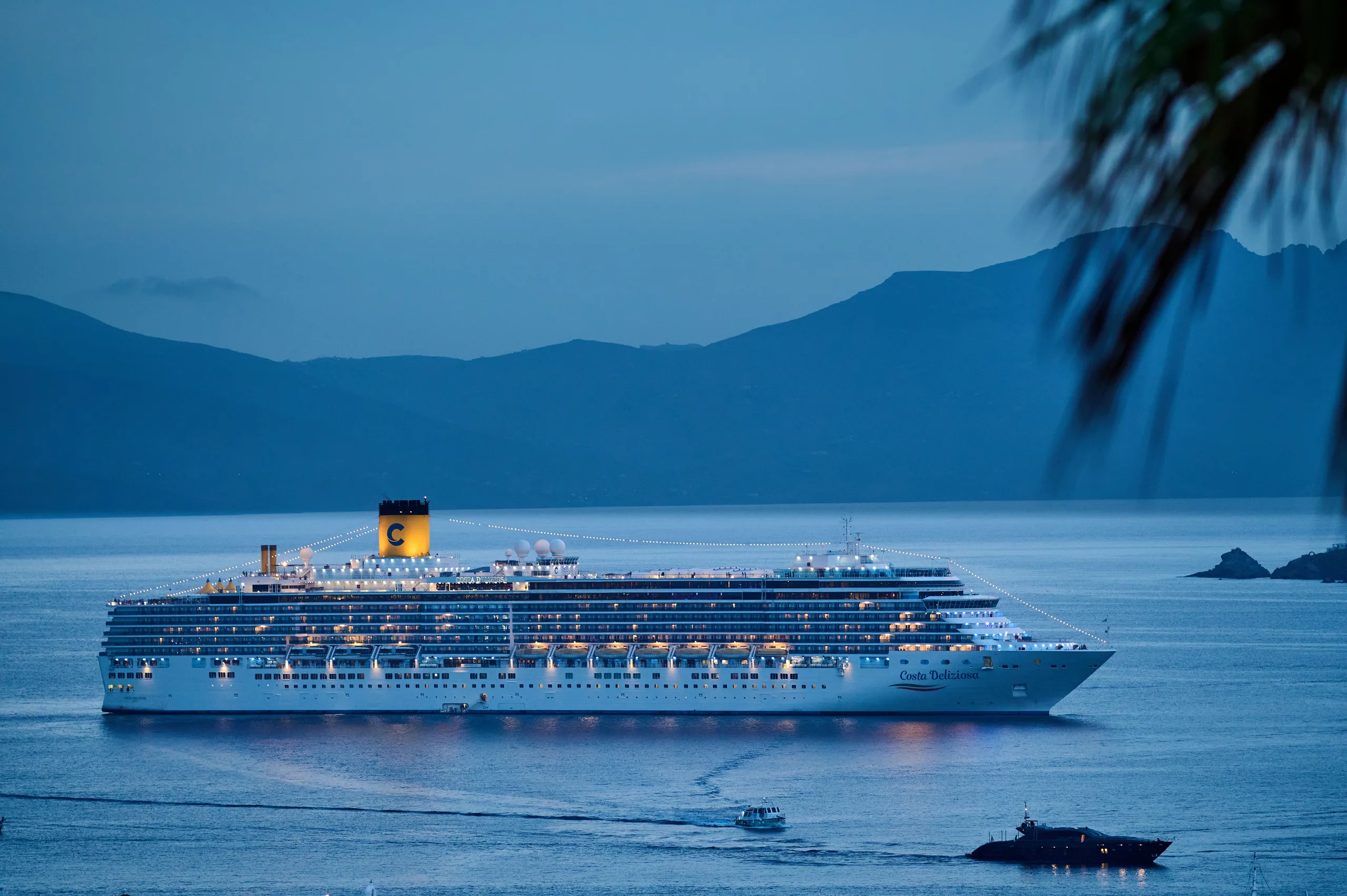
Who Costa is for
Costa is the oldest name in Italian shipping still selling cruises. The company was founded in Genoa in 1854 as Giacomo Costa fu Andrea, a trading house dealing in olive oil and textiles; it put passengers aboard for the first time in March 1948, on the South American run, and it has been Italian ever since. Carnival Corporation bought half of it in 1997 and all of it by 2000, but the brand it bought was not converted into an American one, and that is the single most important thing to understand before booking.
What “Italian style” means in practice is concrete rather than decorative. The food is Italian: pasta as a separate course, espresso that is actually espresso, a wine list built around Italian regions. The senior officers are usually Italian. And the passenger list is European: Italians first, then Germans, French and Spanish, with Americans a small minority. Every announcement, every menu and every show is delivered in four or five languages in sequence, which takes time and which some people find charming and others find exhausting.
The itineraries follow the passengers. Of everything Costa currently has on sale, roughly four in five sailings are in Europe, and most of those are seven-night Mediterranean weeks out of Barcelona, Marseille, Savona, Civitavecchia or Palermo. The line sells the Caribbean out of La Romana and Guadeloupe, South America out of Santos and Buenos Aires, the Canaries out of Tenerife year-round, and one long world cruise. It does not sell Alaska, and it does not homeport anywhere in the United States.
The fares are low. A European Costa week routinely undercuts the equivalent American mainstream cruise by a wide margin, and that is a real part of the proposition.
What to know before you book
Costa Concordia. On January 13, 2012, Costa Concordia struck a rock off Isola del Giglio in Tuscany and capsized. Thirty-two people died. The captain was convicted of manslaughter and abandoning ship and sentenced to sixteen years; the wreck was refloated in 2014 and scrapped by 2017. It was fourteen years ago, the regulatory response reshaped muster procedures across the whole industry, and four of her sister ships are still in service and have run without incident since. It is the fact people search for and it belongs on this page.
The multilingual ship is not a detail. Anglophone passengers are a minority on most sailings and the ship is run accordingly. Trivia, shows and port talks are staged to work across languages, which flattens them. If you want a cruise where everything happens in your language on the first pass, this is the wrong line.
The fleet got smaller, and the good ships moved. Costa ran twice this many hulls before 2020. Costa Luminosa and Costa Venezia are now Carnival Luminosa and Carnival Venezia, Costa Firenze is Carnival Firenze, and Costa Fortuna leaves for Margaritaville at Sea in September 2026. Nine ships remain, and the gap between the two LNG flagships and the fifteen-to-twenty-year-old hulls below them is large. Choose the ship deliberately.
Read the fare. Drinks, gratuities and most dining beyond the main restaurant are extra, and service charges are typically added aboard rather than prepaid. The headline price is genuinely low; it is not all-in.