Royal Caribbean International
Voyager of the Seas
The ship that invented the Royal Promenade, and the reason every big Royal Caribbean ship has a street down the middle
Sailings Available
98
Ports Visited
45
Next Departure
Sep 25, 2026
Trip Length
2–26 nights
Now Booking
Sailings Aboard Voyager of the Seas
Royal Caribbean International
Alaska Adventure Cruise
7 Nights
Sep 25, 2026 • departs Seattle
Royal Caribbean International
Ensenada Cruise
3 Nights
Oct 5, 2026 • departs Los Angeles
Royal Caribbean International
Cabo, Mazatlan, Puerto Vallarta, & Catalina
8 Nights
Oct 8, 2026 • departs Los Angeles
Royal Caribbean International
Cabo Overnight & Ensenada
6 Nights
Oct 16, 2026 • departs Los Angeles
Royal Caribbean International
Cabo Overnight, Mazatlan & Catalina
8 Nights
Oct 22, 2026 • departs Los Angeles
Royal Caribbean International
Ensenada, Cabo & Mazatlan
7 Nights
Nov 13, 2026 • departs Los Angeles
Royal Caribbean International
Cabo, Vallarta & Mazatlan
7 Nights
Nov 20, 2026 • departs Los Angeles
Royal Caribbean International
Cabo Overnight & Mazatlan
7 Nights
Dec 11, 2026 • departs Los Angeles
Royal Caribbean International
Catalina & Ensenada Cruise
4 Nights
Jan 4, 2027 • departs Los Angeles
Royal Caribbean International
Catalina & Ensenada Cruise
5 Nights
Jan 29, 2027 • departs Los Angeles
Royal Caribbean International
Cabo Overnight Cruise
5 Nights
Feb 3, 2027 • departs Los Angeles
Royal Caribbean International
Ensenada Cruise
4 Nights
Feb 15, 2027 • departs Los Angeles
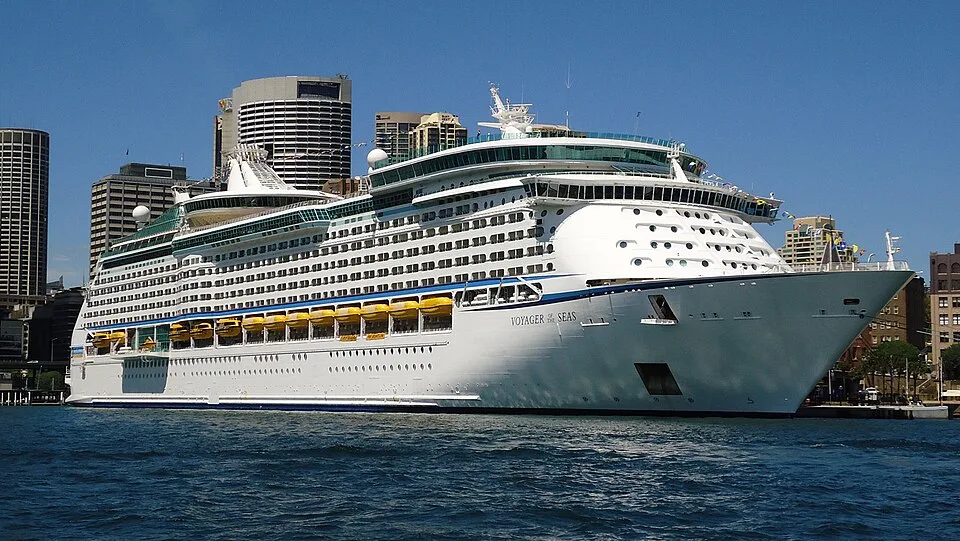
Voyager of the Seas is the ship that changed what a cruise ship looks like on the inside. Kvaerner Masa-Yards delivered her at Turku in October 1999 as the largest passenger ship in the world, and Katarina Witt christened her that November, an appropriate choice, because the headline feature was an ice rink.
The record did not last long. Her sister Explorer of the Seas took it in September 2000 by thirty-two gross tons, which on a 137,000-ton ship is a rounding error. What lasted is the layout. She was the first ship built around a Royal Promenade: an interior street four decks tall and roughly four hundred feet long, running down the middle of the hull, with bars and shops along it and cabins looking down into it from above. Before her, the interior of a large ship was corridors and a lobby. After her, it was a street, and every Royal Caribbean ship of any size since has had one, including, twenty-six years later, the Icon class.
She also carried the first ice rink at sea, Studio B, and the first rock-climbing wall on a cruise ship. Both are now so standard that it is easy to forget somebody had to do them first.
What $97 million bought
By 2019 the hull was twenty years old and the fleet had moved on. She went in for a Royal Amplified refit that autumn ($97 million, which is a serious number for a ship of her age), and came out with most of a current Royal Caribbean product bolted to a 1999 layout.
The pool deck got The Perfect Storm (Typhoon and Cyclone, a pair of three-story racing waterslides), and a rebuilt sun deck above it. Battle for Planet Z, the glow-in-the-dark laser tag arena, was staged inside Studio B. The Vitality spa was rebuilt with the gym moved aft, Adventure Ocean was redesigned, a nursery went in, and seventy-two cabins were added. Johnny Rockets came out.
That was the second round of work. The first was in late 2014 (an $80 million refit, her share of the fleetwide Royal Advantage program) which took out the in-line skating track and put in a FlowRider surf simulator, along with Izumi, Giovanni’s Table, Chops Grille, virtual balconies for the inside cabins and the poolside movie screen. That is also where her measured tonnage went from the 137,276 she was delivered at to the 138,194 she carries today.
What she has today, then: the Royal Promenade and Café Promenade, Studio B and its ice shows, the Perfect Storm slides, the FlowRider, the rock wall, the Voyager Dunes mini-golf course, laser tag, an adults-only solarium, and Chops Grille, Giovanni’s Table, Izumi, Café Promenade and the Windjammer for dining. What she does not have is the Oasis-class trick of splitting a crowd into neighborhoods. She has one great room, and when the ship is full everybody is in it.
Where she actually sails
Three deployments in eighteen months, on opposite sides of an ocean.
Los Angeles for the winter. From October 2026 through April 2027 she runs the West Coast program, three- to eight-night trips down the Mexican Riviera, with Cabo San Lucas on forty of them, Mazatlán on twenty-one and Puerto Vallarta on eleven, plus short Ensenada and Catalina Island runs. Several of the longer itineraries give Cabo an overnight. She is taking this program over from Navigator of the Seas, which leaves California for Singapore in the same season.
Seattle for the summer. Twenty-two seven-night Alaska sailings (one of them closing out her first-ever Alaska season in September 2026, the other twenty-one running May to September 2027) calling at Skagway, Juneau and Victoria on every one of them, with Endicott Arm and Dawes Glacier on fifteen and Sitka and Ketchikan appearing occasionally. This is the standard Inside Passage week and she does nothing else while she is doing it.
Then she leaves. On October 1, 2027 she sails a twenty-six-night transpacific from Seattle to Brisbane by way of Honolulu, Papeete, Moorea, Raiatea and Willis Island, the only sailing of its kind on her schedule and the cheapest per night of anything she offers.
Brisbane has her from late October 2027 through April 2028: twenty-eight round-trips of two to eight nights around Queensland and the South Pacific. Nineteen of them call at Royal Beach Club Lelepa, Royal Caribbean’s first private destination in the South Pacific, a tender call at an island in Havannah Harbour off the northwest coast of Efate, near Port Vila in Vanuatu, with entry included in the fare. It is due to open in October 2027, and Voyager is one of the two ships opening it, alongside Anthem of the Seas out of Sydney. Port Vila, Luganville, Mystery Island and Lifou fill out the week; the short Brisbane getaways and the Whitsundays runs are the rest.
One caveat on that date. As of the spring of 2026 construction had not begun and the environmental impact assessment was unfinished, and in February the Lelepa Council of Chiefs formally objected to it, citing turtle nesting grounds, fishing grounds and the rock art at Fels Cave. October 2027 is what is being sold. It is not yet a date anything has been built to, and these sailings are the ones on her schedule most likely to change.
If you are looking at her calendar and wondering why the ports change continents, that is why. Read the departure port before you read the ship.
Who she suits
Families who want a genuinely current water park, ice show and laser tag without paying for a new hull. The 2019 refit was thorough and the things it installed are the current versions, not tired ones, so nothing here trades on nostalgia for the Royal Promenade.
She suits people sailing from Los Angeles or Seattle, where Royal Caribbean’s options are thin, and she suits Australians particularly well: a 138,000-ton ship based in Brisbane with a private beach club on every South Pacific week is a better product than that market has usually been given.
She does not suit anyone who wants the newest thing. She is twenty-seven years old, the refit is seven years behind her, and no amount of money moves a stairwell; the cabins are 1999 cabins, a large share of them inside or promenade-view rather than balcony. She does not suit anyone who wants quiet; the promenade concentrates a crowd by design, and on a three-night Ensenada or Brisbane getaway with the ship full of people on a long weekend, it shows. And she is a poor match for the transpacific unless the crossing itself is what you want, twenty-six nights on a ship built for seven, with long stretches of open ocean between the interesting parts.
Photo: Amnesiac86 · CC BY-SA 4.0 (share-alike) · Re-encoded to WebP.