Viking
Viking Venus
The ship that restarted Viking after fourteen months tied up, now working Asia and Australia
Sailings Available
164
Ports Visited
56
Next Departure
Nov 6, 2026
Trip Length
12–93 nights
Now Booking
Sailings Aboard Viking Venus
Viking
Komodo & the Australian Coast
16 Nights
Nov 6, 2026 • departs Bali
Viking
Australia & New Zealand
14 Nights
Dec 6, 2026 • departs Sydney
Viking
Grand Pacific Explorer
91 Nights
Feb 22, 2027 • departs Auckland
Viking
Australia, Asia & Alaska
77 Nights
Mar 8, 2027 • departs Sydney
Viking
Bangkok, Bali & Beyond
12 Nights
Mar 24, 2027 • departs Bangkok (Laem Chabang)
Viking
Southeast Asia & Hong Kong
14 Nights
Apr 5, 2027 • departs Bangkok (Laem Chabang)
Viking
Far Eastern Horizons
14 Nights
Apr 19, 2027 • departs Hong Kong
Viking
North Pacific Passage
21 Nights
May 3, 2027 • departs Tokyo
Viking
Far East & Alaska
37 Nights
Sep 7, 2027 • departs Hong Kong
Viking
Southeast Asia Horizons
28 Nights
Sep 30, 2027 • departs Tokyo
Viking
Southeast Asia
26 Nights
Oct 14, 2027 • departs Hong Kong
Viking
South Pacific Sojourn
28 Nights
Oct 28, 2027 • departs Bangkok (Laem Chabang)
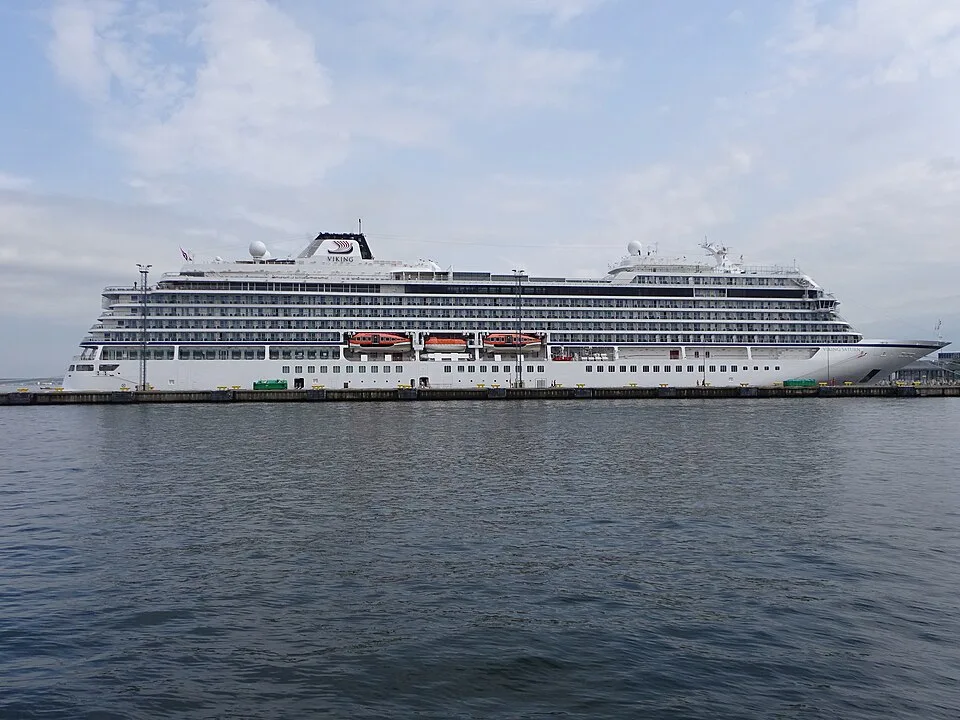
Viking Venus was finished in the worst possible year and given the most consequential job in the fleet. Fincantieri handed her over at Ancona on April 15, 2021, at a point when Viking had not carried a paying passenger in fourteen months, and she was the ship the line chose to start again with.
Starting again
There was no shoreside christening because there could not be one. She was named at sea in the English Channel on May 17, 2021, with the British journalist and broadcaster Anne Diamond as godmother, breaking a bottle of aquavit against the hull after cutting the ribbon with a broad ax. Five days later she sailed from Portsmouth on the first of five round trips billed as England’s Scenic Shores, eight days to Liverpool, the Isles of Scilly, Falmouth and Portland, open only to residents of the United Kingdom, because at that moment nothing else was legal.
Diamond then sailed the first three of them as a guest lecturer, talking about the British radar engineers of the Second World War, her father among them. It is a very Viking detail: the ship reopens the industry and the entertainment is a history lecture.
She repositioned to the Mediterranean that August and spent the following years on eleven- to twenty-one-night runs through Greece, the Adriatic and the eastern Mediterranean. Then she left.
Where she actually sails
She is the only ship in this fleet section that is not a European ship. After an Alaska season in the summer of 2026 she crossed the Pacific (a twenty-two-night run from Vancouver to Tokyo in September, with an overnight at Otaru), and everything on this site after that is Asia or Australia. Hong Kong, Sydney and Laem Chabang each account for about forty departures, Tokyo for half that. The schedule runs to 2029 and does not come back.
Her sailings are long. Twelve nights is the shortest, sixteen is the median, and the longest is ninety-three: the Asia-Pacific season sold as one continuous voyage rather than as segments. That is a serious undertaking on a 930-guest ship with no casino and no production show, and the people who book it overwhelmingly know that already.
What she brings to that ocean
The Viking Star class was designed for Norway, and some of it transplants better than the rest. The retractable roof over the main pool, put there for the fjords, earns its keep in a Hong Kong summer for the opposite reason. The Nordic Spa with its snow grotto is a slightly comic thing to find in the Gulf of Thailand and a genuinely welcome one. The ice-strengthened hull does nothing at all out here.
The rest carries across without argument: an included shore excursion in every port, wine at lunch and dinner, Wi-Fi and the spa in the fare, no photographers, no art auction, no upcharge restaurant, and no guests under eighteen. In Asia, where the shore side is the entire reason to be aboard and independent touring is harder than in Europe, the included excursion is worth more than it is anywhere else Viking sails.
Who she suits
Adults with a lot of time who want Japan, Southeast Asia or Australia handled for them, and who would rather do it from a ship carrying nine hundred people than three thousand. On a two-week Asian itinerary the difference at the gangway and the coach park is not marginal.
She suits nobody traveling with children. She suits nobody who wants nightlife; the evening is a lounge singer and an early bed, and on a ninety-three-night voyage that is a long time to be sure about. And if you are choosing among Viking’s ocean ships, understand that Venus is identical to her sisters in every respect but one; she is the one that goes east.
Photo: Pjotr Mahhonin · CC BY-SA 4.0 (share-alike) · Re-encoded to WebP.