Viking
Viking Neptune
The first cruise ship in the world to go to sea with a hydrogen fuel cell aboard
Sailings Available
98
Ports Visited
47
Next Departure
Nov 10, 2026
Trip Length
7–28 nights
Now Booking
Sailings Aboard Viking Neptune
Viking
Greek Odyssey
10 Nights
Mar 4, 2027 • departs Athens (Piraeus)
Viking
Viking Shores & Fjords
7 Nights
Apr 16, 2027 • departs Amsterdam
Viking
Iberia & Mediterranean Antiquities
21 Nights
Oct 28, 2027 • departs Lisbon
Viking
Aegean & Mediterranean Explorer
14 Nights
Dec 8, 2027 • departs Athens (Piraeus)
Viking
Iberia, the Mediterranean & Aegean
28 Nights
Dec 8, 2027 • departs Lisbon
Viking
Japan Discovery
14 Nights
May 8, 2028 • departs Tokyo
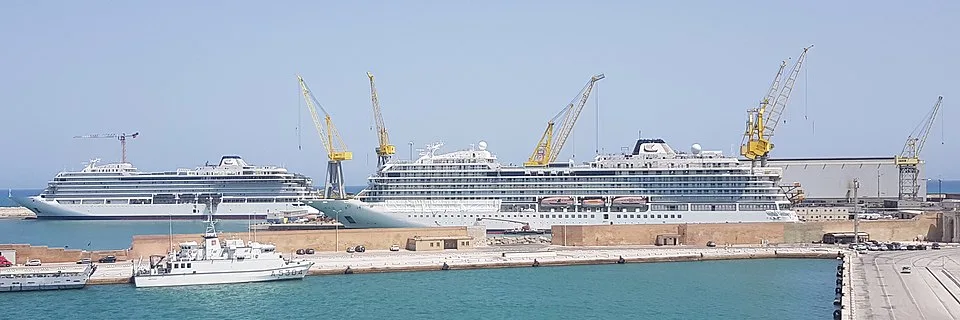
Viking Neptune is mechanically the same ship as the nine Star-class hulls before her (745 feet, 94 in the beam, 465 staterooms, 930 guests) with one addition that nobody else had. When Fincantieri handed her over at Ancona on November 10, 2022, she went to sea carrying a working hydrogen fuel cell. No cruise ship had done that before.
The fuel cell, honestly
It is a 100-kilowatt module: low-temperature PEM cells running on hydrogen gas and room air, generating electricity for hotel load in port and at slow speeds. A hundred kilowatts is not a lot. Her two propulsion motors are rated at 7,250 kilowatts each. The fuel cell does not move the ship and it will never move the ship; it is a test rig with passengers around it, installed so that Fincantieri and Viking could learn what a marine hydrogen installation does over years of real service rather than months on a bench.
The point was always the next number. Viking and Fincantieri said at the time they were working toward a hydrogen generation system of six to seven megawatts, which they described as the largest ever attempted aboard a cruise vessel. That system is what is going into Viking Libra, floated out in March 2026. Neptune is the reason anyone knew it would work.
None of which you will notice from a stateroom. There is no window onto the fuel cell, no display in the atrium, no change to how the ship feels. She is a conventional diesel-electric vessel with a science experiment in her machinery space, and the only honest way to sell that is as a matter of interest rather than a feature.
A career spent going around the world
Her first season was unusual: a few weeks in service and then straight into Viking’s world cruise, 138 days from Fort Lauderdale across 28 countries and 57 ports. She did it again the following December, 137 nights ending at Tilbury. Two consecutive circumnavigations is a hard way to break in a new hull, and it put her in more of the world in two years than most ships see in ten. She was christened partway through, at Los Angeles in July 2023, with the retired NASA astronaut Nicole Stott as godmother.
The schedule on this site is a settled version of the same instinct. Athens is her busiest departure port by a wide margin, with Lisbon and Amsterdam behind it, and then eighteen sailings out of Tokyo, the only Asian program in this group of ships. Her typical voyage is ten nights and the range runs to twenty-eight, so the long-haul habit has not gone away; it has just been broken into pieces you can book.
Who she suits
Adults who choose a cruise by its map. The fare covers a shore excursion in every port, beer and wine with meals, Wi-Fi and the Nordic Spa, so the onboard spend is genuinely small and nobody is selling to you in a corridor. The Japanese sailings are the interesting part of her calendar and they sell early.
She is not a family ship; nobody under eighteen sails at all. She is wrong for anyone who wants a casino, a production show or a late night, and wrong for anyone who wants a ship that feels new: this is a 2015 design in a 2022 hull, and Viking is not pretending otherwise. If the fuel cell is what drew you, book her for the itinerary instead, because you will never see it.
Photo: User:Zenwort · CC BY-SA 4.0 (share-alike) · Re-encoded to WebP.