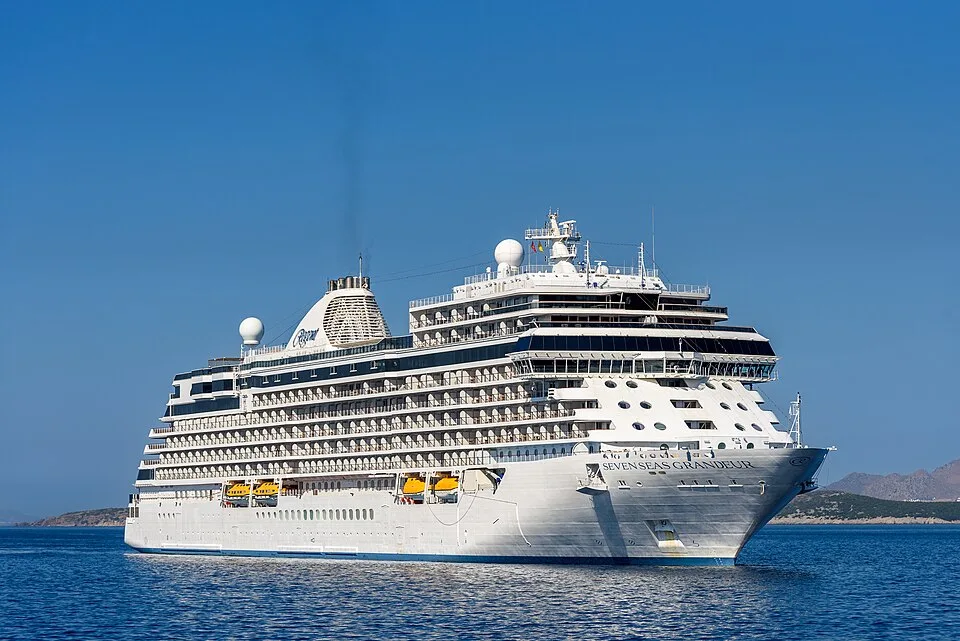
Regent Seven Seas Cruises
Seven Seas Explorer
Built for $450 million and sold, without embarrassment, as the most luxurious ship ever built
Sailings Available
102
Ports Visited
216
Next Departure
Nov 10, 2026
Trip Length
7–101 nights
Now Booking
Sailings Aboard Seven Seas Explorer
Regent Seven Seas Cruises
SKYSCRAPERS & SANCTUARIES
12 Nights
Nov 10, 2026 • departs Hong Kong
Regent Seven Seas Cruises
PEAKS & PAGODAS
11 Nights
Nov 22, 2026 • departs Bangkok (Laem Chabang)
Regent Seven Seas Cruises
CORAL COASTS TO OPERA HOUSE
16 Nights
Dec 3, 2026 • departs Bali
Regent Seven Seas Cruises
AN AUSSIE CELEBRATION
10 Nights
Dec 19, 2026 • departs Sydney
Regent Seven Seas Cruises
TOAST TO THE FJORDS
16 Nights
Dec 29, 2026 • departs Sydney
Regent Seven Seas Cruises
VINTNERS & ARTISANS OF THE PACIFIC
14 Nights
Jan 14, 2027 • departs Auckland
Regent Seven Seas Cruises
FROM OUTBACK TO OASIS
12 Nights
Jan 28, 2027 • departs Sydney
Regent Seven Seas Cruises
ROOS, REEFS & ROMANCE
19 Nights
Jan 28, 2027 • departs Sydney
Regent Seven Seas Cruises
SEAS OF SERENITY
7 Nights
Feb 9, 2027 • departs Darwin
Regent Seven Seas Cruises
CITIES OF MYSTERY & MAGIC
14 Nights
Feb 16, 2027 • departs Bali
Regent Seven Seas Cruises
ICONIC SKYLINES, STARRY NIGHTS
16 Nights
Mar 2, 2027 • departs Bangkok (Laem Chabang)
Regent Seven Seas Cruises
CASTLES, TEMPLES & GEISHAS
12 Nights
Mar 18, 2027 • departs Tokyo
Seven Seas Explorer is the ship that started the current ultra-luxury building race. Regent ordered her in 2013, Fincantieri delivered her from Sestri Ponente on July 1, 2016, and the number attached to her (about $450 million for 746 guests, or more than $600,000 a berth) was roughly triple what a mainstream line was then spending per passenger. Regent called her the most luxurious ship ever built and everyone else in the segment spent the next decade answering that.
What the money bought, in numbers
The interesting figure is not the price. It is 55,254 gross tons divided by 746 guests: about seventy-four tons of ship for each person aboard. That ratio is among the highest of any vessel carrying paying passengers and it is the single statistic that separates Explorer and her sisters from everything else on this site; a large contemporary ship runs somewhere in the thirties. What the extra space buys is not grandeur but absence: wide corridors, a pool deck with empty loungers at eleven in the morning, and a main dining room that seats the whole ship without a reservation system.
She carries 373 suites and no cabins. Every one has a balcony and the entry-level Veranda Suite is a little over 300 square feet. At the other end, the Regent Suite runs 3,875 square feet over the bridge, with a glass-enclosed outdoor sitting room called the Vista Garden and, when she was new, the first spa built into a passenger suite at sea: sauna, steam room and treatment area with unlimited complimentary treatments attached. It lists at around $11,000 a night. The crew is a little over five hundred for fewer than 750 guests, close to three crew for every four passengers, which is the other half of the explanation for the fare.
What is aboard her
Compass Rose is the main dining room, open seating, with a cascading aqua chandelier that is the one piece of decoration on the ship anyone remembers. Prime 7 is the steakhouse, Chartreuse the French room, and Pacific Rim, which debuted on this hull and has since been built into both her sisters, is the pan-Asian one. La Veranda is the daytime buffet and becomes Sette Mari, an Italian restaurant, every evening. None of the specialty rooms carries a surcharge.
The Constellation Theater seats 694 in cabaret arrangement, which on a 746-guest ship means the whole manifest fits in one sitting. There is a Culinary Arts Kitchen with individual cooking stations, a tennis court, a jogging track and a spa, and there is no waterslide, no rock wall and no water park.
The all-inclusive arithmetic
Regent’s fare covers unlimited shore excursions (at least one in every port, booked in advance, first-come) plus every restaurant aboard, wines and spirits, WiFi, gratuities and transfers. Air is the exception: since July 2024 the base All-Inclusive Cruise Fare leaves flights out, and the Ultimate All-Inclusive Fare puts roundtrip air back in, in a class you choose. That is why the headline price looks the way it does. It is not a cruise fare with extras bolted on; it is close to the whole trip.
Whether that math works depends on who you are. If you would otherwise book flights, take a guided tour in every port, drink wine with dinner and tip at the end, Regent’s number is competitive with assembling the same week yourself and is far less work. If you do not drink, prefer to walk a port alone and would rather use your own miles, you are paying for a large bundle you will not open. Excursions beyond the included list carry a charge, and the spa, the boutiques and the casino are cash like anywhere else.
Where she actually sails
She is a Pacific ship now. The pattern is Alaska in the northern summer out of Vancouver and Whittier on seven-night runs, then a repositioning west and a long winter in Asia based on Tokyo, with Japan-intensive itineraries and onward voyages through Southeast Asia and down to Australia and New Zealand out of Sydney. Twelve nights is the typical length.
The exception is worth knowing about. In October 2028 she leaves Athens on the Grand Hemispheres Journey, 101 nights to Auckland by way of East Africa, the Arabian Sea, Southeast Asia and the South Pacific, her first season in Africa and Arabia, and the longest single sailing she has been given.
Regent is also rebuilding the suites across the whole class, larger Veranda Suites, new categories, and the count cut from 373 to no more than 344. Explorer’s turn is April 2028.
Who she suits
People for whom the trip is the tours and the table, and who want to stop counting. She rewards long itineraries and port-heavy ones, because the excursions are the part of the fare with the most money in it.
She does not suit anyone traveling on a budget, and that should be said plainly: per night she and her sisters are among the most expensive ships listed here, and the entry fare buys a 300-square-foot suite, not a large one. She does not suit families with children; there is no permanent youth program. She does not suit anyone who wants production shows, a busy casino or a crowd, or anyone who resents paying in advance for excursions and drinks they may not use. Everyone else will find her the quietest large ship they have been on.