Norwegian Cruise Line
Norwegian Jade
Built US-flagged for Hawaii, and now Norwegian's long-haul workhorse
Sailings Available
375
Ports Visited
55
Next Departure
Nov 12, 2026
Trip Length
7–16 nights
Now Booking
Sailings Aboard Norwegian Jade
Norwegian Cruise Line
Tokyo Cruisetour
9 Nights
Nov 12, 2026 • departs Tokyo
Norwegian Cruise Line
9-Day Asia From Tokyo To Seoul: Osaka, Kochi, Jeju & Nagoya
9 Nights
Nov 12, 2026 • departs Tokyo
Norwegian Cruise Line
9-Day Asia From Seoul To Tokyo: Osaka, Kochi, Jeju & Nagoya
9 Nights
Nov 21, 2026 • departs Seoul (Incheon)
Norwegian Cruise Line
Tokyo Cruisetour
9 Nights
Nov 30, 2026 • departs Tokyo
Norwegian Cruise Line
9-Day Asia From Tokyo To Hong Kong: Taipei, Osaka, Kochi & Okinawa
9 Nights
Nov 30, 2026 • departs Tokyo
Norwegian Cruise Line
14-Day Thailand, Vietnam & Philippines from Hong Kong
14 Nights
Dec 9, 2026 • departs Hong Kong
Norwegian Cruise Line
Hong Kong Cruisetour
14 Nights
Dec 9, 2026 • departs Hong Kong
Norwegian Cruise Line
11-day Asia From Singapore to Hong Kong: Ko Samui, Bangkok & Ho Chi Minh City
11 Nights
Dec 23, 2026 • departs Singapore
Norwegian Cruise Line
14-day Asia from Hong Kong to Singapore: Thailand & Vietnam
14 Nights
Jan 3, 2027 • departs Hong Kong
Norwegian Cruise Line
11-day Asia From Singapore to Hong Kong: Ko Samui, Bangkok & Ho Chi Minh City
11 Nights
Jan 17, 2027 • departs Singapore
Norwegian Cruise Line
Singapore Cruisetour
11 Nights
Jan 17, 2027 • departs Singapore
Norwegian Cruise Line
12-Day Asia From Hong Kong To Singapore: Thailand & Philippines
12 Nights
Jan 28, 2027 • departs Hong Kong
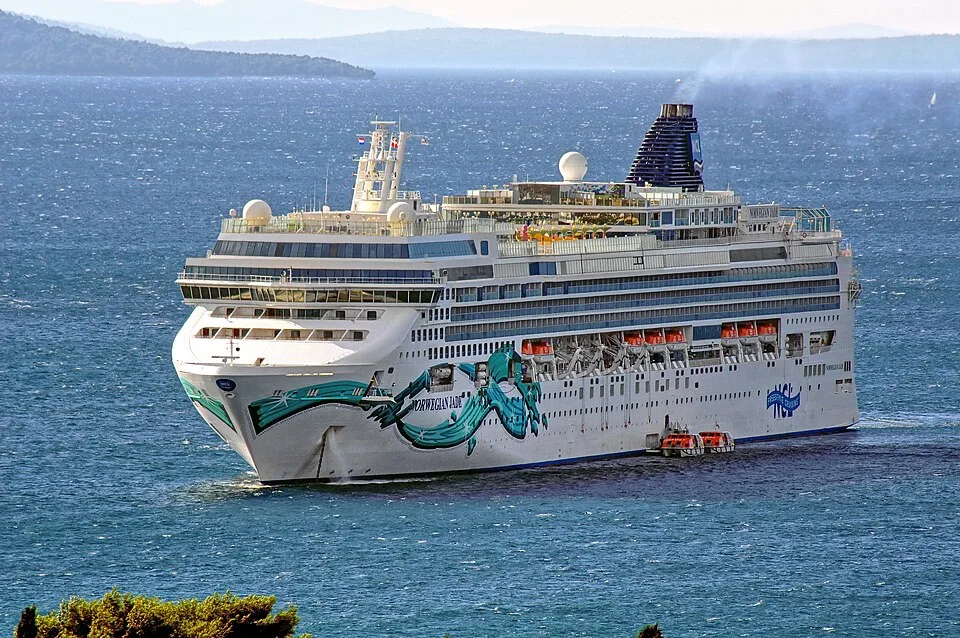
Norwegian Jade is the odd one of the four Jewel-class sisters, because she was not built to be one of them. She came out of Meyer Werft in 2006 as Pride of Hawaii, for NCL America (Norwegian’s US-flagged, US-crewed subsidiary), and at over half a billion dollars she was the largest and most expensive US-flagged passenger ship ever built.
Why she is not still called that
The Hawaii experiment did not pay. US flag meant US crew, US wages and US employment law, and after heavy losses in 2006 Norwegian announced in 2007 that she would leave the islands. Her last Honolulu departure was in February 2008. She was reflagged to the Bahamas, repainted, renamed Norwegian Jade and sent to Europe, and, because a US-flagged ship sailing entirely within American waters cannot run one, a casino was fitted that she had never had.
Traces of the first life lingered for years: Hawaiian floral motifs in the public rooms survived until a three-week drydock in March 2017 finally replaced the theming wholesale, along with the cabin furniture, and added two restaurants and two bars. She went back into dock at Victoria, British Columbia, for two weeks in April and May of 2026, this time for the adults-only Vibe Beach Club on deck fourteen, with seven private cabanas, hot tubs and its own bar, a Starbucks on deck seven, and a rebuilt thermal suite in the spa.
Why she sails where she does
At 965 feet and 93,500 tons she is mid-sized by current standards, and that is exactly why Norwegian keeps sending her where the newer, larger hulls do not go. Her summers are the one-way Gulf of Alaska runs between Vancouver and Whittier (seven nights, the Inside Passage northbound or southbound, with a glacier day), and a good many of them are sold with a Denali rail-and-lodge tour bolted on either end. Her winters are Asia, turning at Tokyo and Incheon for Seoul, with the long Pacific repositioning legs in between.
That is a genuinely unusual pattern in a fleet that mostly parks its ships in the Caribbean, and it is the reason to look at her. If you want Japan on a Norwegian ship, the list of candidates is short and she is on it.
The Haven
Jewel-class ships carry Norwegian’s suite-within-a-ship in its early form: a keycard-gated courtyard with its own pool, hot tub, sundeck and small gym, plus concierge and butler service. What it does not have is a Haven restaurant, that came later, on the Breakaway and Prima hulls. Here suite guests take breakfast and lunch in one of the specialty restaurants and eat dinner wherever everyone else does. It is smaller and less polished than the Haven on the newer classes, and priced accordingly; on a long Pacific crossing the private deck still earns its money.
Who she suits
Anyone booking for the itinerary rather than the hardware, Alaska one-ways and Asia in particular, and anyone who wants Norwegian’s Freestyle set-up, where nothing is fixed-seating and nothing is formal, on a ship small enough to walk end to end without effort.
Less suited to families expecting the go-karts and racing slides of the Prima and Breakaway ships; she has none of that. And a one-way Alaska sailing means two different airports at two ends of a long journey, which is a real cost and catches people out.
Photo: Ivan T. · CC BY-SA 3.0 (share-alike) · Re-encoded to WebP.