Royal Caribbean International
Navigator of the Seas
A 2002 hull with $115 million spent on it, and she is about to leave California for Singapore
Sailings Available
149
Ports Visited
33
Next Departure
Sep 25, 2026
Trip Length
2–16 nights
Now Booking
Sailings Aboard Navigator of the Seas
Royal Caribbean International
Ensenada, Cabo & Mazatlan
7 Nights
Sep 25, 2026 • departs Los Angeles
Royal Caribbean International
Los Angeles To Tokyo Cruise
16 Nights
Oct 2, 2026 • departs Los Angeles
Royal Caribbean International
Tokyo To Singapore Cruise
11 Nights
Oct 18, 2026 • departs Tokyo
Royal Caribbean International
Penang & Phuket Cruise
4 Nights
Oct 29, 2026 • departs Singapore
Royal Caribbean International
Penang Cruise
3 Nights
Nov 9, 2026 • departs Singapore
Royal Caribbean International
Penang, Phuket & Langkawi
5 Nights
Nov 19, 2026 • departs Singapore
Royal Caribbean International
Weekend Getaway Cruise
2 Nights
Nov 27, 2026 • departs Singapore
Royal Caribbean International
Thailand & Vietnam Cruise
10 Nights
Jan 2, 2027 • departs Singapore
Royal Caribbean International
Penang & Phuket Cruise
5 Nights
Feb 8, 2027 • departs Singapore
Royal Caribbean International
Singapore To Tokyo Cruise
12 Nights
Feb 13, 2027 • departs Singapore
Royal Caribbean International
Tokyo To Singapore Cruise
12 Nights
Feb 25, 2027 • departs Tokyo
Royal Caribbean International
Singapore To Tokyo Cruise
13 Nights
Apr 29, 2027 • departs Singapore
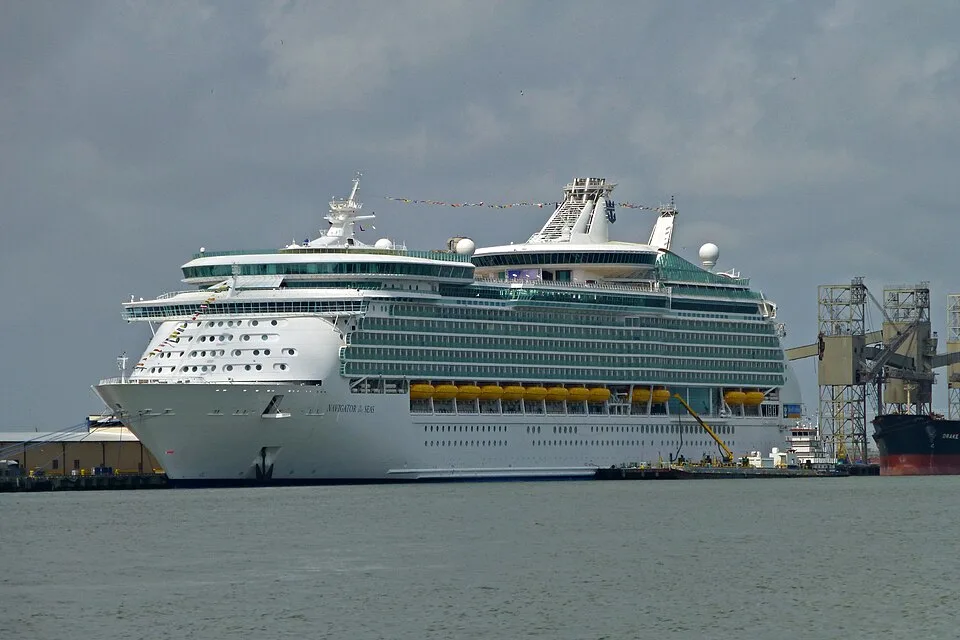
Navigator of the Seas is the fourth of Royal Caribbean’s five Voyager-class ships, delivered by Kværner Masa-Yards at Turku in November 2002. Her hull is twenty-four years old. That is the first thing to say about her and it is not the most important thing, because in early 2019 Royal Caribbean spent $115 million on her, one of the largest single-ship projects in the fleet-wide Royal Amplified program, and what came out the other end has very little to do with a 2002 ship.
What $115 million bought
Amplification is Royal Caribbean’s word for gutting a ship and reinstalling the current product on top of it, and Navigator got a heavy dose. The pool deck was demolished and rebuilt around The Lime and Coconut, a bar stacked over three levels. The Blaster went on above it: an aqua coaster that runs along the outside of the hull, using water jets to push riders uphill, and which Royal Caribbean still bills as the longest waterslide at sea. Alongside it went Riptide, a headfirst mat racer, and The Perfect Storm racing slides. Splashaway Bay took care of the smaller children.
Below decks the changes were less photogenic and probably matter more. New restaurants went in (Jamie’s Italian, Hooked Seafood, El Loco Fresh) along with Battle for Planet Z, a laser tag arena played in the dark, and The Observatorium, an escape room. Cabins, corridors and public rooms were redone. The tonnage went from 139,570 to 139,999 and the certificated maximum capacity rose to 4,000.
The honest summary is that she now has most of what a 2019 Royal Caribbean ship has, in a hull laid out to 2000 thinking. The Voyager class invented the Royal Promenade (an interior street running most of the length of the ship, with cabins looking down into it), and that space is still the best room aboard. What she does not have is the Oasis-class trick of separating a crowd into neighborhoods. When she is full, she feels full, and the promenade is where everyone ends up.
She went back into drydock in Singapore in February 2024, but that was two weeks of regulatory and class work, new carpet and new upholstery. It was not another rebuild.
Where she actually sails
Los Angeles, until the fall of 2026. Her staple there is a mix of three- and four-night runs to Ensenada and longer Mexican Riviera weeks calling at Cabo San Lucas and Puerto Vallarta, a year-round West Coast program, and one of the few places Royal Caribbean keeps a ship of this size on short Baja itineraries.
Then she moves. She crosses the Pacific and arrives at Singapore’s Marina Bay Cruise Terminal on October 29, 2026, for a Southeast Asia season running two- to twelve-night cruises: Phuket, Penang and Langkawi on the shorter loops, Ho Chi Minh City and Laem Chabang on the ten-night, and Taiwan, Hong Kong and Japanese ports on the twelve-night itineraries. A handful of sailings work to and from Tokyo, and there is a transpacific crossing at each end of the season. The Los Angeles program resumes after it.
If you are looking at her schedule and wondering why the port list changes completely partway through, that is why. Book the ship, but read the departure port.
She was also reflagged in April 2026, moving from Nassau to Limassol, the second Royal Caribbean ship to go onto the Cypriot register, after Spectrum of the Seas. Nothing about the onboard experience changes; the paperwork and the stern lettering do.
Who she suits
People who want a large mainstream ship without the Oasis-class price, and people sailing from Los Angeles, where the alternatives are thin. Families do well on her: the slides, Splashaway Bay and the laser tag are genuinely the current-generation versions, not tired ones. Short Ensenada sailings out of California make her a cheap way to find out whether you like cruising at all.
She is a good deal harder to recommend for the Asia season unless the itinerary is what you want, because a ship this heavily programmed is at odds with a port-intensive twelve-night run through Vietnam and Japan; you will be ashore for most of the interesting hours and paying for a water park you are not using.
She does not suit anyone who wants quiet, anyone who wants a balcony on every cabin, a large share of her rooms are inside or promenade-view, and anyone who expects the newest thing. The refit was seven years ago now, the layout is older than that, and no amount of money moves a stairwell.
Photo: Ahecht · CC BY-SA 4.0 (share-alike) · Re-encoded to WebP.