Lindblad Expeditions-National Geographic
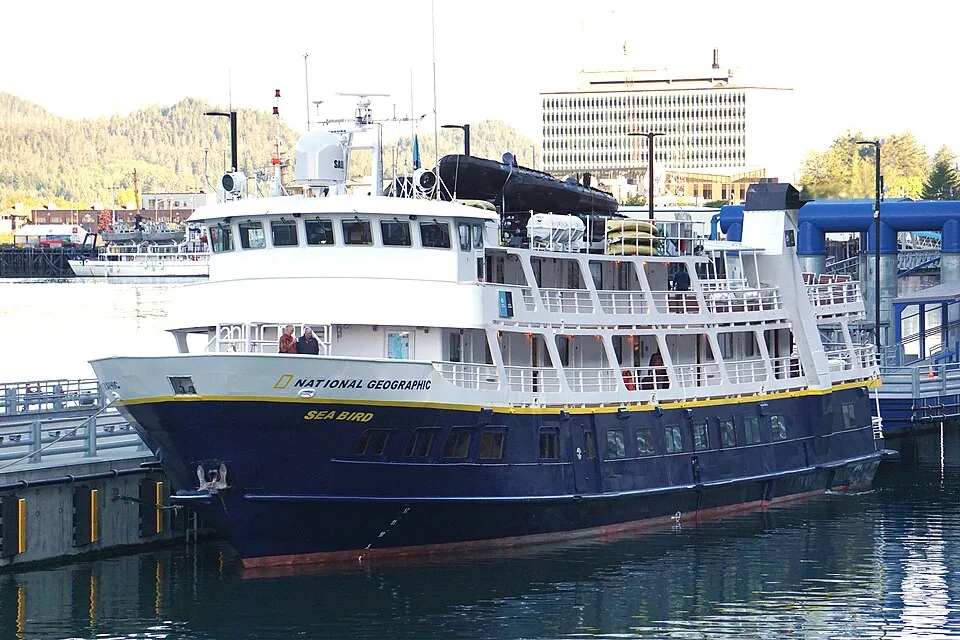
National Geographic Sea Bird
A 1982 hull from Whidbey Island, sailing her farewell season
Sailings Available
5
Ports Visited
7
Next Departure
Sep 26, 2026
Trip Length
7 nights
Now Booking
Sailings Aboard National Geographic Sea Bird
Lindblad Expeditions-National Geographic
Columbia and Snake Rivers: Food, Wine and History 8-Day (8-Day Westbound)
7 Nights
Sep 26, 2026 • departs Clarkston
Lindblad Expeditions-National Geographic
Columbia and Snake Rivers: Food, Wine and History 8-Day (8-Day Eastbound)
7 Nights
Oct 3, 2026 • departs Portland
National Geographic Sea Bird is the oldest and plainest hull Lindblad operates, and 2026 is her last season. She and her twin National Geographic Sea Lion came out of Nichols Brothers Boat Builders on Whidbey Island in 1982, six months apart, ordered by Seattle’s Exploration Cruise Lines as Majestic Alaska Explorer and Great Rivers Explorer. Lindblad picked them up in the early 1990s. They have been working ever since, which is longer than any other vessel in the twelve-ship fleet.
What she is
A hundred and fifty-two feet long, thirty-one feet across, three decks, thirty-one cabins, sixty-two guests and thirty staff and crew. She is American flagged, which is the entire reason she exists in this fleet: a foreign-flag ship cannot run a domestic itinerary between US ports, so the Columbia and Snake, and the inside water of Southeast Alaska, need a US hull.
The shallow draft is the other half of it. She was designed to under a hundred registered tons and displaces roughly three hundred and sixty; she can work fast-moving channels, transit the Columbia and Snake locks, and anchor in small bays that are closed to anything larger. Six Zodiacs and sixteen kayaks go over the side, along with paddleboards. That is the whole expedition kit; there is no ROV, no submersible, no undersea specialist. On a ship this size the naturalists and the Zodiac drivers are the program.
Aboard there is a lounge with a bar and a screen for evening presentations, a library, a dining room that seats everyone at once, an observation deck, a partially covered sun deck and an open bridge. The last serious money spent on her was a full interior renovation in 2015, new cabin furniture, headboards, lighting, USB outlets, bathroom fixtures, a redone lounge and dining room. That made the interiors current eleven years ago. It did not change the fact that the cabins are small, the corridors are narrow, and a 1982 coastal vessel feels like a 1982 coastal vessel.
The river years
Sea Bird is the sister who leaned into the rivers. She opened Lindblad’s Columbia and Snake program in the spring of 2024 with a food-and-wine themed inaugural season out of Portland and Clarkston (regional menus, forty-odd local varietals, vineyard visits and evening tastings), and that program is where she is finishing. Most of her remaining sailings run from Clarkston and Portland, with a couple of Alaska departures out of Juneau and Sitka before she comes back south.
Clarkston sits far up the Snake, on the Idaho line, and getting a passenger ship there means climbing a staircase of dams and locks from the Pacific and coming back down it again. There is a particular pleasure in standing on the bow of a small boat while a concrete chamber empties around you. Very few vessels can do it and after this year Lindblad will not have one that does.
Who she suits
People who care about where the boat can go and who is talking at dinner, and who genuinely do not care what the cabin looks like. The Columbia and Snake weeks are a serious cultural and natural-history program, and sixty-two guests is small enough that you will know most of them by the third day.
She does not suit anyone who wants a comfortable ship. There is no pool, no spa and no balcony anywhere aboard, and the only indoor space to escape to is the one lounge. Getting around means stairs. Anyone with mobility limits should look at National Geographic Quest or Venture instead. And if you want to sail her at all, this is the last year: from 2027 the 154-guest Greg Mortimer, chartered from Aurora Expeditions, takes over the routes.
Photo: Dankarl · CC BY-SA 4.0 (share-alike) · Re-encoded to WebP.