Lindblad Expeditions-National Geographic
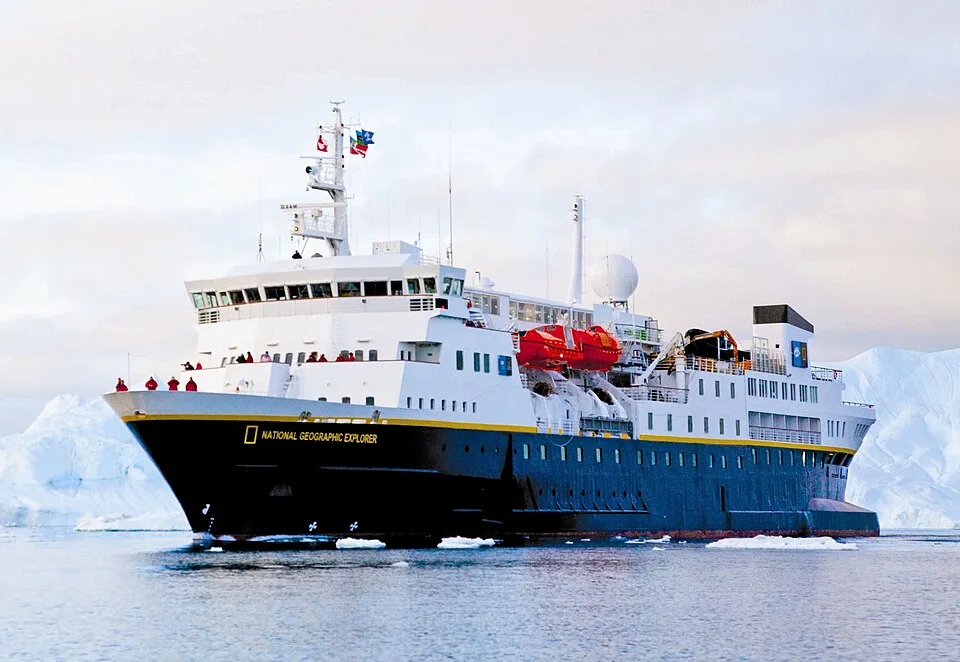
National Geographic Explorer
A 1982 Norwegian coastal ferry with an ice-class hull, now the fleet's hardest-working polar ship
Sailings Available
88
Ports Visited
84
Next Departure
Nov 18, 2026
Trip Length
7–20 nights
Now Booking
Sailings Aboard National Geographic Explorer
Lindblad Expeditions-National Geographic
Antarctica Direct: Sail and Fly the Drake Passage (10-Day Sail-Fly)
9 Nights
Nov 18, 2026 • departs Ushuaia
Lindblad Expeditions-National Geographic
Antarctica Direct: Fly the Drake Passage 8-Day (8-Day Expedition)
7 Nights
Nov 25, 2026 • departs Puerto Natales
Lindblad Expeditions-National Geographic
Antarctica Direct: Sail and Fly the Drake Passage (10-Day Fly-Sail)
9 Nights
Dec 19, 2026 • departs Puerto Natales
Lindblad Expeditions-National Geographic
Antarctica and Patagonia: Legendary Ice and Epic Fjords (Northbound)
17 Nights
Feb 21, 2027 • departs Ushuaia
Lindblad Expeditions-National Geographic
Celtic Coasts and Iberian Shores: Voyage from Edinburgh to Lisbon (2027 (Northbound))
11 Nights
Apr 14, 2027 • departs Lisbon
Lindblad Expeditions-National Geographic
Ancient Isles: England, Ireland and Scotland (2027 (Southbound))
11 Nights
Apr 25, 2027 • departs Edinburgh
Lindblad Expeditions-National Geographic
Ancient Isles: England, Ireland and Scotland (2027 (Northbound))
11 Nights
May 6, 2027 • departs London
Lindblad Expeditions-National Geographic
Norway, Sweden and Denmark: Nordic Flavors and Scenic Landscapes (Eastbound)
8 Nights
May 17, 2027 • departs Edinburgh
Lindblad Expeditions-National Geographic
Norway, Sweden and Denmark: Nordic Flavors and Scenic Landscapes (Westbound)
8 Nights
May 25, 2027 • departs Copenhagen
Lindblad Expeditions-National Geographic
Scotland’s Wild Isles: Shetlands, Orkneys and Inner Hebrides (Westbound)
7 Nights
Jun 2, 2027 • departs Edinburgh
Lindblad Expeditions-National Geographic
Scotland’s Wild Isles: Shetlands, Orkneys and Inner Hebrides (Eastbound)
7 Nights
Jun 9, 2027 • departs Dublin
Lindblad Expeditions-National Geographic
North Atlantic Wonders: Iceland, Scotland and the Faroes (Northbound)
10 Nights
Jun 16, 2027 • departs Edinburgh
National Geographic Explorer is a Norwegian coastal ferry. That is not a put-down. She was built at Ulstein Verft and launched in May 1982 to run the Hurtigruten, the working coastal express that calls at thirty-odd Norwegian ports in all weather, year round, on a timetable. A ship built for that job has an ice-class hull, a shallow draft, real maneuverability at low speed and a crew culture organized around going ashore quickly in bad conditions. Which is, almost exactly, the job of an Antarctic expedition ship.
From Midnatsol to Explorer
She sailed as Midnatsol from 1982 to 2003, then as Midnatsol II for two years when Hurtigruten needed the name for a newer hull, then as Lyngen from 2005. Lindblad bought her in 2008, converted her, and renamed her National Geographic Explorer. She has carried that name for eighteen years now, longer than any of her previous ones, and she is the ship most people picture when they picture this company.
The conversion is the thing that matters, and it is why the 1982 build date is less alarming than it looks. What is original is the steel, the hull form and the ice classification. What is not original is nearly everything a guest touches. Eighty-one cabins, all outside, across six passenger decks.
What the hull buys you and what it costs
Ice class 1A, an ice-reinforced bow, and stabilizers. She draws 15 feet 7 inches, which is the single most useful number on this page; it is why she can work her way into fjord heads, Greenland inlets and Antarctic bays that a 15,000-ton expedition ship reads about. At 367 feet and 6,471 gross tons she is small enough to turn inside a cove and slow enough, at a service speed of about fifteen knots, that the schedule assumes weather.
The cost is the same number read the other way. Six and a half thousand tons is not much ship in the Drake Passage. She is stabilized and she is well found, but there is no mass here to soak up a swell the way a big hull does, and two days of open water south of Cape Horn will be two days of motion. Nobody who sails her should be surprised by that, and the honest version of the pitch is that the Drake is the toll you pay.
The tools and the people
The mudroom with its gear lockers, the open bridge, the chart room below it and the observation deck are the working spaces, and they get more use than the lounge. Guests get access to the bridge, the captain and the officers, which on a ship this size is not a gimmick; the person who spots the whales is often a guest standing next to the mate on watch.
Lindblad’s exploration kit varies by ship, and Explorer carries the polar end of it: Zodiacs, kayaks, a remotely operated vehicle for putting a camera under the ice, hydrophones for listening to whales, a video microscope for plankton hauls, an undersea bow camera, and a crow’s-nest camera on the mast that the line fits to its ice-class vessels. She is also one of three ships, with Endurance and Resolution, where the electronic charts are piped to the cabin monitors, so you can see where the ship actually is at three in the morning.
Ninety-nine staff and crew serve 148 guests. That figure includes the expedition team, not just the hotel side, and the ratio is the product: you are paying for the naturalists, the undersea specialist and the photo instructors as much as for the berth.
Where she actually sails
Two poles and the North Atlantic in between. Just over half her scheduled departures are Antarctic, split between Ushuaia and Puerto Natales; the Puerto Natales sailings are the Antarctica Direct format, where you cross the Drake in one direction and fly it in the other, and the Patagonia-and-Antarctica voyages that run to eighteen days or more. Then a European season built out of Reykjavík for Iceland, Greenland and the Faroes, and an autumn run of Canadian Maritimes and Newfoundland voyages out of St. John’s. Trips run from a week to twenty nights, with nine nights the middle of the range.
Who she suits
People who want to be in the polar regions and are indifferent to the ship. The day is Zodiacs, landings, briefings and a recap before dinner. The evening entertainment is a lecture. If that sounds thin, this is the wrong page.
She does not suit anyone prone to seasickness who intends to cross the Drake by sea, anyone who wants a balcony and a spa treatment schedule, or anyone shopping on price; the per-night cost of 148 guests, ninety-nine crew and a fuel bill for the Southern Ocean is what it is. And she is a forty-four-year-old hull. Well kept, thoroughly rebuilt, correct for the job, and still a hull laid down in 1982.
Photo: UNclimatechange · CC BY 2.0 · Re-encoded to WebP.