Lindblad Expeditions-National Geographic
National Geographic Endurance
The first polar ship Lindblad ever built, and the one whose bow points the wrong way on purpose
Sailings Available
64
Ports Visited
61
Next Departure
Nov 5, 2026
Trip Length
8–21 nights
Now Booking
Sailings Aboard National Geographic Endurance
Lindblad Expeditions-National Geographic
Classic Patagonia: Glaciers and Peaks
8 Nights
Nov 5, 2026 • departs Puerto Natales
Lindblad Expeditions-National Geographic
Antarctica, South Georgia, and the Falklands (2027-28 (22-Day Southbound))
21 Nights
Nov 12, 2026 • departs Ushuaia
Lindblad Expeditions-National Geographic
Voyage to Antarctica
11 Nights
Dec 2, 2026 • departs Ushuaia
Lindblad Expeditions-National Geographic
Voyage to Antarctica
11 Nights
Dec 12, 2026 • departs Ushuaia
Lindblad Expeditions-National Geographic
Quest for the Antarctic Circle
15 Nights
Jan 11, 2027 • departs Ushuaia
Lindblad Expeditions-National Geographic
Quest for the Antarctic Circle
15 Nights
Jan 25, 2027 • departs Ushuaia
Lindblad Expeditions-National Geographic
Antarctica, South Georgia, and the Falklands (2027-28 (22-Day Northbound))
21 Nights
Feb 8, 2027 • departs Ushuaia
Lindblad Expeditions-National Geographic
Porto, Bordeaux and Bergen: Wonders of Western Europe
15 Nights
Mar 26, 2027 • departs Lisbon
Lindblad Expeditions-National Geographic
Norway's Fjords and Arctic Svalbard
15 Nights
Apr 10, 2027 • departs Bergen
Lindblad Expeditions-National Geographic
Svalbard: In Search of Iconic Arctic Wildlife
9 Nights
Apr 23, 2027 • departs Longyearbyen
Lindblad Expeditions-National Geographic
Norwegian Discovery: Svalbard and the Northern Fjords (Southbound)
11 Nights
May 14, 2027 • departs Longyearbyen
Lindblad Expeditions-National Geographic
Norwegian Discovery: Svalbard and the Northern Fjords (Northbound)
11 Nights
May 25, 2027 • departs Tromsø
National Geographic Endurance was the first polar newbuild in a company that had been running polar expeditions for half a century by then. Lindblad had always bought other people’s hulls and rebuilt them. In 2020 they had one made, to Ulstein’s CX104 design, with the hull welded up at CRIST in Gdynia and the finishing done at Ulstein Verft in Norway. The most consequential thing about her is the shape of the front end.
What the X-BOW actually does
A conventional bow has flare and a sheer that rises toward the stem. It lifts over a wave and then comes down on the back of it, which is where the bang, the spray and the shudder come from. The Ulstein X-BOW is inverted: the stem rakes backward, the volume sits low, and the hull pierces the wave rather than climbing it. Nothing lifts, so nothing slams.
In the Drake Passage this is not a comfort footnote. Two days out of Ushuaia and two days back is a third of a short Antarctic voyage, and on a conventionally bowed ship a good part of that is spent horizontal with the curtains shut. The X-BOW does not flatten the sea and it does not stop a ship from rolling; she has stabilizers for that, and they run at zero speed as well as underway, which matters when you are stopped alongside whales. What it removes is the pitching impact: the sensation of the bow falling out from under you every eight seconds, and the noise that goes with it. Guests report the difference most often as being able to sleep.
The design also gives her fuel range, which is the other half of the point. She carries oversized fuel and water tanks so she can stay out in places with nothing to top up from.
Ice class, and what it buys
She is Polar Class 5, Category A under the Polar Code. In plain terms: she is built to work year-round in medium first-year ice with old ice inclusions, and she is allowed to go places a Category C hull is not. Her draft is a little over seventeen feet, and she is 408 feet long on a 69-foot beam, small enough to work fjords and ice-choked bays, strong enough not to have to turn around when the pack closes in behind her.
The rest of the ship is arranged around the same idea. There is an expedition base with gear lockers where guests kit up, a bridge that is open to visitors for most of the voyage, Zodiacs and kayaks, and wildlife spotters standing watch on deck rather than a schedule of shore excursions. The lounges are observation lounges. Restaurant 270° is named for its wrap-around windows and two smaller rooms handle lighter meals and small-group dinners. There is an infinity-edge pool and a yoga studio, and there is Change, a permanent art installation curated by the glacier painter Zaria Forman, which is a more serious piece of programming than a ship’s art collection usually is.
Her interrupted start
Ulstein handed her over on 16 March 2020, which was the worst possible week in the history of passenger shipping to take delivery of a passenger ship. She sat out the following year, and the yard time was used: four suites were cut into eight cabins in Denmark, which is why she carries 138 guests today and 126 on the original drawings. She was finally christened in Reykjavík harbor in July 2021 and went straight into a nineteen-day Iceland and Greenland voyage.
Where she sails
She is a two-hemisphere ship and she works both ends of the year. The Antarctic season runs out of Ushuaia, the Peninsula, the Circle, and the longer Falklands and South Georgia combinations. The northern season splits between Longyearbyen for Svalbard and Reykjavík for Iceland, Greenland and the high Arctic, with a handful of voyages out of Edinburgh working the Scottish islands and the Atlantic edge. Trips on offer here run from eight nights to twenty-one, and the median is eleven.
Who she suits
People who want the highest-latitude version of this and would rather not suffer to get there. A hundred and thirty-eight guests is a small number by cruise standards and a large one by expedition standards: IAATO rules cap Antarctic landings at a hundred people ashore at a time, so on a full ship you will land in shifts rather than all at once. That is the cost of her size, and it is worth knowing before you book.
She does not suit anyone looking for a ship as the destination. There is no casino, no theater and no production show; the evening is a recap from the naturalists and an early night, because the good light in the polar regions happens at hours that have nothing to do with dinner. She is also expensive, and the comfort argument for the X-BOW is real but it is not a promise; the Drake can still be the Drake.
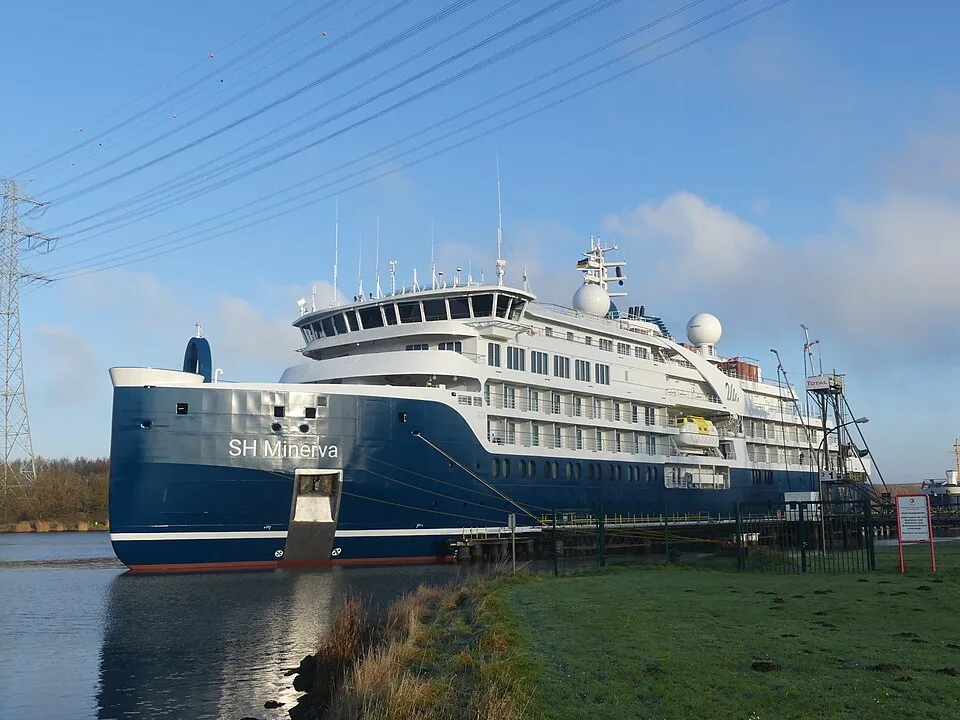
Photo: HenSti · CC BY-SA 4.0 (share-alike) · Re-encoded to WebP.