Lindblad Expeditions-National Geographic
National Geographic Delfina
A 242-ton catamaran carrying sixteen guests, and by a wide margin the smallest vessel in the fleet
Sailings Available
220
Ports Visited
6
Next Departure
Nov 20, 2026
Trip Length
9–15 nights
Now Booking
Sailings Aboard National Geographic Delfina
Lindblad Expeditions-National Geographic
Galápagos by Catamaran: An Intimate Voyage
9 Nights
Nov 20, 2026 • departs Quito
Lindblad Expeditions-National Geographic
Galápagos by Catamaran, Machu Picchu and Peru's Land of the Inca
15 Nights
Nov 20, 2026 • departs Quito
Lindblad Expeditions-National Geographic
Galápagos by Catamaran: An Intimate Voyage
9 Nights
Apr 2, 2027 • departs Quito
Lindblad Expeditions-National Geographic
Galápagos by Catamaran, Machu Picchu and Peru's Land of the Inca
15 Nights
Apr 2, 2027 • departs Quito
Lindblad Expeditions-National Geographic
Galápagos by Catamaran: An Intimate Voyage
9 Nights
Mar 31, 2028 • departs Quito
Lindblad Expeditions-National Geographic
Galápagos by Catamaran, Machu Picchu and Peru's Land of the Inca
15 Nights
Mar 31, 2028 • departs Quito
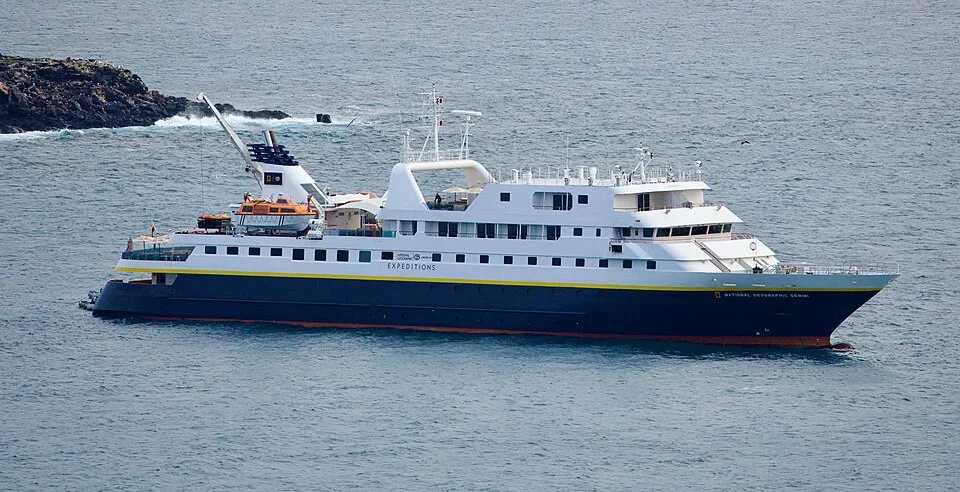
National Geographic Delfina carries sixteen people. Not a hundred and sixteen: sixteen, in eight staterooms, with twelve crew and two expedition staff. She is 98 feet long, 37 feet wide, and 242 gross tons, which makes her roughly one twenty-seventh the size of National Geographic Explorer. She is the smallest thing on this site by a distance, and everything interesting about her follows from that.
A catamaran, which is the point
She was built at Botto Astilleros y Marina in Guayaquil and completed in May 2007, and she is a catamaran: two hulls, a 37-foot beam on a 98-foot length. That geometry is not a styling choice. Two widely spaced hulls resist rolling without stabilizers, which matters on a boat too small to carry them, and they draw very little water, which is what lets her anchor close in at Galápagos landing sites. The deck area a catamaran gets for her length is also why a 98-foot boat can have a wraparound upper deck and a 360-degree observation deck with a hot tub on it.
The cost is speed. Ten knots is slow even by the standards of this fleet, and the archipelago’s longer inter-island runs are done overnight because they have to be.
Three names in nineteen years
She sailed as Athala II for the Ecuadorian operator Ocean Adventures from 2007 to 2017. Royal Caribbean Group bought her in 2017 and ran her as Celebrity Xploration, and in August of that year Nathaly Albán took command of her, becoming the first woman to captain a cruise vessel in the Galápagos. Lindblad acquired her in 2025 along with the larger Xpedition, now National Geographic Gemini, and she started sailing under her present name in early 2025. The name is Sven-Olof Lindblad’s youngest daughter’s.
Sixteen guests and two naturalists
The Galápagos is a regulated trade, and the scale of the vessels working it shows the effect: Lindblad’s four ships there carry 16, 48, 48 and 96 guests while its polar ships carry 138 and 148, and all four fly the Ecuadorian flag and are registered at Guayaquil rather than Nassau. Delfina sits at the bottom of that range on purpose.
Two expedition staff sail with her, both licensed naturalists: an expedition leader and a National Geographic-certified photo instructor. On a ship of sixteen that is a guide for every eight people, and it changes the character of a landing entirely; there is no group, there is a conversation.
Aboard: eight staterooms, each with either a private balcony or direct access to an outer deck. One dining room seating everyone at once, an outdoor café at the stern where most meals are actually served, a forward-facing lounge for recaps, the observation deck, and a marina on the main deck for boarding. Zodiacs, kayaks and snorkeling gear. That is the complete inventory of the ship, and the list is short because the ship is.
Where she actually sails
The Galápagos, year round, every departure staged out of Quito. Voyages run nine to fifteen nights, with twelve the median, longer than the fleet’s other Galápagos ships, because a large share of her sailings are the combination trips that add Machu Picchu and Peru to the islands. She is also offered as a private charter, which for a sixteen-berth boat is a realistic proposition for an extended family rather than a fantasy.
Who she suits
Small groups who want the archipelago with almost nobody else in the way, and families or friends chartering the whole boat. If you have sailed a hundred-guest expedition ship and found the landings crowded, this is the answer to that complaint.
She does not suit anyone who needs space. There is one lounge and one dining room, no gym, no spa, no library to hide in, and no possibility of avoiding your fellow passengers; sixteen people over twelve days is a dinner party you cannot leave. She is nineteen years old, she does ten knots, and she is the most expensive way per night to see the Galápagos in this fleet. What you are buying is a guide-to-guest ratio of one to eight and a boat that can tuck into places the bigger vessels have to admire from further out.