MSC Cruises
MSC World Europa
The first LNG flagship, and the ship that opened the largest class MSC has ever built
Sailings Available
457
Ports Visited
21
Next Departure
Nov 4, 2026
Trip Length
3–28 nights
Now Booking
Sailings Aboard MSC World Europa
MSC Cruises
4-Night Mediterranean from La Valletta to Genoa
4 Nights
Nov 4, 2026 • departs Valletta
MSC Cruises
6-Night Mediterranean from Barcelona
6 Nights
Nov 6, 2026 • departs Barcelona
MSC Cruises
6-Night Mediterranean from Marseille
6 Nights
Nov 7, 2026 • departs Marseille
MSC Cruises
6-Night Mediterranean from Genoa
6 Nights
Nov 8, 2026 • departs Genoa
MSC Cruises
5-Night Mediterranean from Civitavecchia to Genoa
5 Nights
Nov 9, 2026 • departs Civitavecchia
MSC Cruises
6-Night Mediterranean from Civitavecchia
6 Nights
Nov 9, 2026 • departs Civitavecchia
MSC Cruises
4-Night Mediterranean from Messina to Genoa
4 Nights
Nov 10, 2026 • departs Messina
MSC Cruises
6-Night Mediterranean from Barcelona
6 Nights
Nov 12, 2026 • departs Barcelona
MSC Cruises
5-Night Mediterranean from Barcelona to Marseille
5 Nights
Nov 12, 2026 • departs Barcelona
MSC Cruises
4-Night Mediterranean from Marseille
4 Nights
Nov 13, 2026 • departs Marseille
MSC Cruises
28-Night MSC Grand Voyages from Genoa to Fort de France
28 Nights
Nov 14, 2026 • departs Genoa
MSC Cruises
4-Night MSC Grand Voyages from Genoa to Barcelona
4 Nights
Nov 14, 2026 • departs Genoa
MSC World Europa is the ship that started MSC’s largest class and its most expensive technical bet. Chantiers de l’Atlantique delivered her at Saint-Nazaire on October 24, 2022, 215,863 gross tons, 333 meters long, and burning liquefied natural gas rather than marine diesel. She carried a 50-kilowatt solid-oxide fuel cell as a demonstrator, the first fitted to any cruise ship, and her maiden voyage sailed from Doha rather than the Mediterranean because MSC had chartered her out as a floating hotel for the World Cup.
The structural idea that separates her from every other ship this size is the stern. Instead of closing the hull with a flat transom and stacking cabins over it, the designers cut a Y-shaped notch out of the after end and hung balcony cabins down both flanks of it, looking inward and down onto an open-air promenade seven decks below. It is the one part of the ship that does not feel like a shopping mall, and on a warm Mediterranean evening it is where the ship is.
What she is known for
The Venom Drop. A dry slide that begins on deck 20 and falls eleven decks in a spiral. It is genuinely alarming, it is free, and there is usually a line.
The Yacht Club. MSC’s gated suite complex sits forward across the top of the ship, with its own restaurant, lounge, pool and sun deck and a butler attached to each suite. On a hull carrying this many people it is the difference between a crowded week and a quiet one, and it is the strongest argument for booking this ship over a cheaper one.
The gas. LNG cuts sulfur emissions to nearly nothing and nitrogen oxides by most of the way, which matters less in the Caribbean and a great deal in the European ports that are tightening what they will let alongside. It is also the reason she is a long-term Mediterranean asset rather than a ship that will be sent somewhere else in five years. The fuel-cell demonstrator she carries is a research installation rather than a working power plant, fifty kilowatts on a ship that needs tens of megawatts, but it is the first of its kind at sea and the reason naval architects pay attention to her.
The dining. She carries the specialty brands MSC runs fleet-wide (Butcher’s Cut for steak, Kaito for sushi and teppanyaki, a taco and tequila room, and a chef-led restaurant that is the closest thing MSC has to fine dining) spread across a dozen-plus paying venues on top of the included main dining rooms and buffet. The included food is Italian in its instincts, which is the single biggest onboard difference an American passenger will notice: pasta arrives as its own course, there is more fish and less fried food than a US mass-market ship serves, portions are smaller, and the coffee is espresso made properly.
The tiers. MSC sells the same cabin at three prices. Bella is the cheapest and the room is assigned to you; Fantastica lets you pick it and adds room-service breakfast and flexible dining; Aurea adds a thermal-spa pass, priority boarding and a drinks package. On a hull this size, priority boarding and a reserved dining time are worth more than the price difference suggests.
Where she actually sails
She is a Western Mediterranean ship, and the way MSC sells her takes a moment to understand. The same seven-night circuit is on sale from five different embarkation ports at once (Barcelona, Marseille, Genoa, Civitavecchia and Palma de Mallorca) with La Spezia added as a call. You board wherever is convenient and sail the same week as everybody else, which is why a single ship generates twenty-odd departures a month here. That program runs from April through October in both 2027 and 2028, and it is by far the largest part of what is on sale.
Winter is the interesting part. From December 2026 to early April 2027 she crosses to the Caribbean, but not to Miami: she works seven-night Southern Caribbean weeks out of Pointe-à-Pitre and Fort-de-France, with Bridgetown running fourteen-night versions, calling at Philipsburg, St. John’s, Kingstown, Basseterre, Castries and Roseau. This is the French Caribbean program MSC sells into France and the islands, and it is not an American product. The repositioning legs either side are sold as MSC Grand Voyages of thirteen to twenty-one nights.
The second winter is not on the schedule. Everything between November 2027 and March 2028 is missing from her calendar, and she reappears in the Mediterranean in April 2028.
Who she suits
Anyone who wants a brand-new ship in the Mediterranean without paying for one. She is four years old, she is the biggest thing MSC has, and a Barcelona or Genoa week on her routinely undercuts an older ship from an American line on the same sea. If you can stretch to the Yacht Club, do; this is the hull where it pays for itself.
She is also a rare thing in the Mediterranean: a ship that is worth a sea day. Most Western Med weeks are port-heavy on the assumption that nobody wants to stay aboard, and on this hull that assumption is wrong. If you are traveling with children, the water park, the slide and the sports deck will carry an afternoon on their own.
She does not suit anyone who wants quiet or a small ship. Six thousand people at full occupancy is six thousand people, the sea days are busy, and the Western Med calls are the large industrial ones rather than the pretty small ones; Civitavecchia is ninety minutes from Rome, Marseille and Genoa are working container ports, and La Spezia is a bus ride from anywhere you actually want to be. If the point of the trip is the ports rather than the ship, a smaller vessel on a slower itinerary will serve you better.
She is also the wrong ship for an American traveler looking for a familiar mass-market week. The announcements are multilingual and there are several of them; the passenger list is mostly Italian, French, Spanish and German; the service style is more formal and less chatty than a US crew’s; and the Caribbean season sails out of Guadeloupe and Martinique rather than Florida, which means a transatlantic flight to reach a ship full of French passengers. That is a perfectly good vacation and it is not the one most Americans think they are buying.
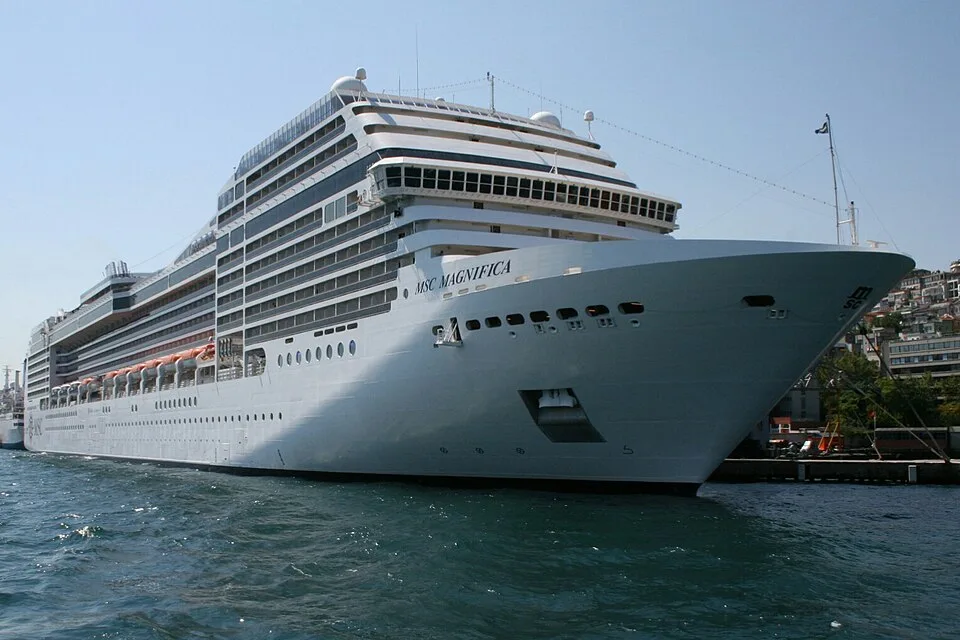
Photo: MichalPL · CC BY-SA 4.0 (share-alike) · Re-encoded to WebP.