MSC Cruises
MSC Splendida
Fantasia's identical twin, five years in China, and the widest-ranging schedule of the four
Sailings Available
269
Ports Visited
59
Next Departure
Sep 20, 2026
Trip Length
3–25 nights
Now Booking
Sailings Aboard MSC Splendida
MSC Cruises
7-Night Western Mediterranean from Barcelona
7 Nights
Sep 20, 2026 • departs Barcelona
MSC Cruises
7-Night Mediterranean from Marseille
7 Nights
Sep 21, 2026 • departs Marseille
MSC Cruises
7-Night Mediterranean from Livorno
7 Nights
Sep 22, 2026 • departs Livorno
MSC Cruises
7-Night Mediterranean from Cagliari
7 Nights
Sep 23, 2026 • departs Cagliari
MSC Cruises
7-Night Mediterranean from Palermo
7 Nights
Sep 24, 2026 • departs Palermo
MSC Cruises
7-Night Mediterranean from La Valletta
7 Nights
Sep 25, 2026 • departs Valletta
MSC Cruises
24-Night MSC Grand Voyages from Marseille to Buenos Aires
24 Nights
Nov 9, 2026 • departs Marseille
MSC Cruises
21-Night MSC Grand Voyages from Palermo to Buenos Aires
21 Nights
Nov 12, 2026 • departs Palermo
MSC Cruises
11-Night MSC Grand Voyages from Barcelona to Maceio
11 Nights
Nov 15, 2026 • departs Barcelona
MSC Cruises
18-Night MSC Grand Voyages from Barcelona to Buenos Aires
18 Nights
Nov 15, 2026 • departs Barcelona
MSC Cruises
14-Night MSC Grand Voyages from Barcelona to Rio de Janeiro
14 Nights
Nov 15, 2026 • departs Barcelona
MSC Cruises
4-Night South America from Rio de Janeiro to Buenos Aires
4 Nights
Nov 29, 2026 • departs Rio de Janeiro
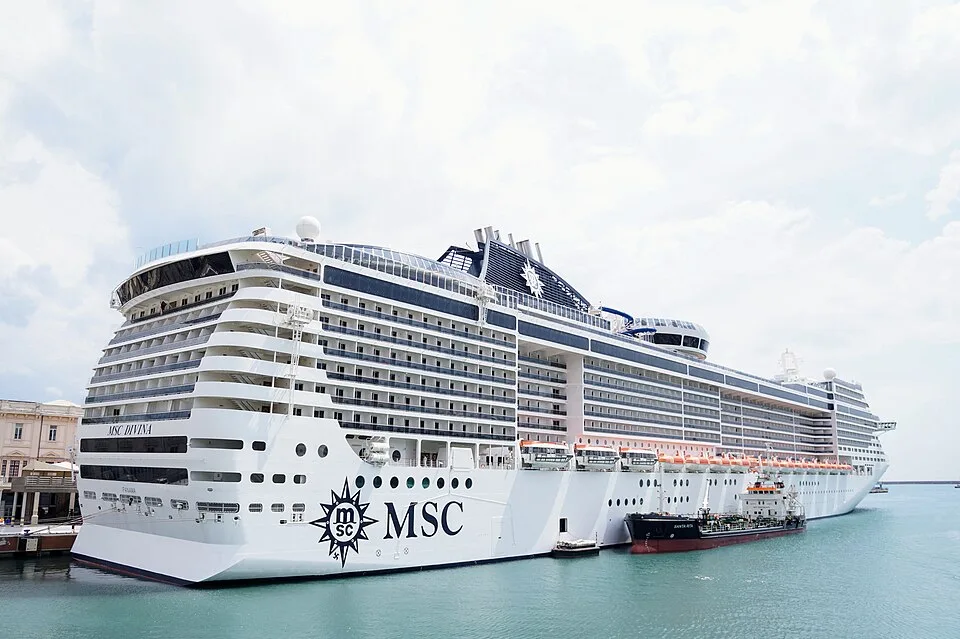
MSC Splendida is the second Fantasia-class ship and, structurally, the same vessel as MSC Fantasia, 137,936 gross tons, 333 meters, 1,637 cabins, the same gated Yacht Club forward that her sister introduced a year earlier. STX France delivered her at Saint-Nazaire on July 2, 2009 for around $550 million, and Sophia Loren christened her at Barcelona ten days later. She was ordered under a different name, MSC Serenata, and renamed before she ever went in the water.
What makes her worth a separate page is not the ship. It is that MSC has never been able to leave her alone. Of the four Fantasia-class hulls she is the one that has been moved furthest and most often, and the schedule on sale now has her working three different continents inside two years.
The China years, and what came back
In 2017 MSC refitted her and sent her east, to sell into the Chinese domestic market out of Shanghai, a market that a number of Western lines entered around the same time and almost all of them left again. She came back to Europe, and the refit came back with her: the interiors were reworked for a different set of expectations and the ship has been kept current since rather than rebuilt.
She is otherwise a straight repeat of Fantasia. The Yacht Club is the same proposition and the same argument for booking her: on a hull carrying 3,274 guests at double occupancy against 1,313 crew, paying for the gated end of the ship buys a private restaurant, a private pool deck and a butler, and it is the one upgrade on this class that changes the week rather than decorating it.
Below it, 1,637 cabins across thirteen passenger decks, with a theater, a casino, a spa, several specialty restaurants against the main dining rooms, and a top deck that predates the era when ships were expected to carry a water park. She is a 2009 vessel and reads as one: heavy on marble, glass and polished metal, light on the sort of features that photograph well in a brochure aimed at families.
Where she actually sails
Three separate deployments, none of which repeats, which is unusual for an MSC ship and makes her calendar the most interesting of the four sisters.
August to November 2026 is the Western Mediterranean. Seven nights, sold at once from Barcelona, Marseille, Livorno, Cagliari, Palermo and Valletta, six embarkation ports on one weekly loop, which is even more ports than MSC usually strings together.
December 2026 to March 2027 she is in South America. Eight- and nine-night runs out of Rio de Janeiro and Buenos Aires, calling at Punta del Este, Ilhabela, Balneário Camboriú, Montevideo and Maceió. Twenty-nine departures across the southern summer. She gets there and back on Grand Voyages of sixteen to twenty-five nights (Barcelona or Marseille out, Buenos Aires to Trieste or Tarragona home), and those crossings are sold as voyages in their own right.
April to November 2027 is the Adriatic and the Aegean. Nine-night circuits sold from Trieste, Bari, Piraeus and Istanbul, with Corfu, Kusadasi and Split as the recurring calls. Roughly twenty-two departures from each of the four homeports, and this is the largest block on her schedule.
Summer 2028 is the Baltic. Seven- and eleven-night weeks out of Warnemünde and Copenhagen, plus a set of one-way crossings between Oslo and Stockholm, calling at Helsinki, Tallinn, Visby and Kristiansand. She runs it from April to late September and then the schedule stops.
The gap is worth flagging: there is nothing at all on her calendar between December 2027 and March 2028. Whatever she does that winter has not been filed.
Who she suits
Travelers who want a big ship somewhere specific and are willing to work around her rather than the other way round. The nine-night Adriatic-Aegean circuit is the pick; nine nights is a better length than seven for that stretch of water, Istanbul is a real call rather than a token one, and boarding at Trieste or Bari puts you a train ride from most of northern Italy. The Baltic summer and the Buenos Aires winter are both good products at prices well under what the equivalent American-line week costs.
She does not suit anyone who wants consistency. Book her twice in three years and you will be on the same ship in three different oceans with three different crew rotations and three different passenger mixes; a Rio departure and a Copenhagen departure are not the same holiday. She is also the wrong ship if you need the week planned around a specific port: the multi-homeport structure means the ship sails the same loop whichever end you get on, so a Palermo booking and a Barcelona booking see identical places in a different order, and neither gives you longer anywhere. And, like the rest of the class, she is a 2009 hull with 2009 ideas about what a ship should have on the top deck.
Photo: René Cortin · CC BY-SA 4.0 (share-alike) · Re-encoded to WebP.