MSC Cruises
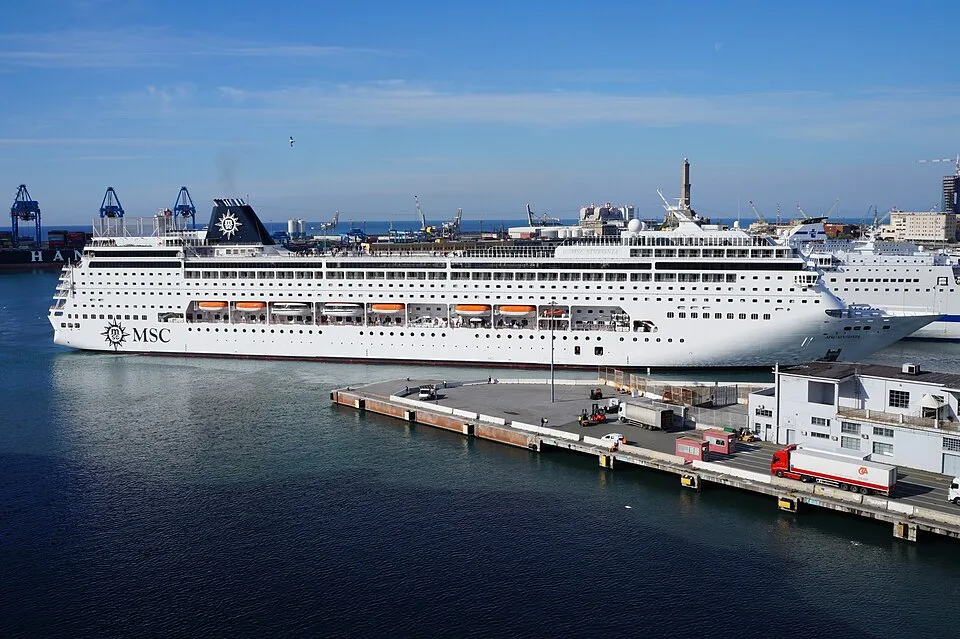
MSC Sinfonia
The last ship Festival Cruises ever built, carrying a 2,400-tonne section that was not in the original drawings
Sailings Available
329
Ports Visited
46
Next Departure
Sep 22, 2026
Trip Length
3–31 nights
Now Booking
Sailings Aboard MSC Sinfonia
MSC Cruises
7-Night Mediterranean from Piraeus
7 Nights
Sep 22, 2026 • departs Piraeus
MSC Cruises
7-Night Eastern Mediterranean from Bari
7 Nights
Sep 26, 2026 • departs Bari
MSC Cruises
6-Night Mediterranean from Piraeus
6 Nights
Oct 20, 2026 • departs Piraeus
MSC Cruises
7-Night Mediterranean from Bari to Valencia
7 Nights
Oct 24, 2026 • departs Bari
MSC Cruises
5-Night Eastern Mediterranean from Bari to Civitavecchia
5 Nights
Oct 24, 2026 • departs Bari
MSC Cruises
3-Night Eastern Mediterranean from Piraeus to Civitavecchia
3 Nights
Oct 26, 2026 • departs Piraeus
MSC Cruises
5-Night Western Mediterranean from Piraeus to Valencia
5 Nights
Oct 26, 2026 • departs Piraeus
MSC Cruises
5-Night Western Mediterranean from Civitavecchia to Genoa
5 Nights
Oct 29, 2026 • departs Civitavecchia
MSC Cruises
4-Night Western Mediterranean from Civitavecchia to Marseille
4 Nights
Oct 29, 2026 • departs Civitavecchia
MSC Cruises
3-Night Western Mediterranean from Civitavecchia to Tarragona
3 Nights
Oct 29, 2026 • departs Civitavecchia
MSC Cruises
8-Night Mediterranean from Valencia to Barcelona
8 Nights
Oct 31, 2026 • departs Valencia
MSC Cruises
6-Night Mediterranean from Valencia
6 Nights
Oct 31, 2026 • departs Valencia
MSC Sinfonia was the end of one company and the beginning of another’s fleet. Chantiers de l’Atlantique delivered her at Saint-Nazaire in April 2002 as European Stars, the fourth and last ship Festival Cruises ever took delivery of, and the sister of European Vision, now MSC Armonia. Festival went under two years later. MSC bought her in July 2004 for a reported €220 million and put her into service under her present name in March 2005.
She is one of the four Lirica-class ships, the oldest and smallest hulls MSC still runs, and like all four of them she is no longer the ship the yard delivered.
2,400 tonnes that were not in the plan
In the winter of 2015 she went to Fincantieri at Palermo, where the yard cut her through the hull, pulled the two halves apart, and floated in a prefabricated midsection built separately. The section was 24 meters long, weighed 2,400 tonnes, and contained 193 cabins. The work took ten weeks, from mid-January to late March 2015, and she came out at 274.9 meters and 65,542 gross tons.
The interesting number is the 2,400 tonnes. That is a substantial ship in its own right, built on land, moved into a gap and welded on both faces, and the fact that MSC did it four times in fourteen months tells you how much cheaper this was than ordering a new hull. The Renaissance Programme is the largest thing of its kind anyone has attempted on passenger ships.
What it did not do was widen her. She is still 94 feet in the beam and still nine passenger decks, which is why she still gets alongside in places larger ships cannot, Portimão, Mahon and Ceuta among them, none of which appear on many big-ship schedules and all of which are on hers.
She kept her name through the rebuild, which not every ship does, and she kept her Festival-era bones: a compact layout you can learn in an afternoon, a single main pool, a theater, a casino, a spa, and a walk to dinner measured in seconds rather than minutes.
Where she actually sails
Her schedule shifts twice, and the version she settles into is the unusual one.
For one late-summer stretch she is in the eastern Mediterranean, running seven-night circuits out of Bari and Piraeus with Katakolon, Corfu, Cefalonia and Santorini.
Through the winter that follows she moves west for a seven-night Western Mediterranean loop sold from Genoa, Marseille, Barcelona, Civitavecchia and Valencia, with Livorno and Olbia as calls.
Then she takes over the ten-night Iberia and Morocco circuit, and this is what she is for. Ten nights, sold at once from Genoa, Marseille, Alicante, Málaga and Lisbon in equal share, calling at Olbia, Mahon, Cádiz, Portimão, Gibraltar, Ceuta, Casablanca and Tangier. It runs May through October, summer after summer, and it is the largest block on her calendar by some way. Ten nights is the right length for that coastline: you get Andalusia, the Algarve, the Straits and the Moroccan coast without the two-day hops that a seven-night version forces.
It is worth noting that this is the same circuit MSC Opera runs out of the same five ports until she crosses to the Caribbean. Sinfonia inherits it, which is the sort of thing only the schedule shows you.
Come one autumn she leaves for South Africa on twenty-seven- to thirty-one-night voyages from Genoa, Marseille and Alicante to Durban, by way of Alexandria, the Suez Canal, Sharm el Sheikh, Limassol, Rhodes, Mauritius and Réunion. Then her calendar goes dark until the spring, when she reappears in the Mediterranean. Whatever season she works out of Durban that winter has not been filed.
Who she suits
Anyone who wants Morocco and southern Spain properly rather than as a day trip. Ten nights and five embarkation ports; this is one of the best-value long itineraries in Europe and the ports are unusual: Portimão, Ceuta and Mahon do not appear on many big-ship schedules at all.
She also suits travelers who prefer a smaller ship and do not need to be sold on it. Nine passenger decks means you learn the layout on the first afternoon, the walk to dinner is short, and the crew see the same faces all week.
She does not suit anyone expecting the ship to be the holiday. She is twenty-four years old, the entertainment is a theater and a lounge band, and the lengthening added cabins without adding a proportionate amount of public room; a full sailing is noticeably fuller than the 65,542 tons implies. She is the wrong ship for families with teenagers and the wrong ship for anyone who wants a balcony as a matter of course, since a large share of the accommodation on this class is inside and oceanview. And if a suite experience matters, look elsewhere in the fleet: there is no Yacht Club on any Lirica-class hull.
Photo: René Cortin · CC BY-SA 4.0 (share-alike) · Re-encoded to WebP.