MSC Cruises
MSC Seaview
The Miami prototype sent to Europe instead, and the busiest Mediterranean ship in the fleet
Sailings Available
430
Ports Visited
33
Next Departure
Sep 20, 2026
Trip Length
3–27 nights
Now Booking
Sailings Aboard MSC Seaview
MSC Cruises
7-Night Mediterranean from Civitavecchia
7 Nights
Sep 20, 2026 • departs Civitavecchia
MSC Cruises
7-Night Mediterranean from Palermo
7 Nights
Sep 21, 2026 • departs Palermo
MSC Cruises
7-Night Mediterranean from Barcelona
7 Nights
Sep 24, 2026 • departs Barcelona
MSC Cruises
7-Night Mediterranean from Marseille
7 Nights
Sep 25, 2026 • departs Marseille
MSC Cruises
7-Night Western Mediterranean from Genoa
7 Nights
Sep 26, 2026 • departs Genoa
MSC Cruises
7-Night Mediterranean from Barcelona to Tarragona
7 Nights
Nov 5, 2026 • departs Barcelona
MSC Cruises
7-Night Mediterranean from Marseille
7 Nights
Nov 6, 2026 • departs Marseille
MSC Cruises
7-Night Mediterranean from Genoa
7 Nights
Nov 7, 2026 • departs Genoa
MSC Cruises
6-Night Mediterranean from Civitavecchia to Genoa
6 Nights
Nov 8, 2026 • departs Civitavecchia
MSC Cruises
5-Night Mediterranean from Palermo to Genoa
5 Nights
Nov 9, 2026 • departs Palermo
MSC Cruises
3-Night South America from Santos
3 Nights
Nov 29, 2026 • departs Santos
MSC Cruises
3-Night South America from Santos
3 Nights
Dec 2, 2026 • departs Santos
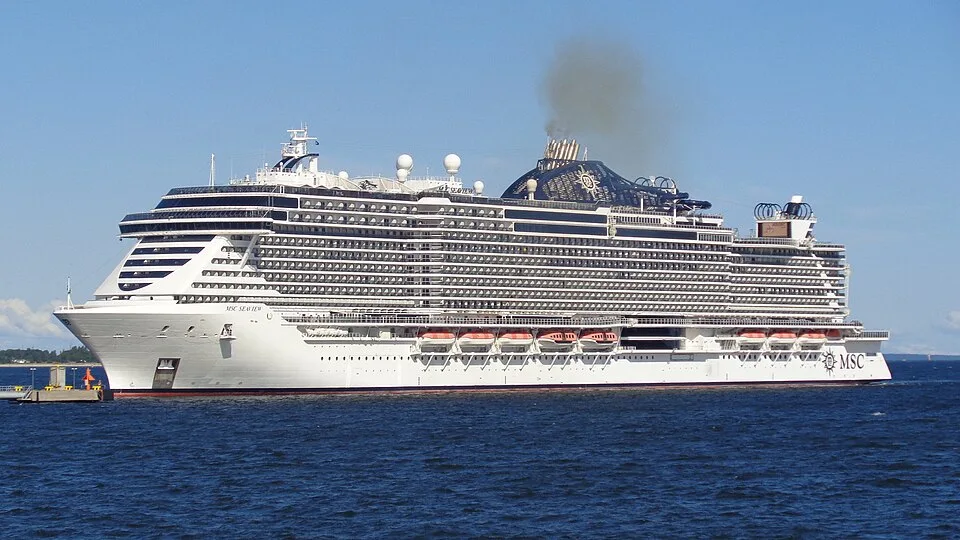
MSC Seaview is the sister of a ship designed for Florida, and she has spent almost none of her life there. Fincantieri delivered her at Monfalcone on June 4, 2018, MSC christened her in Genoa five days later, and she sailed her maiden voyage into the Western Mediterranean rather than west across the Atlantic. She is the same 153,516-ton hull as MSC Seaside (the same wide beam and narrow superstructure, the same open boardwalk running around deck 8 with the sea below it, the same glass bridges across the transom) put to work on a completely different set of seas.
That turns out to suit her. The Seaside design’s whole idea was to get people outdoors, and a Mediterranean summer is a better place to be outdoors than a Caribbean one.
What she is known for
The promenade. Two decks above the water, wrapping the hull, with tables on the outboard side. On an Adriatic evening it is the reason to book this class over a taller, more enclosed ship.
Range. She works harder and over more water than any other MSC ship in this schedule, the Western Med, the Aegean, the Adriatic, the Sea of Marmara, the Canaries and the coast of Brazil, all inside two years.
The Yacht Club. Five decks of gated suites forward, own restaurant, own pool, butler service and drinks included inside the gates. On a ship carrying four thousand people through a Mediterranean August it earns its price, and it is the single most reliable way to make a busy MSC ship feel like a calm one.
The dining. Included main dining rooms and a buffet, with the fleet specialty rooms above them, a steakhouse, a sushi and teppanyaki room, a taco and tequila bar. On this ship, sailing where she sails, the Italian instincts of the included menu are an advantage rather than a surprise: pasta as its own course, plenty of fish, small portions, proper espresso.
The fare tiers. The same cabin sells at three prices, Bella with the room assigned, Fantastica with your choice plus room-service breakfast and flexible dining, Aurea adding a thermal-spa pass, priority boarding and a drinks package. On a nine-night Eastern Mediterranean run with eight port days in it, the Aurea drinks package is usually the one worth doing the arithmetic on.
Where she actually sails
Three distinct programs, and which one you get depends entirely on the month.
Most of the year is the Western Mediterranean: seven nights sold from Marseille, Palermo, Barcelona, Genoa, Naples and Valletta at once, the same circuit bookable from whichever pier you can reach. That runs April through October and accounts for the bulk of everything she does.
Layered into it is something MSC does not run much of elsewhere, a nine-night Eastern Mediterranean loop, sold from Trieste, Piraeus, Bari and Istanbul, with Kusadasi, Split and Corfu on the way, an even share from each of those four homeports. If you want the Adriatic and the Aegean on one ship, this is the sailing on this fleet that has them.
From late November to March she crosses to South America and runs seven-night Brazilian and River Plate weeks out of Santos, Balneário Camboriú and Buenos Aires, calling at Punta del Este, Montevideo, Rio de Janeiro, Maceió and Búzios. The crossings either side are sold as MSC Grand Voyages of twenty to twenty-seven nights by way of the Canaries, Madeira and Cape Verde. Note that she does not do it every year: some winters she stays in the Mediterranean rather than going back south.
Who she suits
Europeans and anyone flying to Europe who wants a lot of ship for the money, and particularly anyone who wants the Eastern Mediterranean without paying premium prices for it. The nine-night Trieste and Piraeus runs are the pick of her calendar. The Brazilian season is a genuine option too, and MSC is the dominant line on that coast, so the ship will feel like it belongs there in a way a visiting American ship does not.
The multi-homeport model is worth understanding before you book her, because it is how MSC gets so many departures out of one ship. The same physical week is on sale from six or seven piers at once: a couple joining at Palermo and a couple joining at Barcelona are on the same sailing with the same crew, they simply start and finish at different points on the loop. Board wherever your flights are cheapest; the cruise is identical, and the fare often is not.
She does not suit an American looking for a familiar week. This is among the most European ships in the fleet by passenger mix, the announcements are multilingual and there are several of them, and the Brazilian season in particular sails with a largely Brazilian and Argentine passenger list and a Portuguese- and Spanish-first tone. Nothing about that is a fault; it is simply not what a US mass-market brochure has trained people to expect.
She is also eight years old on a class that has since been superseded twice. Cabins are smaller than the World-class ones, the water park is dated, and there is no LNG. If you want the newest MSC hardware in the Mediterranean, MSC World Asia is the ship and this one is the bargain, and if what you want is a lot of open deck in good weather rather than the newest interiors, the bargain is the better buy.
Photo: Pjotr Mahhonin · CC BY-SA 4.0 (share-alike) · Re-encoded to WebP.