MSC Cruises
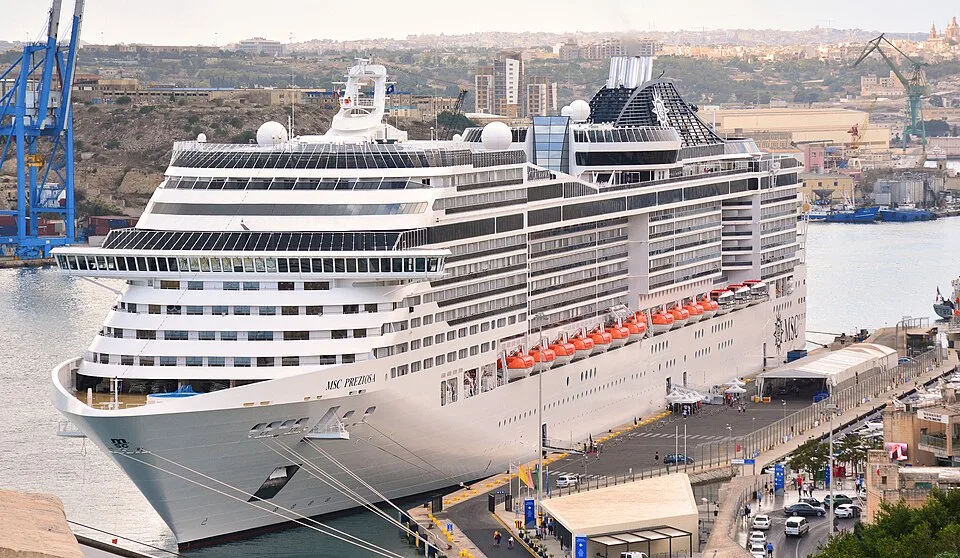
MSC Preziosa
Ordered by the Gaddafis, finished by MSC, and now Hamburg's year-round ship
Sailings Available
218
Ports Visited
34
Next Departure
Nov 5, 2026
Trip Length
3–14 nights
Now Booking
Sailings Aboard MSC Preziosa
MSC Cruises
7-Night Northern Europe from Le Havre
7 Nights
Nov 5, 2026 • departs Le Havre
MSC Cruises
7-Night Northern Europe from Southampton
7 Nights
Nov 6, 2026 • departs Southampton
MSC Cruises
7-Night Northern Europe from Hamburg
7 Nights
Nov 8, 2026 • departs Hamburg
MSC Cruises
7-Night Northern Europe from Rotterdam
7 Nights
Nov 11, 2026 • departs Rotterdam
MSC Cruises
7-Night Northern Europe from Le Havre
7 Nights
Nov 12, 2026 • departs Le Havre
MSC Cruises
7-Night Northern Europe from Southampton
7 Nights
Nov 20, 2026 • departs Southampton
MSC Cruises
6-Night Northern Europe from Rotterdam
6 Nights
Nov 25, 2026 • departs Rotterdam
MSC Cruises
7-Night Northern Europe from Le Havre
7 Nights
Nov 26, 2026 • departs Le Havre
MSC Cruises
7-Night Northern Europe from Southampton
7 Nights
Nov 27, 2026 • departs Southampton
MSC Cruises
7-Night Northern Europe from Hamburg
7 Nights
Nov 29, 2026 • departs Hamburg
MSC Cruises
7-Night Northern Europe from Rotterdam
7 Nights
Dec 1, 2026 • departs Rotterdam
MSC Cruises
7-Night Northern Europe from Le Havre
7 Nights
Dec 3, 2026 • departs Le Havre
MSC Preziosa was not supposed to be an MSC ship. She was laid down at Saint-Nazaire as Phoenicia, ordered by Libya’s state-owned General National Maritime Transport Company under Hannibal Gaddafi, and specified with things no commercial operator would have asked for, a shark aquarium among them. In February 2011 the Libyan civil war began. In June 2011 the yard cancelled the contract, and a nearly complete 139,000-ton cruise ship sat at Saint-Nazaire with no owner. MSC bought her in March 2012 for a reported €550 million, took the aquarium out, kept the Swarovski chandeliers and the marble, and put her into service in March 2013 as the fourth and last of the Fantasia class.
Sophia Loren christened her at Genoa on March 23, 2013. She has been a European ship ever since, and for several years now a northern European one.
What she carries
She is the twin of MSC Divina: 139,072 gross tons, 1,751 cabins, 3,502 guests at double occupancy, the two extra elevators and the redesigned restaurant decks that separate the second pair of Fantasia-class ships from the first. The Yacht Club sits forward across the top decks, gated, with its own restaurant, pool and butlers.
The feature people book her for is Vertigo, a spiral water slide that leaves the top deck, swings out over the side of the hull and comes back, the longest slide at sea when she was delivered, and still the most alarming thing on any of these four ships. She went through refits in April and October 2019 that reworked the dining and brought the interiors in line with the rest of the fleet.
The Libyan specification left traces. The shark aquarium came out, but the Swarovski chandeliers, the marble and a general level of finish above what MSC would have ordered for itself stayed in, which is why she is the most opulent of the four in a way that has nothing to do with the class drawings. It is the only cruise ship afloat whose interiors were partly specified by a state that never took delivery of it.
Where she actually sails
She is based in northern Europe permanently, and the schedule splits cleanly in two.
Summer, May to September, is Hamburg only. Runs of ten to fourteen nights north: Norway’s fjords and the far north (Bergen, Ålesund, Molde, Trondheim, Tromsø, Honningsvåg), and, on the longer ones, Iceland by way of Reykjavík, Akureyri and Ísafjörður, with a handful of departures reaching Longyearbyen on Spitsbergen. There are only a few of these a month because they are long, and they are the reason to book her.
Winter, October to April, is the North Sea circuit. A seven-night loop between Hamburg, Southampton, Le Havre, Rotterdam and Zeebrugge, sold from four of those five as embarkation ports at once. Hamburg sells the most of them, Southampton and Le Havre a little fewer, Rotterdam fewer still. It runs through the whole northern winter, week after week even in January and February, which is a genuinely strange product and worth understanding before booking: this is a ship sailing between four large ports in the North Sea in February. What it sells is not scenery. It is a cheap week aboard a big ship with a short drive to the pier, at a time of year when nothing else is running from those cities.
Longer eleven- to fourteen-night versions out of Hamburg appear through the winter as well, and a few three- to five-night one-way hops connect the homeports at each changeover. Every single departure on her calendar is in northern Europe. There is no Mediterranean season and no Caribbean.
Who she suits
Anyone in Germany, the Netherlands, northern France or southern England who wants a large ship without an airport. That is the whole proposition of the winter program and it is a strong one: no flight, no hotel night, no transfer, and a fare to match.
The summer is a different and much better ship. Fourteen nights from Hamburg to Spitsbergen on a 3,500-guest hull with a Yacht Club is one of the more comfortable ways to see the Arctic, and it costs a fraction of what the expedition operators charge for the same latitudes.
She does not suit anyone booking the winter circuit for the destinations. The North Sea in January is grey, the days are short, and Zeebrugge and Le Havre are industrial ports with a long bus ride to Bruges and Paris respectively; if the ports are the point, sail her in July instead. She is also the wrong ship for anyone who needs warm weather, she does not go anywhere near it on this schedule, and for anyone unhappy in a swell, since a North Sea or Norwegian Sea crossing in winter is a working sea and this hull, for all its size, is not immune to it.
Photo: Mike McBey · CC BY 2.0 · Re-encoded to WebP.