MSC Cruises
MSC Poesia
MSC's Alaska ship in summer, and a long-cruise ship out of Miami all winter
Sailings Available
111
Ports Visited
35
Next Departure
Sep 21, 2026
Trip Length
5–29 nights
Now Booking
Sailings Aboard MSC Poesia
MSC Cruises
26-Night MSC Grand Voyages from Seattle to Miami
26 Nights
Sep 21, 2026 • departs Seattle
MSC Cruises
7-Night Alaska from Seattle
7 Nights
Sep 21, 2026 • departs Seattle
MSC Cruises
24-Night MSC Grand Voyages from Seattle to Miami
24 Nights
Sep 28, 2026 • departs Seattle
MSC Cruises
19-Night Panama Canal from Seattle to Miami
19 Nights
Sep 28, 2026 • departs Seattle
MSC Cruises
15-Night MSC Grand Voyages from Los Angeles to Miami
15 Nights
Oct 2, 2026 • departs Los Angeles
MSC Cruises
14-Night MSC Grand Voyages from San Diego to Miami
14 Nights
Oct 3, 2026 • departs San Diego
MSC Cruises
5-Night Western Caribbean from Miami
5 Nights
Oct 17, 2026 • departs Miami
MSC Cruises
15-Night Southern Caribbean from Miami
15 Nights
Oct 17, 2026 • departs Miami
MSC Cruises
21-Night Southern & Western Caribbean from Miami
21 Nights
Oct 22, 2026 • departs Miami
MSC Cruises
10-Night Southern Caribbean from Miami
10 Nights
Oct 22, 2026 • departs Miami
MSC Cruises
11-Night Southern & Western Caribbean from Miami
11 Nights
Nov 1, 2026 • departs Miami
MSC Cruises
21-Night Eastern & Western Caribbean from Miami
21 Nights
Nov 1, 2026 • departs Miami
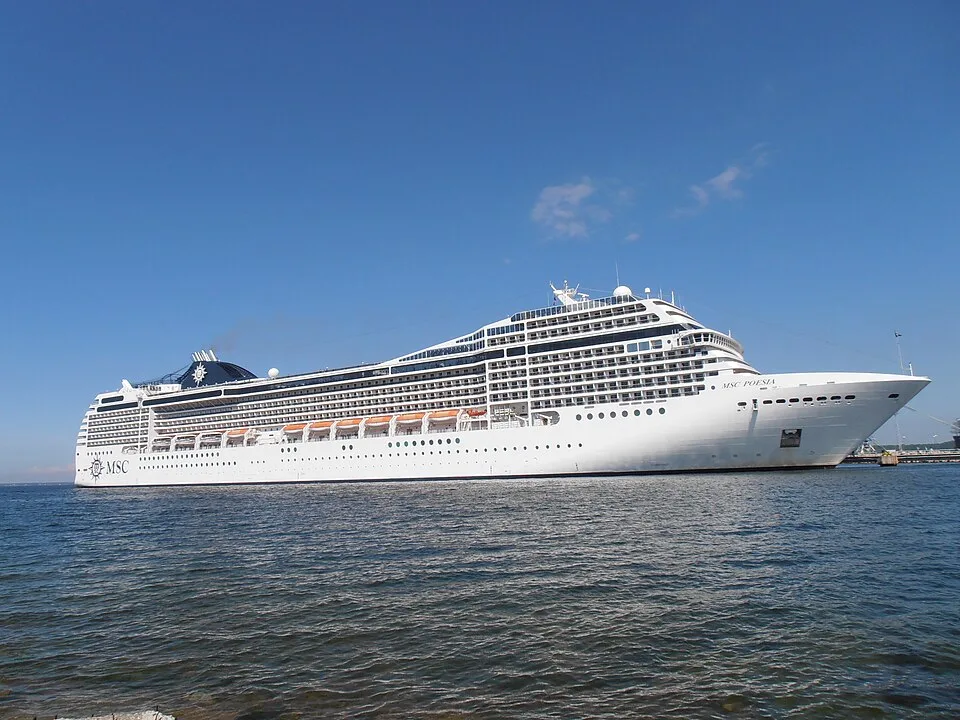
MSC Poesia is the Musica-class ship MSC sent to America. Aker Yards delivered her at Saint-Nazaire in 2008 at 92,627 gross tons, and she was christened at Dover on April 5 that year by Sophia Loren, the first MSC ship ever named outside Italy, which at the time was a statement about where the company thought it was going. Eighteen years later she is the only one of the line’s twelve older hulls based on the western side of the Atlantic, and the only one of her four sisters to have been given a Yacht Club.
That refit, a yard period in the spring of 2026, is the thing that changes her. The gated suite complex that the Fantasia class introduced in 2008 is now retrofitted into a 964-foot hull carrying 2,550 guests at double occupancy, which is a much better ratio than it enjoys on the bigger ships. If the Yacht Club is worth paying for anywhere in this fleet, it is on the smallest ship that has one.
What she is like
The Musica-class layout: a three-deck atrium around a waterfall, a glass staircase, thirteen passenger decks, 1,275 cabins. She is small by 2026 standards, a third the tonnage of the ships Royal Caribbean sends to Alaska from Seattle, and on the Inside Passage that is a straightforward advantage. Smaller ships get better berths, shorter gangway waits and a less overwhelmed town at the other end.
She is not a new ship and does not pretend to be. There is no waterpark, no ropes course and no ice rink. There is a theater, a casino, a spa, several restaurants and a lot of deck.
She has form for incident. She grounded on a reef in the Bahamas in 2012, broke her moorings at Kiel in a gale in 2013, and made contact with sister ship MSC Orchestra at Buenos Aires in 2019. None of it was serious and none of it is a reason to avoid her; a hull that has been working continuously for eighteen years across four oceans accumulates a record.
Where she actually sails
Two seasons, and they are properly different from one another.
Alaska, May through September, out of Seattle. Seven-night departures every week of the season, running the standard Inside Passage week: Ketchikan, Juneau, Icy Strait Point, Victoria on the way home, and Tracy Arm Fjord on nearly all of them, with Endicott Arm and the Dawes Glacier substituting on a handful. Sitka barely appears at all. It is a conventional Seattle Alaska week, sailed by an unconventional operator.
Miami, October through April, and this is the unusual half. Almost none of it is a week. The schedule is built on ten-, eleven-, twenty- and twenty-one-night Caribbean voyages, a run of twenty-one-night “Caribbean & Bahamas” departures, more twenty-one-night circuits around the Southern and Western Caribbean, and a scattering of tens and elevens. A five-night sailing is a rarity on her calendar. Ocho Rios comes up most often, then Colón and Cartagena, then Belize City, Puerto Limón and Roatán, with Oranjestad, Willemstad, Kralendijk and George Town behind them.
That is not how Miami usually works. The Florida market is built on seven-night weeks, and MSC is instead selling this ship as a long-cruise product, three weeks aboard, deep into the Southern and Western Caribbean, at a European price. It is the most distinctive deployment among the twelve.
Between the two she transits the Panama Canal, north and south, on repositioning voyages of fourteen to twenty-nine nights, calling at Cartagena, Colón, Puntarenas, Huatulco, Cabo San Lucas, Los Angeles and San Diego. A handful of them, sold as Panama Canal itineraries or MSC Grand Voyages, and a twenty-nine-night Miami-to-Seattle run is the longest thing she does.
Who she suits
Retired travelers with time. The Miami program is close to unique in that market: if you want three weeks in the Caribbean rather than one, on a mid-sized ship, without paying a luxury-line fare, there is very little competing with her. The Panama Canal legs are the same argument in a different shape.
Alaska suits anyone who would rather not be one of five thousand. Seattle, seven nights, a ship of 2,550 at double occupancy, and a Yacht Club now aboard for anyone who wants a quiet forward end and a private sun deck at 58 degrees north.
She does not suit families, and the Miami schedule makes that obvious; a twenty-one-night Caribbean voyage in November is not a school-holiday product and is not priced or programmed like one. She is the wrong ship for anyone expecting an American mass-market experience: MSC’s service style, dining timings, drinks policy and multilingual announcements come with the ship whichever ocean she is in. And on the Alaska weeks she is an eighteen-year-old hull with limited indoor public space for a route where it rains; check the forecast before assuming the sea days will be spent outside.