MSC Cruises
MSC Musica
The ship that started MSC's growth years, still running the same weekly Mediterranean loop
Sailings Available
419
Ports Visited
27
Next Departure
Nov 16, 2026
Trip Length
3–25 nights
Now Booking
Sailings Aboard MSC Musica
MSC Cruises
4-Night South America from Santos
4 Nights
Nov 16, 2026 • departs Santos
MSC Cruises
3-Night South America from Santos
3 Nights
Nov 20, 2026 • departs Santos
MSC Cruises
4-Night South America from Santos
4 Nights
Nov 26, 2026 • departs Santos
MSC Cruises
3-Night South America from Santos
3 Nights
Nov 30, 2026 • departs Santos
MSC Cruises
3-Night South America from Santos
3 Nights
Dec 3, 2026 • departs Santos
MSC Cruises
4-Night South America from Santos
4 Nights
Dec 13, 2026 • departs Santos
MSC Cruises
7-Night South America from Santos to Itajai
7 Nights
Dec 20, 2026 • departs Santos
MSC Cruises
6-Night South America from Santos to Paranaguá
6 Nights
Dec 20, 2026 • departs Santos
MSC Cruises
7-Night South America from Rio de Janeiro
7 Nights
Dec 22, 2026 • departs Rio de Janeiro
MSC Cruises
7-Night South America from Paranaguá
7 Nights
Dec 26, 2026 • departs Paranaguá
MSC Cruises
7-Night South America from Itajai
7 Nights
Dec 27, 2026 • departs Itajai
MSC Cruises
7-Night South America from Rio de Janeiro
7 Nights
Dec 29, 2026 • departs Rio de Janeiro
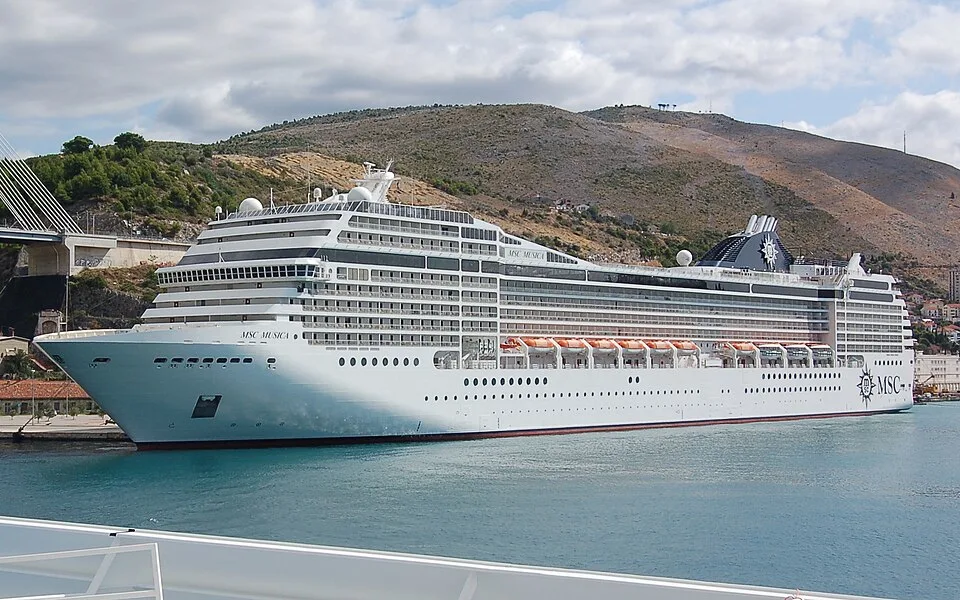
MSC Musica is where MSC Cruises stopped being a small Mediterranean operator. Chantiers de l’Atlantique delivered her at Saint-Nazaire in 2006 at 92,409 gross tons, nearly double anything the line had run before, and she was the first of four sisters that arrived at roughly one a year through 2010, by which point MSC had gone from a curiosity to the largest privately held cruise company in the world. Sophia Loren christened her at Venice, beginning a run of MSC christenings that has not stopped since.
Twenty years on she is one of the smaller ships in a fleet that now includes 215,000-ton hulls, and that is the most useful thing about her.
What she is like
The atrium. Three decks of it, built around a waterfall, crossed by a glass staircase, with a grand piano on a platform in the middle. It is the Musica-class signature and it is the room that dates the ship in the best way, a 2006 idea of elegance, executed properly, rather than a 2026 idea of a shopping street.
The numbers. 1,275 cabins and 2,550 guests at double occupancy on a 964-foot hull. That is roughly half what MSC’s World-class ships carry, and it shows in every queue on the ship: the buffet at eight, the tender line, the theater at nine, the gangway on a port morning. She has no water park, no ropes course, no eleven-deck slide and no Yacht Club. What she has is far fewer people.
No Yacht Club. Worth stating plainly, because three of her four sisters have either gained one or are getting one and she has not. On Musica, the top of the ship is open to everybody.
Where she actually sails
Overwhelmingly one thing, with one long interruption.
The Western Mediterranean week is very nearly all she does. Seven nights, sold at once from Genoa, Marseille, Valencia, Civitavecchia and Palermo, with Ibiza as the sixth call, the five homeports sharing it evenly between them, and it runs season into season with no break. Marseille, Valencia, Genoa and Civitavecchia come round on essentially every sailing, Palermo on nearly all of them and Ibiza on most. It is the same loop every week, and MSC simply sells it from whichever end you live nearest.
November to March she crosses to Brazil, and this is the part of her schedule worth planning around. Not the short Santos weekend runs that MSC puts on some of its other hulls, a proper seven-night coastal week, sold from Rio de Janeiro, Itajaí and Paranaguá, calling at Buzios, Ilha Grande, Ilhabela and Santos. The three homeports split it evenly, plus a handful of three- and four-night Santos runs at the shoulders. It is the only southern season on her calendar and it does not come round again the following winter.
The crossings either side are sold as MSC Grand Voyages of fourteen to seventeen nights, Genoa or Marseille to Santos and Rio in the autumn and the reverse in April, by way of Lisbon, the Canaries and Salvador. A few of them, each running once.
There is one loose end. In one autumn she appears with departures from Lisbon as well as her usual five Mediterranean ports, and then the calendar stops until the spring. She does not go back to Brazil, and nothing else is filed for that winter, so if the South American week is what you want from this ship, expect a single season of it and book it when you see it.
Who she suits
People who want the Mediterranean and would rather not share it with six thousand others. That is the honest case for the Musica class in 2026: same sea, same ports, same line, half the ship. A Genoa or Marseille week on her is one of the cheapest ways to see the Western Med from a European port.
The Brazilian season suits anyone who can be in Rio in January. Seven nights down the coast on a European ship with a mostly Brazilian passenger list is a very different and much warmer holiday than the same ship does in the Med, and the ports (Buzios, Ilha Grande, Ilhabela) are the good ones rather than the industrial ones.
She does not suit families looking for a ship to entertain the children. There is a pool, a theater and a kids’ club, and that is close to the whole inventory; the teenagers will be bored by day three. She is not the ship for anyone who wants a suite experience either, since she has no gated complex and her top-category cabins are simply larger rooms. And a warning about the Western Med loop specifically: with essentially her whole European calendar on one itinerary, this is the definition of a repeated product. Sail her twice and you will see Ibiza twice.
Photo: Bahnfrend · CC BY-SA 3.0 (share-alike) · Re-encoded to WebP.