MSC Cruises
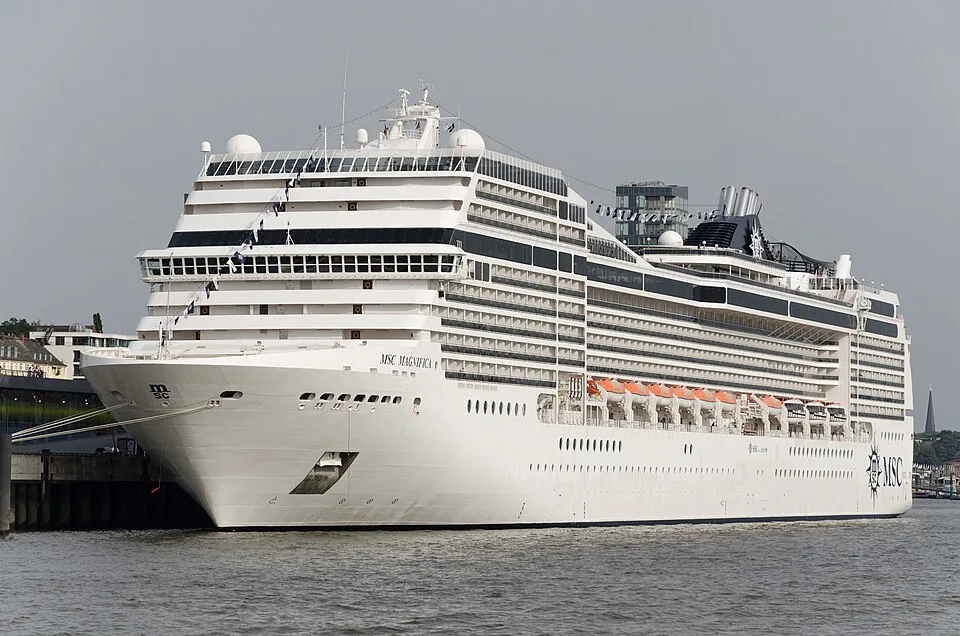
MSC Magnifica
The modified fourth Musica-class ship, and the one MSC sends around the world
Sailings Available
287
Ports Visited
107
Next Departure
Nov 5, 2026
Trip Length
4–132 nights
Now Booking
Sailings Aboard MSC Magnifica
MSC Cruises
8-Night Mediterranean from Tarragona to Barcelona
8 Nights
Nov 5, 2026 • departs Tarragona
MSC Cruises
5-Night Mediterranean from Genoa to Barcelona
5 Nights
Nov 8, 2026 • departs Genoa
MSC Cruises
7-Night Mediterranean from Genoa
7 Nights
Nov 8, 2026 • departs Genoa
MSC Cruises
7-Night Mediterranean from Naples
7 Nights
Nov 9, 2026 • departs Naples
MSC Cruises
7-Night Mediterranean from Barcelona
7 Nights
Nov 13, 2026 • departs Barcelona
MSC Cruises
7-Night Mediterranean from Marseille
7 Nights
Nov 14, 2026 • departs Marseille
MSC Cruises
4-Night Mediterranean from Naples to Barcelona
4 Nights
Nov 30, 2026 • departs Naples
MSC Cruises
6-Night Mediterranean from Naples to Genoa
6 Nights
Nov 30, 2026 • departs Naples
MSC Cruises
4-Night Mediterranean from Barcelona
4 Nights
Dec 4, 2026 • departs Barcelona
MSC Cruises
10-Night Mediterranean from Genoa
10 Nights
Dec 6, 2026 • departs Genoa
MSC Cruises
10-Night Mediterranean from Marseille
10 Nights
Dec 7, 2026 • departs Marseille
MSC Cruises
10-Night Mediterranean from Barcelona
10 Nights
Dec 8, 2026 • departs Barcelona
MSC Magnifica is the fourth Musica-class ship and the one that is not quite a sister. STX Europe delivered her at Saint-Nazaire in 2010, four years after MSC Musica and two after MSC Poesia, and by then MSC had learned enough from the first three to change the drawings. She is 95,128 gross tons against their 92,400 or so, 981 feet long against 964, and 113 feet in the beam against 106. She is usually filed as a modified Musica class, and that is the right description: same family, larger boat.
Sophia Loren christened her at Hamburg on March 6, 2010, the second MSC ship after Poesia to be named outside Italy.
What the extra size bought
Seventeen more feet of length and seven more of beam do not sound like much until you consider that they are all in the middle of the ship. The public rooms are wider, the promenade is broader, and the restaurant decks carry a comparable number of guests with more space to do it in. She has the Musica-class atrium and its glass staircase, the same theater and casino, thirteen passenger decks, and 1,027 crew.
She is a very different proposition from a modern MSC flagship: no gated Yacht Club, no waterpark, no eleven-deck slide. What she has instead is a hull that is comfortable to be on for a long time, which is precisely the job MSC gives her.
Where she actually sails
She is the fleet’s long-distance ship, and her schedule is built around two circumnavigations.
The world cruise runs every January. It is sold from Genoa, Marseille, Civitavecchia and Barcelona at once, at 115 to 121 nights depending on which of them you join, and it goes both ways round the world: the Panama Canal appears on twenty of her sailings, Cape Horn and Ushuaia on fourteen, with Papeete, Sydney, Hobart, Valparaíso, Buenos Aires and Rio de Janeiro along the way. She does it in January 2027 and again in January 2028. The longest single voyage on her calendar runs 132 nights.
Attached to the 2027 circumnavigation are two sectors sold separately: seventy-one nights from Civitavecchia to Sydney, and fifty nights from Sydney back to Civitavecchia in March. If four months is too much, those are the way in.
Summers, when she is not going round the world, are the Baltic. Seven-night weeks out of Warnemünde and Copenhagen calling at Gdynia, Klaipėda, Riga and Stockholm, sixty-six calls at each of those three ports, with fourteen-night versions reaching Tallinn, Helsinki and the Norwegian coast at Bergen, Eidfjord, Sandnes and Kristiansand. There are also one-way crossings between Oslo and Stockholm at six to nine nights, seventeen of them, which are the pick of her northern program. She runs the Baltic from August to October 2026 and again from May to October 2027.
Autumns and winters are the Western Mediterranean. Seven-night circuits from Genoa, Marseille, Civitavecchia, Tarragona and Valencia with La Spezia as a call, and ten-night versions that run west to Málaga, Cádiz, Alicante and Casablanca. In 2028 she stays in the Med for the summer as well, from April through October, and skips the Baltic entirely.
The consequence of a January world cruise is that she vanishes from the ordinary schedule for a third of each year. There is nothing bookable on her between January and May 2027 except the circumnavigation and its two Australian sectors, and nothing between January and April 2028 at all. If you want a normal week on this ship, it has to be in the second half of the year.
Who she suits
Anyone shopping for a world cruise on a budget. That is the headline and it is a real one, a four-month circumnavigation on a mid-sized ship with a European passenger list, sold from four Mediterranean ports, undercuts every other world cruise on the market by a wide margin. If you have the time and not the budget of a Cunard or Viking guest, she is the ship.
The Baltic weeks are the second good reason. Gdynia, Klaipėda and Riga are places most Baltic itineraries skip in favor of St Petersburg’s replacement ports, and a seven-night loop that treats them as the destination rather than filler is unusual.
She does not suit anyone who wants a modern ship. She is sixteen years old, there is no Yacht Club to buy your way out of the crowd, and 132 nights is a long time in a cabin designed in 2008. The world cruise in particular is a commitment to a specific kind of company; the passenger list skews old, European and repeat, and the onboard program is lectures and ballroom rather than production shows. And anyone booking her Mediterranean weeks should know they are the same weeks MSC Musica and MSC Orchestra run from the same ports; on that itinerary there is nothing she does that they do not.
Photo: ChristianSchd · CC BY-SA 4.0 (share-alike) · Re-encoded to WebP.