MSC Cruises
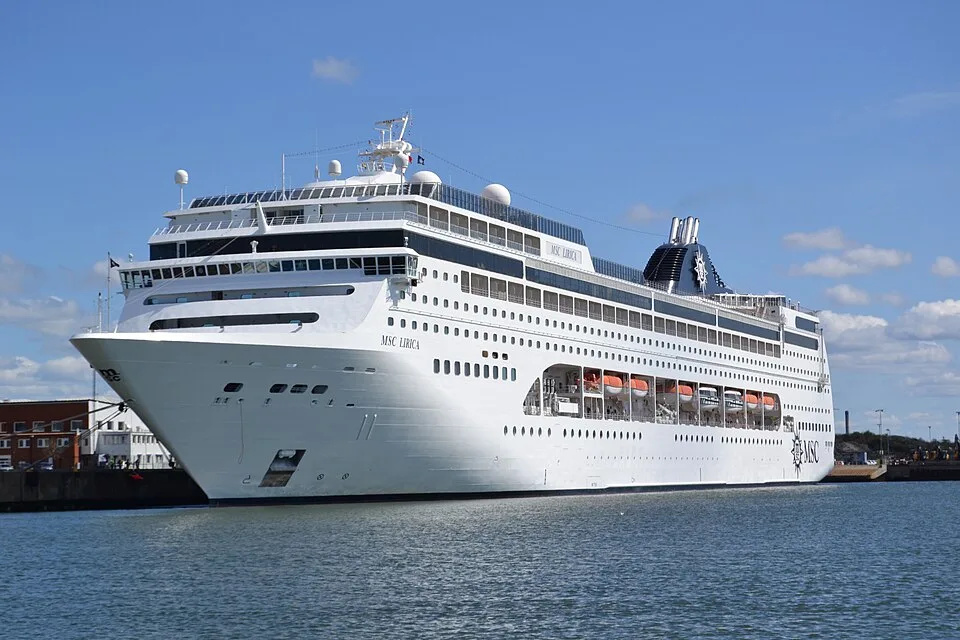
MSC Lirica
MSC's first newbuild, last of the four to be lengthened, and the one that still sails to Alexandria
Sailings Available
257
Ports Visited
24
Next Departure
Sep 25, 2026
Trip Length
3–13 nights
Now Booking
Sailings Aboard MSC Lirica
MSC Cruises
7-Night Mediterranean from Ancona
7 Nights
Sep 25, 2026 • departs Ancona
MSC Cruises
7-Night Eastern Mediterranean from Venice - Marghera
7 Nights
Sep 26, 2026 • departs Venice - Marghera
MSC Cruises
12-Night Mediterranean from Ancona to Venice - Marghera
12 Nights
Oct 23, 2026 • departs Ancona
MSC Cruises
11-Night Mediterranean from Venice - Marghera
11 Nights
Oct 24, 2026 • departs Venice - Marghera
MSC Cruises
10-Night Mediterranean from Venice - Marghera to Split
10 Nights
Nov 4, 2026 • departs Venice - Marghera
MSC Cruises
11-Night Mediterranean from Split
11 Nights
Nov 14, 2026 • departs Split
MSC Cruises
11-Night Mediterranean from Venice - Marghera
11 Nights
Nov 15, 2026 • departs Venice - Marghera
MSC Cruises
10-Night Mediterranean from Split
10 Nights
Dec 6, 2026 • departs Split
MSC Cruises
10-Night Mediterranean from Venice - Marghera
10 Nights
Dec 7, 2026 • departs Venice - Marghera
MSC Cruises
12-Night Mediterranean from Venice - Marghera to Bari
12 Nights
Dec 28, 2026 • departs Venice - Marghera
MSC Cruises
7-Night Mediterranean from Bari
7 Nights
Jan 9, 2027 • departs Bari
MSC Cruises
4-Night Eastern Mediterranean from Bari to Istanbul
4 Nights
Jan 9, 2027 • departs Bari
MSC Lirica is where MSC Cruises stopped buying other people’s ships. Every vessel the line ran before her had been secondhand: Italian ferries, Festival Cruises castoffs, older tonnage bought cheap. She was ordered new from Chantiers de l’Atlantique at Saint-Nazaire, christened in March 2003, and gave her name to the three that followed her. Everything MSC has built since, up to and including the 215,000-ton World class, descends from the decision to order this hull.
She is now the smallest kind of ship MSC still operates, and she is not the ship that was delivered in 2003.
Last through the yard
The Renaissance Programme ran through 2014 and 2015 and put all four Lirica-class ships through Fincantieri’s yard at Palermo to be cut in half and lengthened. Armonia went first in the autumn of 2014, Sinfonia in the winter, Opera in early summer 2015, and Lirica, the lead ship, went last, from August 31 to November 4, 2015.
There is a logic to the order. MSC put its two ex-Festival hulls through first, the ones it had paid least for, and only committed its own first newbuild once the operation had been proved three times. She came out 274.9 meters long against 251.25, with a 24-meter midsection carrying 193 cabins, and 65,591 gross tons against 59,058.
Nothing else about her changed. She is still 94 feet in the beam, still nine passenger decks, still 21 knots, still a small ship by any measure MSC now uses. That narrowness is the whole reason she is useful: she goes into ports where a Fantasia-class hull cannot turn around.
Where she actually sails
She is an Adriatic and Aegean ship for most of the schedule, and the pattern is seasonal in a way the rest of the fleet’s is not.
April to October she runs a seven-night circuit from Venice-Marghera and Ancona. Ancona sells a few more of them than Venice does. The remarkable port is Mykonos: it comes up on more of her weeks than either of the two she sails from, which is not something you can say about many ships. Kotor and Syros follow, a long way back. It is a Greek-island week that happens to start in Italy.
November and December she moves to eleven-night runs, and these are the ones worth planning a year around. From Venice-Marghera and Split she goes to the eastern end of the Mediterranean: Port Said, Alexandria and Heraklion on essentially all of them, Limassol and Rhodes on nearly as many. Egypt from a European port on a European ship is a scarce product, and there is only a short season of it here.
In the depths of one winter she works Bari, Istanbul and Piraeus on seven-night Aegean circuits, and in another she goes west entirely, running a seven-night Western Mediterranean loop sold from Barcelona, Civitavecchia, Genoa, Marseille and Valencia with Livorno as a call. That western block is the densest stretch on her calendar and the only one where she leaves the eastern Mediterranean behind.
She then returns to Ancona and Venice-Marghera in the spring and runs the seven-night circuit through to November.
Worth noting where “Venice” is on her tickets. Every departure reads Venice-Marghera, the container and industrial port on the mainland, not the Stazione Marittima in the city, the consequence of the 2021 ban on large ships in the Giudecca Canal, itself a consequence of her sister MSC Opera hitting a moored river boat there in 2019. Marghera works, but it is a bus ride from anywhere you actually want to be, and a Venice embarkation is no longer the walk-on-from-the-city experience it was when this ship was new.
Who she suits
Anyone who wants the Greek islands from an Italian port at the lowest price available. Ancona and Venice-Marghera are both easy to reach overland from central and northern Europe, and the week is genuinely island-heavy rather than port-city-heavy.
The Egypt weeks are the reason to look at her specifically. Alexandria and Port Said on an eleven-night run out of Venice, with Cyprus and Rhodes attached, is an itinerary very few ships offer and almost none offer at this price.
She does not suit anyone who wants space. She is the smallest MSC ship on this list, the lengthening put 193 more cabins into a hull whose public rooms were sized for the original passenger count, and a full summer sailing is crowded in a way the tonnage does not warn you about. She is twenty-three years old with no Yacht Club, no waterpark and a modest cabin standard. And the Mykonos-heavy summer week has an obvious drawback: you will be in the most crowded port in the Aegean, in July, alongside everyone else. Take the November Egypt run instead if that sounds like the wrong holiday.
Photo: Bo Randstedt · CC BY-SA 3.0 (share-alike) · Re-encoded to WebP.