MSC Cruises
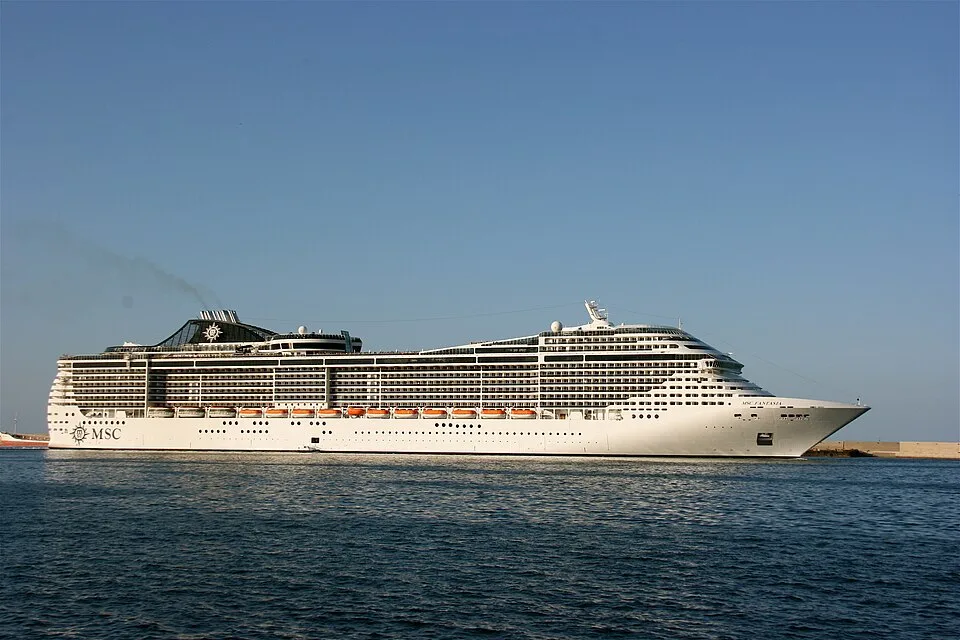
MSC Fantasia
The first ship anywhere to carry a Yacht Club, and MSC's busiest hull in the Mediterranean
Sailings Available
552
Ports Visited
27
Next Departure
Nov 7, 2026
Trip Length
3–13 nights
Now Booking
Sailings Aboard MSC Fantasia
MSC Cruises
9-Night Mediterranean from Bari
9 Nights
Nov 7, 2026 • departs Bari
MSC Cruises
9-Night Mediterranean from Trieste
9 Nights
Nov 8, 2026 • departs Trieste
MSC Cruises
6-Night Mediterranean from Piraeus to Trieste
6 Nights
Nov 11, 2026 • departs Piraeus
MSC Cruises
4-Night Mediterranean from Istanbul to Trieste
4 Nights
Nov 13, 2026 • departs Istanbul
MSC Cruises
8-Night Canary Islands and Madeira from Civitavecchia to Funchal
8 Nights
Dec 7, 2026 • departs Civitavecchia
MSC Cruises
10-Night Canary Islands and Madeira from Civitavecchia to Arrecife de Lanzarote
10 Nights
Dec 7, 2026 • departs Civitavecchia
MSC Cruises
11-Night Canary Islands and Madeira from Civitavecchia to Las Palmas de G.Canaria
11 Nights
Dec 7, 2026 • departs Civitavecchia
MSC Cruises
6-Night Canary Islands and Madeira from Civitavecchia to Santa Cruz de Tenerife
6 Nights
Dec 7, 2026 • departs Civitavecchia
MSC Cruises
7-Night Canary Islands and Madeira from Santa Cruz de Tenerife
7 Nights
Dec 13, 2026 • departs Santa Cruz de Tenerife
MSC Cruises
7-Night Canary Islands and Madeira from Funchal
7 Nights
Dec 15, 2026 • departs Funchal
MSC Cruises
7-Night Canary Islands and Madeira from Arrecife de Lanzarote
7 Nights
Dec 17, 2026 • departs Arrecife
MSC Cruises
7-Night Canary Islands and Madeira from Las Palmas de G.Canaria
7 Nights
Dec 18, 2026 • departs Las Palmas
MSC Fantasia is the ship that invented the most copied idea in the modern cruise business. STX France delivered her at Saint-Nazaire in December 2008 at 137,936 gross tons, at the time the largest passenger ship ever built for a European owner, and she carried something nobody else had put to sea: a gated suite complex, with its own restaurant, lounge, pool deck and butlers, sealed off behind a key card at the forward end of the top decks. MSC called it the Yacht Club. Every line that now sells a ship-within-a-ship, under whatever name, is following a template this hull established.
She remains the busiest of the older MSC ships on the current schedule, and every departure on it is in Europe.
What separates her from her sisters
She is the original. Splendida is her identical twin; Divina and Preziosa came four years later, longer on cabins and rearranged inside. What Fantasia has that they do not is the first working version of the Yacht Club concept, which on a hull carrying 3,274 guests at double occupancy is the difference between a crowded week and a quiet one. The complex is small, a few dozen suites, and it books out early, which tells you what it is worth.
The atrium. Two Swarovski crystal staircases run up through the middle of the ship, and they are exactly as much as that sounds like. MSC in 2008 was building for a European market that wanted visible glamour, and the interiors have not been sanded down since.
Sophia Loren. She christened Fantasia at Naples in December 2008 and went on to christen most of the fleet after her, including all three of this ship’s sisters. It is the single most consistent piece of MSC branding there is.
Where she actually sails
Two seasons, each sold the way MSC sells everything, which takes a moment to follow: the same weekly circuit goes on sale from every port it touches, and you board wherever suits you.
Summer, April to October, is the Western Mediterranean. One seven-night loop, sold simultaneously out of Civitavecchia, Barcelona, Livorno, Cagliari and Cannes, with Ibiza as the sixth call. It goes round week after week from all five of them, and it is by a wide margin the largest single thing on her calendar. Rome, Barcelona, Florence, Sardinia, the Côte d’Azur and Ibiza in one week, with a night at sea and no long crossings.
Winter, December to March, is the Canaries and Madeira. Another seven-night loop, this one sold out of Arrecife de Lanzarote, Santa Cruz de Tenerife, Las Palmas and Funchal, calling additionally at Fuerteventura and Santa Cruz de la Palma. She does not come home to the Med for the winter; she stays in the Atlantic and works the islands. A handful of one-way legs of six to thirteen nights connect Civitavecchia to the Canaries at each changeover, and those are the only repositioning voyages she offers.
There is one block that fits neither pattern. For a single late-summer stretch she is in the Adriatic and Aegean instead, running nine-night circuits sold from Trieste, Bari, Piraeus and Istanbul, with Corfu, Katakolon and Kusadasi on the way. A short run of departures, and then she goes to the Canaries and does not return to that program.
Who she suits
Anyone who wants a large, well-equipped ship in the Mediterranean at a European price. The five-port structure is the real argument: if you live within reach of Barcelona, Rome, Livorno, Cagliari or Cannes, you can drive or take a short flight and skip the transatlantic airfare entirely, and the fare is often less than half what an American line charges for the same sea in the same week.
The Canaries winter is the other case for her. Seven nights of island-hopping in January at 20 degrees, with almost no sea time, is a genuinely scarce product and she is one of very few big ships that does it as a scheduled weekly circuit rather than a one-off.
She does not suit anyone who wants a new ship. She is coming up on twenty years old, the design is pre-waterpark and pre-ropes-course, and the entertainment is the theater, the casino and the bars rather than a slide falling eleven decks, book MSC World Europa if that is what you are after. She is also a poor match for a first-time cruiser expecting an American ship: the announcements run through five or six languages, the passenger list is largely Italian, Spanish, French and German, the dining is early or late seating rather than anytime, and drinks are not included unless you buy a package. And on a Western Med week she calls at the big industrial cruise ports, not the small pretty ones; Civitavecchia is not Rome, and the coach ride is ninety minutes each way.
Photo: Matthias Süßen · CC BY 3.0 · Re-encoded to WebP.