MSC Cruises
MSC Euribia
The fleet's second LNG ship, with a hull painted by a competition winner and a summer in the Norwegian fjords
Sailings Available
363
Ports Visited
24
Next Departure
Sep 20, 2026
Trip Length
3–14 nights
Now Booking
Sailings Aboard MSC Euribia
MSC Cruises
7-Night Northern Europe from Copenhagen
7 Nights
Sep 20, 2026 • departs Copenhagen
MSC Cruises
7-Night Northern Europe from Kiel
7 Nights
Sep 26, 2026 • departs Kiel
MSC Cruises
7-Night Northern Europe from Copenhagen
7 Nights
Sep 27, 2026 • departs Copenhagen
MSC Cruises
7-Night Northern Europe from Kiel
7 Nights
Oct 3, 2026 • departs Kiel
MSC Cruises
7-Night Northern Europe from Copenhagen
7 Nights
Oct 4, 2026 • departs Copenhagen
MSC Cruises
12-Night Northern Europe from Kiel to Genoa
12 Nights
Oct 10, 2026 • departs Kiel
MSC Cruises
10-Night Northern Europe from Kiel to Barcelona
10 Nights
Oct 10, 2026 • departs Kiel
MSC Cruises
11-Night Northern Europe from Kiel to Marseille
11 Nights
Oct 10, 2026 • departs Kiel
MSC Cruises
9-Night Northern Europe from Copenhagen to Barcelona
9 Nights
Oct 11, 2026 • departs Copenhagen
MSC Cruises
11-Night Northern Europe from Copenhagen to Genoa
11 Nights
Oct 11, 2026 • departs Copenhagen
MSC Cruises
10-Night Northern Europe from Copenhagen to Marseille
10 Nights
Oct 11, 2026 • departs Copenhagen
MSC Cruises
4-Night Western Mediterranean from Barcelona
4 Nights
Oct 20, 2026 • departs Barcelona
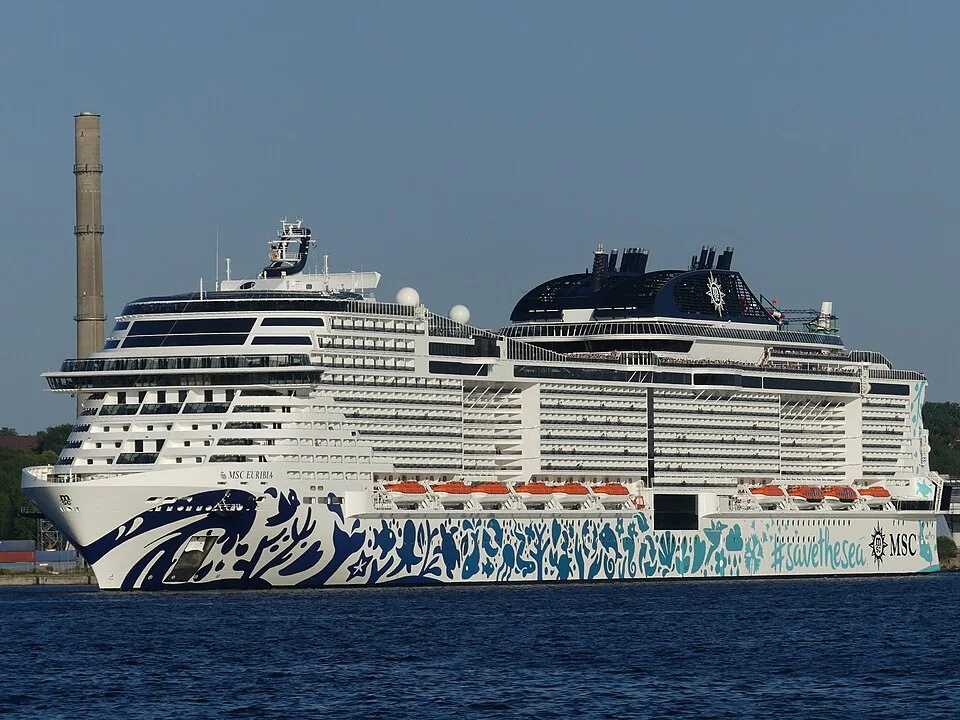
MSC Euribia is the heaviest of the Meraviglia Plus ships at 184,011 gross tons and the only one that does not burn oil. Chantiers de l’Atlantique delivered her on May 31, 2023 as the second liquefied-natural-gas vessel in the fleet after MSC World Europa, and MSC took her to Copenhagen to be christened on June 8 with Sophia Loren standing as godmother, the same godmother as most of this fleet, and a fitting choice for a ship named after a Greek goddess invoked for safe passage.
She is also the only ship here whose paint job was crowdsourced. MSC ran a design competition in October 2021 and the winning entry, by the German designer Alex Flämig, went onto the hull as a full-length marine mural under the line’s “#savethesea” campaign. It looks better in person than it sounds.
Under the artwork she is a Meraviglia Plus: the stretched 331-meter hull, the long Galleria promenade running through the middle under a continuous LED sky screen, and a large gated Yacht Club forward with its own restaurant, lounge, pool and butler service.
What she is known for
The gas. LNG cuts sulfur emissions to effectively nothing and takes most of the nitrogen oxides and particulates with them. In the Norwegian fjords, where national and local rules on emissions in the world heritage waters have been tightening for years, that is what allows a ship this size to keep going up Geirangerfjord at all.
The Galleria. The LED-roofed indoor street. On a Baltic or Norwegian week in shoulder season it is the most useful space aboard, and it is the reason to pick this class over an open-deck Seaside hull for a northern itinerary.
The hull. Unmistakable at a distance, which on a fleet of white ships is worth something.
The Yacht Club. Gated forward with its own restaurant, lounge, pool and sun deck, a butler for each suite and drinks included inside the gates. The stretched Plus hulls carry a larger version than the original Meraviglia ships do. On a Norwegian week where the weather decides how much of the ship is usable, a private indoor lounge with a view forward is worth more than the same money buys in the Caribbean.
Cirque du Soleil. The Carousel Lounge, the small purpose-built theater-in-the-round MSC developed with Cirque du Soleil, is part of the class. Two shows a cruise, dinner option available, and the room is deliberately small.
The dining and the fare tiers. Included main dining rooms and a buffet, with the fleet specialty rooms above them, a steakhouse, a sushi and teppanyaki room, a taco and tequila bar. The same cabin sells at three prices: Bella with the room assigned, Fantastica with your choice plus room-service breakfast and flexible dining, Aurea adding a thermal-spa pass, priority boarding and a drinks package. Drinks, wi-fi, specialty dining and gratuities are otherwise extra, which is how the lead-in fare gets as low as it does.
Where she actually sails
Two seasons, split almost exactly in half, with everything filed under Europe, a schedule years deep in which not one departure leaves the continent.
Summers are the fjords, from two German and Danish bases: Kiel and Copenhagen in equal measure, all seven nights. The Norwegian ports are the good ones, Flåm and Hellesylt on every one of those weeks, Ålesund on nearly all of them, Geirangerfjord on most and Molde on a rare few. That program runs roughly May through September.
Winters are the Western Mediterranean, and this is the larger half because MSC sells the same week from five ports at once: Marseille, Genoa and Barcelona a little ahead, Palermo and Naples just behind. La Goulette, for Tunis, is on the great majority of those weeks, which puts her on the North African circuit rather than the Balearic one. Add a few four-night short breaks out of Barcelona, Genoa and Marseille and a handful of departures from Tarragona.
The two seasons are joined by repositioning runs of nine to fourteen nights, Kiel or Copenhagen to Barcelona, Genoa, Marseille or Tarragona and back, calling at Amsterdam, Cherbourg, La Rochelle, Bilbao, La Coruña, Gibraltar, Cádiz and Málaga. Those are among the more interesting sailings on her calendar and there are never many of them.
Who she suits
Anyone in northern Europe who wants the Norwegian fjords on a large modern ship at MSC’s prices, and anyone in the western Mediterranean who wants Tunis on the itinerary. The Kiel and Copenhagen bases are unusually convenient for German and Scandinavian passengers, which is the point of them, and a fjord week here undercuts most of the competition on the same water.
The repositioning runs deserve a second mention, because they are the most interesting sailings on her calendar and almost nobody looks for them. Nine to fourteen nights, Copenhagen or Kiel to Barcelona, Genoa, Marseille or Tarragona, down the Atlantic coast through Amsterdam, Cherbourg, La Rochelle, Bilbao and La Coruña, then through the Strait with Gibraltar, Cádiz and Málaga on the way in. That is a genuinely varied itinerary sold at repositioning prices, and it comes round only at the two changeovers each year.
She is a poor fit for an American traveler flying in. The passenger list is heavily German, Italian and French, the announcements are multilingual and there are several of them, the service style is more formal than a US crew’s, and neither summer homeport is a straightforward connection from the United States; Kiel means a train from Hamburg, Copenhagen means a connection.
She is also, with well over four thousand guests aboard, a very large ship for the fjords. The small Norwegian ports absorb her but they do not do it gracefully, and Flåm and Hellesylt in particular are villages taking a ship the size of a small town. Anyone booking Norway for an intimate experience should be looking at a much smaller vessel, and anyone booking it for the scenery should accept that they will be sharing the rail.
Nothing on her schedule is shorter than four nights and almost everything is seven, so she is not a short-break ship. And if what you want is a Mediterranean week with Spain and the Balearics on it rather than Tunisia, check the itinerary rather than the ship; La Goulette is on the great majority of her weeks.
Photo: MSC Euribia · CC BY-SA 4.0 (share-alike) · Re-encoded to WebP.