MSC Cruises
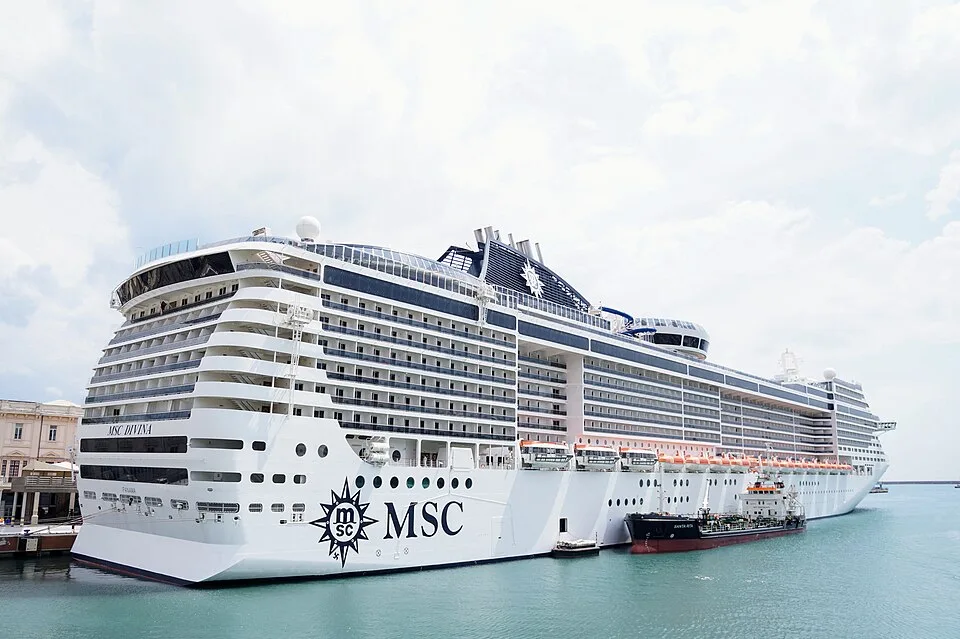
MSC Divina
Named for Sophia Loren, rebuilt inside from her sisters, and now a Turkish-homeport ship
Sailings Available
270
Ports Visited
27
Next Departure
Sep 21, 2026
Trip Length
3–22 nights
Now Booking
Sailings Aboard MSC Divina
MSC Cruises
7-Night Mediterranean from Kusadasi
7 Nights
Sep 21, 2026 • departs Kusadasi
MSC Cruises
7-Night Mediterranean from Naples
7 Nights
Sep 24, 2026 • departs Naples
MSC Cruises
7-Night Eastern Mediterranean from Civitavecchia
7 Nights
Sep 25, 2026 • departs Civitavecchia
MSC Cruises
4-Night Eastern Mediterranean from Kusadasi to Civitavecchia
4 Nights
Oct 26, 2026 • departs Kusadasi
MSC Cruises
21-Night MSC Grand Voyages from Kusadasi to Santos
21 Nights
Oct 26, 2026 • departs Kusadasi
MSC Cruises
18-Night MSC Grand Voyages from Naples to Santos
18 Nights
Oct 29, 2026 • departs Naples
MSC Cruises
17-Night MSC Grand Voyages from Naples to Rio de Janeiro
17 Nights
Oct 29, 2026 • departs Naples
MSC Cruises
17-Night MSC Grand Voyages from Civitavecchia to Santos
17 Nights
Oct 30, 2026 • departs Civitavecchia
MSC Cruises
3-Night Western Mediterranean from Civitavecchia to Tarragona
3 Nights
Oct 30, 2026 • departs Civitavecchia
MSC Cruises
16-Night MSC Grand Voyages from Civitavecchia to Rio de Janeiro
16 Nights
Oct 30, 2026 • departs Civitavecchia
MSC Cruises
13-Night MSC Grand Voyages from Civitavecchia to Salvador
13 Nights
Oct 30, 2026 • departs Civitavecchia
MSC Cruises
16-Night MSC Grand Voyages from Genoa to Santos
16 Nights
Oct 31, 2026 • departs Genoa
MSC Divina is the ship MSC named after a person. She was ordered as MSC Fantastica, following her sisters’ naming pattern, and renamed before delivery in tribute to Sophia Loren, la divina, who by 2012 had already christened Fantasia, Splendida, Musica, Orchestra, Poesia, Magnifica and Opera and who stood as godmother again when this one was named at Marseille on May 26, 2012. No other cruise line has tied itself to a single public figure this thoroughly, and Divina is where the connection stopped being a christening ritual and became the ship’s name.
STX France delivered her at Saint-Nazaire on May 19, 2012 at 139,072 gross tons. She and MSC Preziosa form the second pair of the Fantasia class, and they are not simply repeats of the first two.
What the redesign actually changed
Fantasia and Splendida carry 1,637 cabins. Divina and Preziosa carry 1,751 on the same 333-meter hull, 114 more, which is where the extra 1,136 gross tons and the jump from 3,274 to 3,502 guests at double occupancy comes from. The yard put in two additional elevators to move them and redesigned the restaurant decks to spread them out, which is the kind of change that does not show up in a brochure photograph and shows up immediately at eight in the morning on a port day.
The crew count went up with it, to 1,388, and the Yacht Club her eldest sister introduced in 2008 is aboard in its more developed form: gated suites forward across the top decks, private restaurant, private pool, butler service. It is still the strongest reason to book this class over a cheaper MSC ship.
Outside the gate, the ship sells in tiers rather than by cabin alone: Bella at the bottom, where the line assigns your cabin and you eat at the later seating; Fantastica in the middle, where you choose; Aurea at the top, with a reserved sun deck, a spa package and dining whenever you like. The advertised fare is always the Bella one. On a hull carrying 3,502 guests the step up to Aurea buys you somewhere to sit on a sea day, which on this class is not a trivial purchase.
Where she actually sails
She is an Eastern Mediterranean ship with a Brazilian winter, and the interesting part is where she picks people up.
The core is one seven-night loop, and it is unusual. Civitavecchia, Naples, Marmaris, Mykonos and Santorini, sold from three homeports at once, Rome, Naples and Marmaris. Civitavecchia, Naples and Marmaris come round every week, Mykonos on nearly all of them and Santorini on most, which tells you this is essentially a single circuit run over and over for a couple of years at a time. Marmaris being a full embarkation port rather than a shore excursion is the thing to notice: MSC is selling this week into Turkey as a domestic product, and a substantial share of the departures start there. Kusadasi does the same job for a smaller run of departures.
November to March she is in Brazil. Short runs out of Santos, three and four nights, with Buzios, Ilha Grande, Ilhabela, Salvador and Maceió. A brief season, and short by design; this is the Brazilian domestic weekend market, not a Caribbean-style week.
The crossings are sold separately. A handful of them, thirteen to nineteen nights, badged MSC Grand Voyages: Civitavecchia, Genoa, Naples, Barcelona or Tarragona out to Santos, Rio de Janeiro or Salvador in the autumn, and the reverse in March, calling at Tenerife, Las Palmas and Casablanca on the way. If you want a transatlantic on this ship, that is when.
Everything on her calendar is one of those three things. There is no Northern Europe season, no Caribbean, and no Western Mediterranean beyond the repositioning legs.
Who she suits
Anyone who wants the Greek islands without the Greek-island premium. Mykonos on nearly every week and Santorini on most of them is a serious commitment to two ports that most Mediterranean itineraries treat as an occasional highlight, and this is a large, comfortable, well-staffed ship doing it week in and week out.
She is also the obvious pick for anyone flying into Turkey or already there. Marmaris embarkation removes an Italian connection entirely.
She does not suit anyone who dislikes crowded ports. Santorini’s caldera in July with 3,500 people going ashore by tender is exactly what it sounds like, and the Mykonos call is the same problem with a pier. She is a poor match for travelers who want variety within a booking; this is one loop, and a second cruise on her in the same season sees the same five places. And the Brazilian season is a different product entirely: three-night runs out of Santos are a party market with a young Brazilian passenger list, and anyone booking it expecting the European week will be surprised.
Photo: René Cortin · CC BY-SA 4.0 (share-alike) · Re-encoded to WebP.