MSC Cruises
MSC Bellissima
MSC's ship for Asia, based in Shanghai and running four- and five-night weeks to Japan and Korea
Sailings Available
98
Ports Visited
18
Next Departure
Nov 21, 2026
Trip Length
3–13 nights
Now Booking
Sailings Aboard MSC Bellissima
MSC Cruises
4-Night Asia from Tokyo to Keelung
4 Nights
Nov 21, 2026 • departs Tokyo
MSC Cruises
6-Night Asia from Tokyo to Naha
6 Nights
Nov 21, 2026 • departs Tokyo
MSC Cruises
4-Night Asia from Keelung
4 Nights
Nov 25, 2026 • departs Keelung
MSC Cruises
5-Night Asia from Naha
5 Nights
Nov 27, 2026 • departs Naha
MSC Cruises
5-Night Asia from Keelung
5 Nights
Nov 29, 2026 • departs Keelung
MSC Cruises
4-Night Asia from Naha
4 Nights
Dec 2, 2026 • departs Naha
MSC Cruises
4-Night Asia from Keelung
4 Nights
Dec 4, 2026 • departs Keelung
MSC Cruises
4-Night Asia from Keelung
4 Nights
Jan 5, 2027 • departs Keelung
MSC Cruises
4-Night Asia from Naha
4 Nights
Jan 7, 2027 • departs Naha
MSC Cruises
6-Night Asia from Naha to Tokyo
6 Nights
Jan 11, 2027 • departs Naha
MSC Cruises
7-Night Asia from Keelung to Shanghai
7 Nights
Jan 13, 2027 • departs Keelung
MSC Cruises
4-Night Asia from Keelung to Tokyo
4 Nights
Jan 13, 2027 • departs Keelung
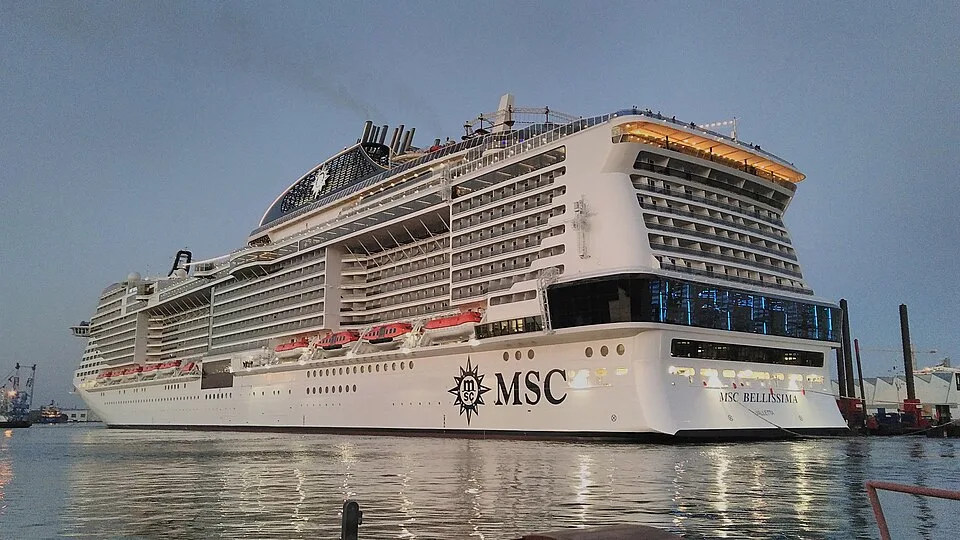
MSC Bellissima is the second Meraviglia-class ship and the one MSC sent east. Chantiers de l’Atlantique delivered her at Saint-Nazaire on February 27, 2019, Sophia Loren christened her at Southampton three days later, and after a short Mediterranean season and a winter in the Persian Gulf she went to Asia, which is where she has stayed. She is the line’s dedicated ship for the Chinese, Japanese and Taiwanese markets, and almost nothing about how she is deployed resembles the rest of the fleet.
Physically she is MSC Meraviglia with the interior redone: the same 171,598-ton hull, the same 316-meter length, the same Galleria running the length of the ship under a continuous LED sky screen. What she added at the time was ZOE, a voice assistant installed in every cabin, the first fitted to any cruise ship, and a piece of 2019 that has aged the way most voice assistants have. The Swarovski staircase, with something like 700,000 crystals set into it, has aged rather better.
What she is known for
The Galleria. The LED-roofed indoor street that defines the class. On an East China Sea crossing in February, an enclosed promenade is not a gimmick; it is where the ship lives.
Being built for a different market. The dining, the retail and the entertainment on this hull are pitched at an Asian passenger list rather than a European one, and the difference is real. The theater programming, the duty-free operation and the food are not what you would find on her sister in the Mediterranean.
The Yacht Club. MSC’s gated suite complex forward, with its own restaurant, lounge, pool and butler service and drinks included inside the gates. On short, densely-booked Asian sailings (where the ship is full, the turnarounds are fast and the public rooms are busy from the moment you board), it is the most valuable thing on the ship, and the premium over a balcony cabin is smaller in this market than it is in Europe.
The fare tiers. MSC does not vary its commercial structure by region. The same cabin sells at three prices: Bella with the room assigned to you, Fantastica with your choice plus room-service breakfast and flexible dining, Aurea adding a thermal-spa pass, priority boarding and a drinks package. Drinks, wi-fi, specialty dining and gratuities are otherwise extra, which is how the headline fare gets as low as it does.
Cirque du Soleil. The Carousel Lounge, the purpose-built theater-in-the-round that MSC developed with Cirque du Soleil, is part of the class and she has one. It is one of the very few pieces of cruise-ship entertainment worth arranging an evening around, and it works across a language barrier in a way a book musical does not, which is presumably part of why this hull went east.
Where she actually sails
Asia, entirely; every departure on her schedule is filed under Asia and none reaches anywhere else.
Shanghai is the base and takes the clear majority of her round trips, four to nine nights apiece. The staple is short: four-night sailings above all, then five-night ones, running to Jeju Island and Busan in Korea, or to Fukuoka, Sasebo and Kagoshima in Kyushu. Longer eight- and nine-night versions reach further into Japan, Kobe, Hiroshima, Kochi, Beppu.
Three secondary homeports carry the rest. Keelung, for Taipei, is the busiest of them, with four- and five-night departures. Naha in Okinawa sells a handful, reaching Miyako Island and Ishigaki in the Ryukyus. Tokyo sells fewer still, but they include the longest things she does, a ten-night and a thirteen-night Japan circuit. A scattering of one-way repositioning runs of three to seven nights links the four bases: Shanghai to Tokyo, Keelung to Shanghai, Tokyo to Incheon.
She is the only ship in this fleet operating in Asia at all.
Who she suits
Travelers already in East Asia, and anyone building a Japan or Korea trip who wants a few nights at sea in the middle of it without a long flight to reach the pier. The Okinawa and Ryukyu calls out of Naha are genuinely hard to reach any other way. Prices are low even by MSC standards and the ship is a large, modern one.
The Tokyo departures are the exception worth flagging for a visitor. The ten-night and thirteen-night Japan circuits out of Tokyo are the longest things she runs and the only ones that behave like a conventional cruise itinerary, reaching Kobe, Hiroshima, Kochi and Beppu rather than making a fast run to Korea and back. If you are flying to Asia for a cruise rather than adding one to a trip, that is the sailing on her schedule to look at.
She is otherwise a difficult ship to recommend to an American or European traveler flying in specifically for her. The sailings are short, four and five nights dominate, the ports are close together, and the onboard experience is built around a Chinese-speaking passenger majority, with announcements, entertainment, retail and service pitched accordingly. Sea days are few and the ones there are tend to be short. That is simply who she is for, and booking her expecting a Mediterranean MSC week in Japanese waters is the mistake to avoid.
One practical note: her schedule is thinner and patchier than any other ship in this fleet, whole months carrying only one or two departures, and long gaps between them. Asian deployments are rearranged more often than European ones, so treat dates more than a year out as provisional and check before booking flights.
Photo: Hashar · CC BY-SA 4.0 (share-alike) · Re-encoded to WebP.