MSC Cruises
MSC Armonia
Built as Festival's European Vision, and the first ship MSC cut in half
Sailings Available
226
Ports Visited
44
Next Departure
Nov 23, 2026
Trip Length
3–31 nights
Now Booking
Sailings Aboard MSC Armonia
MSC Cruises
4-Night South Africa from Durban
4 Nights
Nov 23, 2026 • departs Durban
MSC Cruises
3-Night South Africa from Durban
3 Nights
Nov 27, 2026 • departs Durban
MSC Cruises
4-Night South Africa from Durban
4 Nights
Nov 30, 2026 • departs Durban
MSC Cruises
3-Night South Africa from Durban
3 Nights
Dec 11, 2026 • departs Durban
MSC Cruises
5-Night South Africa from Durban
5 Nights
Dec 21, 2026 • departs Durban
MSC Cruises
12-Night South Africa from Durban
12 Nights
Dec 26, 2026 • departs Durban
MSC Cruises
4-Night South Africa from Durban
4 Nights
Feb 8, 2027 • departs Durban
MSC Cruises
3-Night South Africa from Durban to Cape Town
3 Nights
Mar 8, 2027 • departs Durban
MSC Cruises
5-Night South Africa from Cape Town
5 Nights
Mar 16, 2027 • departs Cape Town
MSC Cruises
3-Night South Africa from Cape Town
3 Nights
Mar 26, 2027 • departs Cape Town
MSC Cruises
3-Night South Africa from Cape Town to Durban
3 Nights
Mar 29, 2027 • departs Cape Town
MSC Cruises
29-Night MSC Grand Voyages from Cape Town to Venice - Marghera
29 Nights
Mar 29, 2027 • departs Cape Town
MSC Armonia started life as somebody else’s ship. Chantiers de l’Atlantique built her at Saint-Nazaire for Festival Cruises as European Vision, and she entered service on July 1, 2001. Three weeks later she was in Genoa, chartered as a secure floating hotel for the twenty-seventh G8 summit, heads of government sleeping aboard a brand-new cruise ship while the city outside was closed. It is an unusual first month at sea.
Festival collapsed in 2004. MSC bought her on June 22 that year, renamed her, and put her to work; she has been an MSC ship for twenty-two years now, which is considerably longer than she was a Festival one.
The ship that proved the Renaissance would work
Ten years into MSC ownership, the line had a problem with its four oldest hulls. They were small, they were fully depreciated, and they were competing against ships twice their size. The answer, announced as the Renaissance Programme, was to cut all four in half and insert a new midsection.
Armonia went first. She entered Fincantieri’s yard at Palermo on August 31, 2014 and came out on November 7, ten weeks to be severed, pulled apart, fitted with a 24-meter prefabricated section and welded back together, with 193 new cabins in it. She came out 274.9 meters long and 65,542 gross tons, against 58,174 before. Her three sisters followed through 2015, but she is the one that had to work before the other three were committed. Everything the class is now was proved on this hull.
She has nine passenger decks and a 94-foot beam, which is narrow by any modern standard and is the reason she gets into ports the big ships cannot. It is also why the Renaissance Programme lengthened these ships rather than widening them: the narrowness is an asset on the itineraries MSC gives them, and a wider hull would have cost the class the Adriatic and the Dalmatian coast.
Where she actually sails
Two homes, half the year in each.
April to November she is an Adriatic ship, running a seven-night circuit sold from three ports at once: Venice-Marghera, Brindisi and Split. The three share the season almost evenly, Venice a little ahead and Split a little behind. She calls at Kotor and Corfu on nearly every sailing, Dubrovnik on most of them and Zadar on a rare few. That is one of the better weeks in the Mediterranean and it is almost entirely small-port: Kotor’s fjord, Dubrovnik’s walls, the Dalmatian islands, and a narrow-beam ship that can berth close to all of them.
November to March she is in South Africa, based at Durban. Short runs of three, four and five nights up the Mozambique coast to Pomene and Portuguese Island, with a twelve-night version and a small Cape Town program of three- and five-night sailings. This is the MSC South Africa domestic market, a market the line has served for decades and where it is the dominant operator, and it is a genuinely local product with a local passenger list.
Getting between the two takes a month. The repositioning voyages run twenty-six to thirty-one nights, Durban to Venice-Marghera by way of Mauritius, Réunion, Nosy Be and Antsiranana in Madagascar, then up through the Suez Canal with calls at Aqaba and Sharm el Sheikh. There are only a couple of them and they are the most interesting thing on her schedule.
One gap: every so often she is booked on Grand Voyages from Venice-Marghera and Barcelona to Rio de Janeiro, Santos and Salvador, and then nothing until she reappears in the Adriatic the following spring. Whatever she does in Brazil that winter is not on sale here.
Who she suits
Anyone who wants the Croatian and Montenegrin coast on a ship small enough to fit it. Nine decks and 902 feet is modest, the ports are the pretty ones rather than the industrial ones, and a Brindisi or Split departure is cheap to reach from most of Europe.
The Durban season suits South Africans, which is who it is for. It is priced in rand, sold locally and full of local families, and a visitor booking it should understand they are joining somebody else’s domestic holiday rather than an international cruise.
She does not suit anyone who wants a big modern ship. She is twenty-five years old, she has no gated suite complex, no waterpark and a single main pool, and the inserted midsection did not add public space in proportion to the cabins; a full sailing on the lengthened Lirica class feels fuller than the tonnage suggests. She is also the wrong ship for anyone who needs a lift to a wide range of decks or an accessible route to every venue; a 2001 hull rebuilt in 2014 is a compromise on both counts.
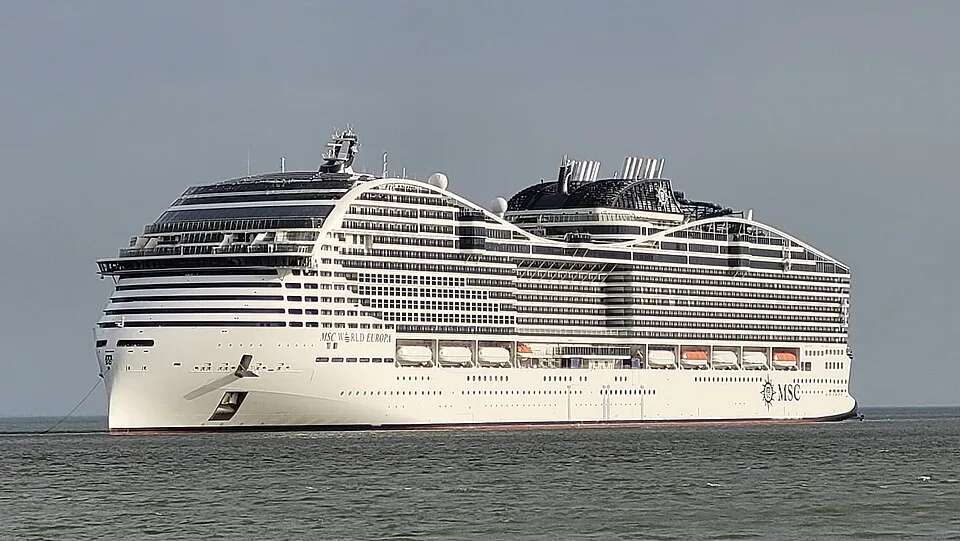
Photo: ND44 · CC BY-SA 4.0 (share-alike) · Re-encoded to WebP.