Lindblad Expeditions-National Geographic
Lord of the Glens
One hundred fifty feet long because Thomas Telford's locks are one hundred fifty feet long
Sailings Available
5
Ports Visited
18
Next Departure
Jun 7, 2027
Trip Length
7 nights
Now Booking
Sailings Aboard Lord of the Glens
Lindblad Expeditions-National Geographic
Scotland's Highlands and Islands Aboard Lord of the Glens (Westbound)
7 Nights
Jun 7, 2027 • departs Inverness
Lindblad Expeditions-National Geographic
Scotland's Highlands and Islands Aboard Lord of the Glens (Eastbound)
7 Nights
Aug 9, 2027 • departs Kyle of Lochalsh
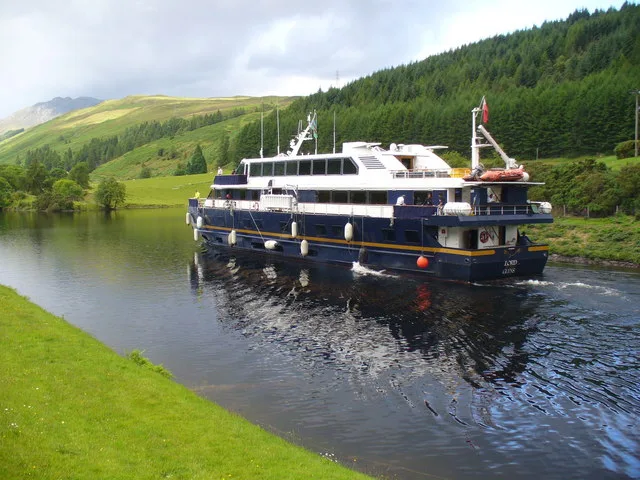
Thomas Telford finished the Caledonian Canal in 1822, after nineteen years and £910,000, and the locks he built are 45.72 meters long and 10.67 meters wide. That is 150 feet by 35. Lord of the Glens is 150 feet long and 33 feet in the beam, and every other fact about her (how many people she carries, what her cabins are like, why she costs what she costs) descends from those two numbers. She is not a small ship that happens to fit the canal. She is a ship built to the inside of a lock chamber.
What the canal is
Sixty miles from the Beauly Firth at Inverness to Loch Linnhe at Fort William, following the Great Glen, the geological fault that cuts Scotland in half. Only about a third of it is dug; the rest is Loch Dochfour, Loch Ness, Loch Oich and Loch Lochy, four natural lochs strung together. Twenty-nine locks and ten swing bridges take a vessel across, the most dramatic of them Neptune’s Staircase at Banavie, a flight of eight chambers that drops the water sixty-four feet in five hundred yards.
The maximum draft is 4.1 meters. Lord of the Glens draws twelve feet, which leaves her room, and she is built strongly enough to leave the canal at the western end and work the open water of the Inner Hebrides, which very little else of canal dimensions can do. That combination, a hull that fits Telford’s locks and still handles the Sound of Mull, is the whole trick.
Greek hull, Scottish rebuild
She was built in 1985 at the Psarros yard at Perama, near Piraeus, and spent her first fifteen years as MS Victoria, then briefly Victoria II. The Magna Carta Steamship Company bought her at the end of the 1990s, gutted her to the steel and rebuilt the interior, and relaunched her in 2000 for the Caledonian Canal. She passed to HP Shipping in August 2020 and now runs under charter, principally to Hebridean Island Cruises and to Lindblad.
Inside she is closer to a country hotel than to an expedition ship: teak exterior decks, hardwood joinery, fabrics rather than fiberglass. Four decks, two lounges, two open-air viewing areas, a dining room that seats everyone at once, and no elevator to speak of on a hull this size. Twenty crew for forty-six guests. She carries bicycles and kayaks, which on the towpaths and sheltered lochs of the Great Glen are genuinely usable rather than decorative.
The guest count came down recently. She carried fifty-two in twenty-six cabins until 2025, when the lowest deck was taken out of passenger use and the number dropped to forty-six. Fewer people on a ship this size is noticeable in one specific place: the deck rail during a lock transit, which is where everybody wants to be.
Where she actually sails
Seven departures in the database and all seven are the same week: Scotland’s Highlands and Islands, seven nights, between Inverness and Kyle of Lochalsh. Four run westbound out of Inverness, three run eastbound out of Kyle. There is nothing else: no Hebridean extension, no ten-night version, no other region.
The season is short and lumpy. Two departures in August 2026, then nothing until one in June 2027, then four more in August 2027. That is not a ship laid up; it is a ship on charter, and these are the weeks Lindblad has taken.
The port list is the itinerary read aloud. Inverness is the hinge, appearing more than any other name, with Culloden and the Clava Cairns visited from it, a battlefield and a Bronze Age burial site within a few miles of the pier. Then the canal: Loch Ness, Fort Augustus with its flight of five locks in the middle of the village, the Laggan Locks, and Corpach at the western end below Ben Nevis. Out into Loch Linnhe, then Oban, and Mull, Craignure, Duart Castle on four of the seven, Tobermory with its painted harbor front, and Iona, where Columba landed in 563. Glenfinnan appears on every sailing, for the monument at the head of Loch Shiel and the viaduct above it. Armadale puts you on Skye; Inverie, on Knoydart, is on ten of the calls and is reachable by boat or on foot and by nothing else. Kyle of Lochalsh, under the Skye bridge, is the western terminus.
Seven nights, every time, in either direction.
Who she suits
People who want Scotland end to end without a coach, and people who find lock transits interesting, because you will do twenty-nine of them, slowly, in the open air, close enough to talk to the lock keeper. The itinerary is unusually dense for a week at sea: a battlefield, a burial cairn, a monastery, three castles, two islands and a canal, with the ship tying up in the middle of small towns rather than at an industrial terminal a bus ride out.
She does not suit anyone who wants a ship as the point of the trip. There is no pool, no spa, no entertainment beyond a lounge and whatever the guide has prepared, the cabins are small by any modern standard, and at 729 gross tons she is smaller than most harbor ferries. She does not suit anyone with mobility limits, a four-deck vessel of 1985 with steep stairs, gangways onto stone quays, and half the good stuff reached on foot. And she does not suit anyone with a fixed date in mind: seven departures across two summers, all of them in June and August, is the entire offer.
Photo: Colin Smith · CC BY-SA 2.0 (share-alike) · Re-encoded to WebP.