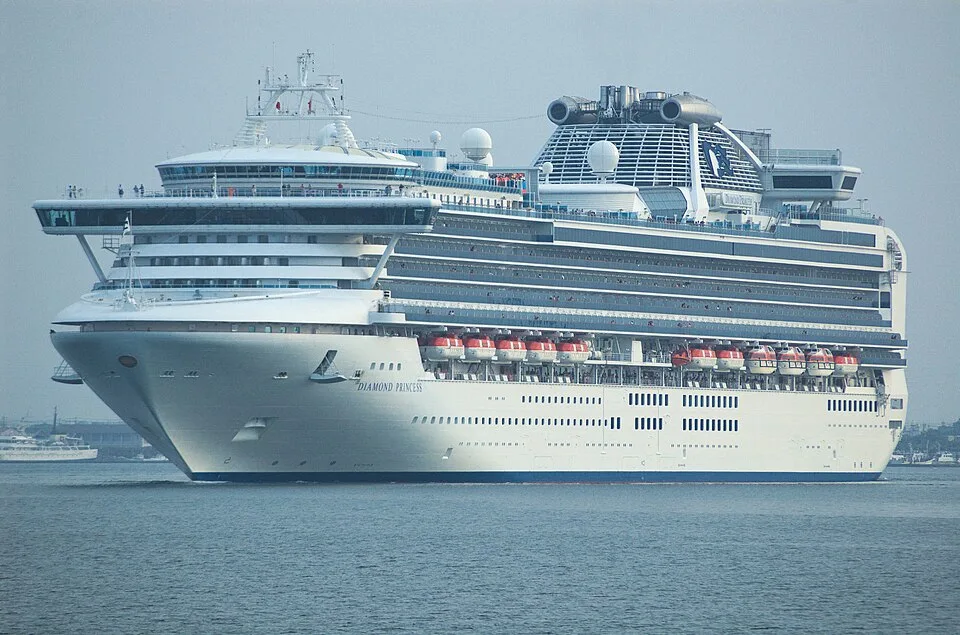
Princess Cruises
Diamond Princess
Built in Nagasaki, named after a fire, and the only Princess ship with an onsen
Sailings Available
122
Ports Visited
56
Next Departure
Sep 22, 2026
Trip Length
7–31 nights
Now Booking
Sailings Aboard Diamond Princess
Princess Cruises
Okinawa & Taiwan
9 Nights
Sep 22, 2026 • departs Tokyo
Princess Cruises
Grand Japan with Okinawa & Taiwan
18 Nights
Sep 22, 2026 • departs Tokyo
Princess Cruises
Japan Explorer
9 Nights
Oct 1, 2026 • departs Tokyo
Princess Cruises
Grand Circle Japan
18 Nights
Oct 1, 2026 • departs Tokyo
Princess Cruises
Grand Circle Japan
18 Nights
Oct 10, 2026 • departs Tokyo
Princess Cruises
Circle Japan
9 Nights
Oct 10, 2026 • departs Tokyo
Princess Cruises
Grand Circle Japan with Fall Foliage
23 Nights
Oct 19, 2026 • departs Tokyo
Princess Cruises
Japan Explorer
9 Nights
Oct 19, 2026 • departs Tokyo
Princess Cruises
Grand Japan with Fall Foliage
14 Nights
Oct 28, 2026 • departs Tokyo
Princess Cruises
Grand Circle Japan with Fall Foliage
28 Nights
Oct 28, 2026 • departs Tokyo
Princess Cruises
Grand Japan with Fall Foliage
14 Nights
Nov 11, 2026 • departs Tokyo
Princess Cruises
Circle Japan Fall Foliage & Southeast Asia
28 Nights
Nov 11, 2026 • departs Tokyo
Diamond Princess is one of two Princess ships built in Japan, and she has spent most of the last decade sailing there. She is a Gem-class ship, a variation on the Grand-class hull that Fincantieri was building in Italy at the same time, but she was assembled at Mitsubishi Heavy Industries in Nagasaki, and the differences that come from that are the reason to be interested in her.
The fire and the swap
Two sisters were under construction at Nagasaki at once. In October 2002 a major fire tore through the one then named Diamond Princess, and repairing her would have pushed her delivery well past the date Princess had sold. So the yard exchanged the names. The undamaged hull was completed as Diamond Princess and delivered on schedule in early 2004; the burned one was rebuilt and entered service as Sapphire Princess. The ship you sail today is the one that did not catch fire, wearing the other one’s name.
The episode cost Mitsubishi enough that these two were the last Carnival Corporation ships the yard built for over a decade, until AIDAprima in 2016.
What being built in Japan actually left aboard
Izumi. A Japanese bath complex of about 818 square meters, the largest at sea, with separate men’s and women’s onsen, an indoor and outdoor bathing area, a coed hot tub section and saunas. It is not a spa treatment room with a Japanese name on the door; it is a proper bathhouse, and no other ship in the Princess fleet has one.
Five dining rooms instead of one. Vivaldi, Pacific Moon, International, Santa Fe and Savoy are five separate restaurants rather than a single stacked hall, each with its own character. On a ship carrying 2,670 guests at double occupancy that produces rooms of a size you can hold a conversation in. Kai Sushi and Sabatini’s cover the specialty side.
The machinery. She carries a General Electric LM2500 gas turbine alongside four Wärtsilä diesel generators, a combination Princess used briefly in the early 2000s and then abandoned. In June 2017 she was fitted with a hull air lubrication system, a curtain of bubbles under the flat of the bottom to reduce drag, which is a retrofit few ships of her age have had.
A drydock at Singapore in early 2019 modernized the spa, the casino and the Movies Under the Stars audio, and fitted Japanese-style bidets through the public restrooms and suite bathrooms, which tells you plainly who the ship is being maintained for.
2020
She is, unavoidably, the ship of the Yokohama quarantine. On February 4, 2020, with 3,711 passengers and crew aboard, Japanese authorities held her at Yokohama after a disembarked passenger tested positive for COVID-19. At least 712 people on board were eventually infected. Disembarkation ran through February and into March; the ship did not leave Yokohama until May 16. Reported deaths among those who had been aboard vary by source and by cutoff date, nine by mid-April 2020 in one account, fourteen in another. Japan covered the great majority of the medical costs.
She did not carry passengers again until November 2022. There is nothing about the ship herself in any of this, and six years on there is nothing aboard that records it. It is part of her history and it is worth knowing before you book her, which is why it is here.
Where she sails
Japan, almost exclusively. Her season runs roughly February to November out of Tokyo, working from Yokohama, on a program that Princess has been extending year over year, around fifty departures across thirty-five distinct itineraries in a recent season, reaching three countries. Sailings run seven to thirty-one nights with a median of fourteen.
The shapes repeat: cherry-blossom itineraries in March and April working south to north as the front moves, circumnavigations of the four main islands calling at Nagasaki, Kanazawa and Maizuru for Kyoto, and southern runs to Okinawa, Ishigaki and Taiwan. In the northern winter she repositions to Singapore for a short Southeast Asia season through Vietnam, Malaysia and Thailand.
Who she suits
People whose reason for booking is Japan. Sailing a Japanese coast on a Japanese-built ship with a real onsen on deck fifteen is a coherent thing to do, and the itineraries reach ports that are genuinely awkward to string together by train. The long median sailing suits travelers who want more than the Tokyo– Kyoto corridor.
Be clear-eyed about the rest. She is twenty-two years old and it shows in the cabins: smaller than the current standard, less storage, fewer outlets, and tiered balconies on the lower categories where the deck above looks down into yours. She has no waterslide, no dome, no aerial theater. Her passenger mix leans heavily Japanese and announcements and menus reflect that, which is a feature if you came for Japan and a friction if you did not expect it. Families with young children will find far more on almost any newer ship. Book her for the coastline; do not book her for the vessel.