Costa Cruises
Costa Toscana
The busiest ship in the fleet, running one Western Mediterranean week over and over
Sailings Available
462
Ports Visited
11
Next Departure
Nov 5, 2026
Trip Length
2–8 nights
Now Booking
Sailings Aboard Costa Toscana
Costa Cruises
Western Mediterranean from Civitavecchia | Rome
7 Nights
Nov 5, 2026 • departs Civitavecchia
Costa Cruises
Western Mediterranean from Genoa | Portofino
7 Nights
Nov 6, 2026 • departs Genoa
Costa Cruises
Western Mediterranean from Marseilles
7 Nights
Nov 7, 2026 • departs Marseille
Costa Cruises
Western Mediterranean from Barcelona
7 Nights
Nov 8, 2026 • departs Barcelona
Costa Cruises
Western Mediterranean from Palma
7 Nights
Nov 9, 2026 • departs Palma de Mallorca
Costa Cruises
Western Mediterranean from Barcelona
7 Nights
Nov 15, 2026 • departs Barcelona
Costa Cruises
Western Mediterranean from Palma
7 Nights
Nov 16, 2026 • departs Palma de Mallorca
Costa Cruises
Western Mediterranean from Civitavecchia | Rome
8 Nights
Nov 19, 2026 • departs Civitavecchia
Costa Cruises
Western Mediterranean from Genoa | Portofino
2 Nights
Nov 20, 2026 • departs Genoa
Costa Cruises
Western Mediterranean from Genoa | Portofino
6 Nights
Nov 20, 2026 • departs Genoa
Costa Cruises
Western Mediterranean from Genoa | Portofino
8 Nights
Nov 20, 2026 • departs Genoa
Costa Cruises
Western Mediterranean from Marseilles
8 Nights
Nov 21, 2026 • departs Marseille
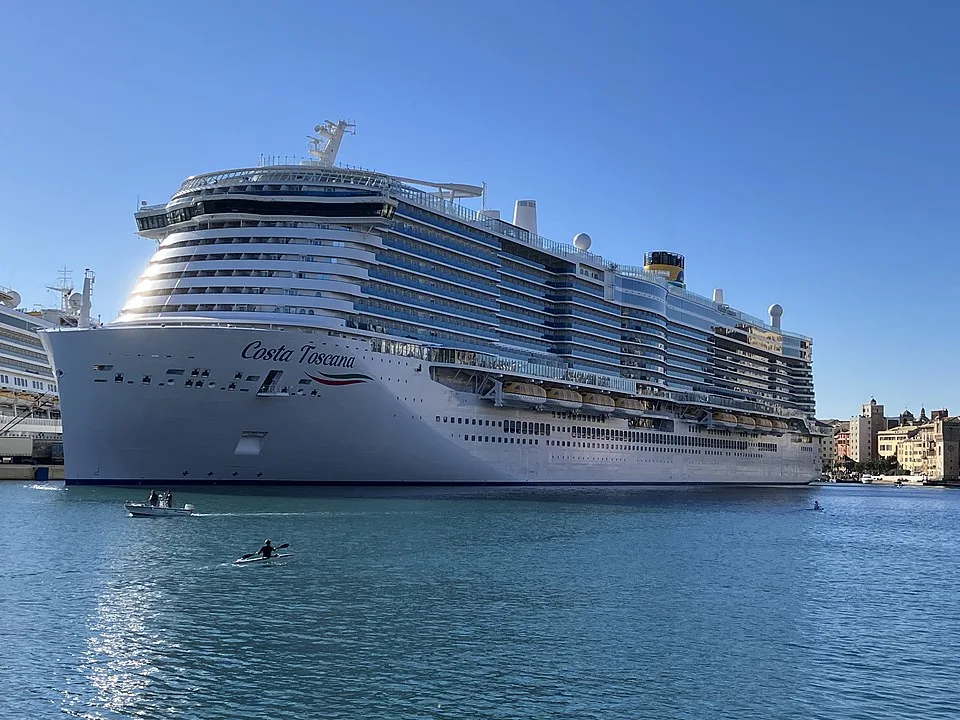
Costa Toscana is the second and larger of Costa’s two LNG ships, and the biggest vessel the line has ever taken delivery of: 186,364 gross tons, 2,663 cabins, delivered from Meyer Turku on December 2, 2021. She is a near-twin of Costa Smeralda (same 337-metre hull, same four Caterpillar dual-fuel engines, same ABB azipods) with a slightly denser cabin plan and a Tuscan rather than pan-Italian design theme.
She is also, by a wide margin, the hardest-working ship on this site’s Costa inventory. Nearly five hundred departures are loaded for her between August 2026 and May 2028, more than any other ship in the fleet, and every single one of them is the same seven-night Western Mediterranean circuit.
The seven-port week
This is the thing worth understanding about her, because it is not how American lines sell cruises. Costa Toscana runs a fixed loop (Savona, Marseille, Barcelona, Palma de Mallorca or Ibiza, Palermo, Civitavecchia), and every one of those Italian, French and Spanish ports is a turnaround port. You board where it suits you and you get off there seven days later, having called at all the others on the way round.
The database bears this out precisely. Civitavecchia, Marseille and Barcelona each account for about ninety departures; Palermo and Savona around seventy-eight each; Palma de Mallorca forty-two; Genoa fourteen. Line up the port calls and the pattern is unmistakable: a Palermo-embarking week calls at Barcelona, Civitavecchia, Savona and Marseille eighty times apiece over the window, because it is the same voyage viewed from a different pier.
What that buys the passenger is a drive-to or short-flight cruise from almost anywhere on the northern Mediterranean rim, which is exactly why Costa carries the European passenger numbers it does. What it costs is variety: there is one itinerary on this ship, and it does not change.
A handful of calls at La Goulette for Tunis, Naples, Cagliari and Alicante turn up on the longer eight-night versions of the week. Beyond that, this is Savona to Palermo and back, in perpetuity.
What is aboard
Eleven restaurants, nineteen bars, two theaters, a spa, an aqua park with slides, a casino and a large open-deck complex. The decks are named for Italian regions and the interiors lean on Tuscan materials and Tuscan color, which on a ship this size means the public rooms feel warmer than the glass-and-chrome standard.
The LNG plant is the substantive engineering. She burns liquefied natural gas at sea and alongside, which removes essentially all of the sulphur and particulate emissions a conventional ship produces in port. In a season that puts her alongside Barcelona and Marseille eighty times each, that is not an abstraction; it is the reason she is welcome there.
She carries somewhere over five thousand guests at double occupancy and up to 6,554 with every upper berth folded down, against roughly 1,678 crew. That is a low crew-to-guest ratio by any standard, and it shows in the queues.
Where she actually sails
Year-round Western Mediterranean, without a break. The monthly counts run between sixteen and twenty-seven departures every month from August 2026 through May 2028, which is to say she does not lay up, does not reposition, and does not have a winter program that differs from her summer one. Barcelona, Civitavecchia and Marseille each see her nearly six hundred times across the window; Palermo and Savona above five hundred; Palma de Mallorca three hundred and twenty-six.
Almost everything is seven nights. A few weeks stretch to eight and a small number of one-way legs run four to six nights between two of the turnaround ports; those are schedule adjustments sold as short breaks, not a separate product.
Who she suits
Anybody in southern Europe who wants a big new ship without an airport. The seven-turnaround-port structure means the drive to the pier is short, the fares are low, and the ship is genuinely modern. For a first cruise taken from Barcelona or Rome she is close to the obvious answer.
She is also a reasonable pick for an American traveler already going to Italy or Spain, on the same logic that makes a cheap week at sea a sensible add-on to a land trip, provided you understand what you are buying.
She is the wrong ship for anyone who wants a varied itinerary. There is exactly one, it is the Western Mediterranean, and if you have done Barcelona and Rome you have done most of it. She is wrong for anyone who wants space: over five thousand guests on a ship with 1,678 crew is a busy vessel, and the ratio is worse than anything the American premium lines run. And she is wrong for anyone expecting an English-language cruise; the passenger list is Italian, German, French and Spanish first, every announcement runs through five languages, and the entertainment is built to work without dialogue for that reason.
Photo: Gérard · CC BY-SA 4.0 (share-alike) · Re-encoded to WebP.