Costa Cruises
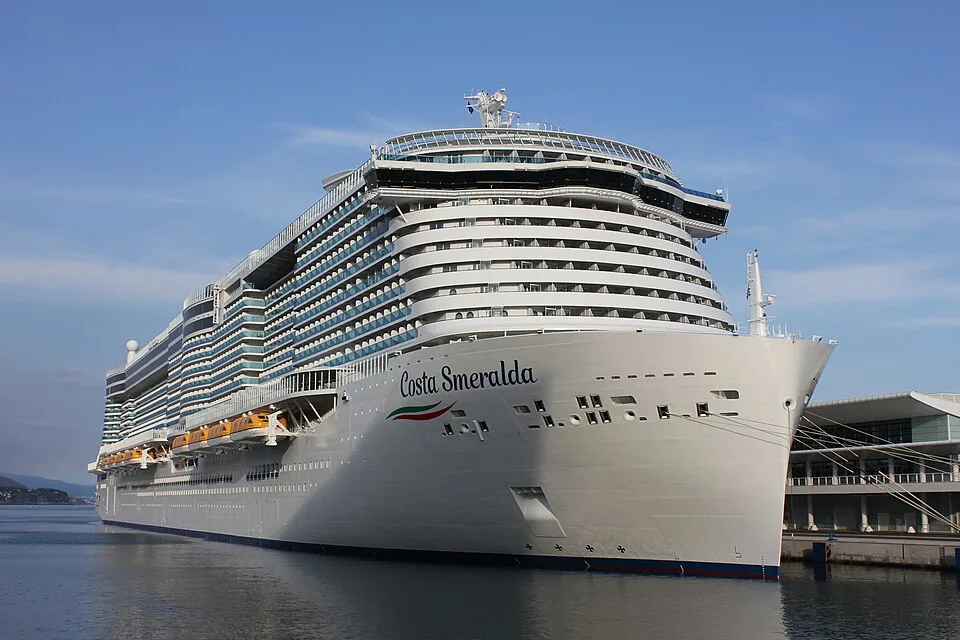
Costa Smeralda
The second cruise ship ever built to run on LNG, and the largest Costa has operated
Sailings Available
358
Ports Visited
17
Next Departure
Nov 6, 2026
Trip Length
2–18 nights
Now Booking
Sailings Aboard Costa Smeralda
Costa Cruises
Mini Cruises from Civitavecchia | Rome
5 Nights
Nov 6, 2026 • departs Civitavecchia
Costa Cruises
Mini Cruises from Savona
5 Nights
Nov 7, 2026 • departs Savona
Costa Cruises
Mini Cruises from Marseilles
3 Nights
Nov 8, 2026 • departs Marseille
Costa Cruises
Mini Cruises from Marseilles
4 Nights
Nov 8, 2026 • departs Marseille
Costa Cruises
Mini Cruises from Marseilles
5 Nights
Nov 8, 2026 • departs Marseille
Costa Cruises
Mini Cruises from Barcelona
3 Nights
Nov 9, 2026 • departs Barcelona
Costa Cruises
Mini Cruises from Barcelona
5 Nights
Nov 9, 2026 • departs Barcelona
Costa Cruises
Ocean Cruises from Civitavecchia | Rome
8 Nights
Nov 11, 2026 • departs Civitavecchia
Costa Cruises
Ocean Cruises from Civitavecchia | Rome
11 Nights
Nov 11, 2026 • departs Civitavecchia
Costa Cruises
Ocean Cruises from Savona
2 Nights
Nov 12, 2026 • departs Savona
Costa Cruises
Ocean Cruises from Savona
7 Nights
Nov 12, 2026 • departs Savona
Costa Cruises
Ocean Cruises from Savona
10 Nights
Nov 12, 2026 • departs Savona
Costa Smeralda is the ship that made Costa modern again. She was delivered by Meyer Turku on December 5, 2019, at 185,010 gross tons and 5,224 guests at double occupancy, the largest hull the line has ever operated, and by a considerable margin the newest thing in a fleet whose next-youngest ship dates from 2014.
What makes her structurally interesting is the fuel. She burns liquefied natural gas, from four Caterpillar dual-fuel engines, in port as well as at sea, and she was only the second cruise ship in the world built to do it. That is not a marketing detail: LNG effectively eliminates the sulphur oxide and particulate emissions that make a conventional cruise ship unwelcome in a European harbor, and it is the reason a ship this size can tie up in the middle of Barcelona and Marseille week after week without becoming a political problem. Her sister Costa Toscana followed in 2021, and the two of them are the only ships in the fleet that will still look current in ten years.
What she is known for
She is an Italy-themed ship, quite literally. The sixteen passenger decks are named for Italian cities (Roma, Milano, Venezia, Firenze and so on), and each is decorated to its namesake. It is more thoroughly committed than the usual cruise-ship theming, and on a line whose whole proposition is Italian style it lands rather better than it sounds.
Co.De. An actual museum aboard, running through a century of Italian industrial design: furniture, appliances, typewriters, the Vespa. It is small, free, and the most unusual public room on any ship in this fleet.
Scale. Eleven restaurants, nineteen bars, two theaters, an aqua park and a spa spread across a hull that is nearly a quarter of a mile long. She is a genuinely big ship, with the crowd density that implies, and Costa fills her.
Where she actually sails
Everything on her calendar between August 2026 and April 2028 is filed under Europe. There is no repositioning to the Caribbean, no crossing, no Alaska, just two programs and the runs between them.
Summer and autumn are the Western Mediterranean. Seven nights, sold from whichever port you live nearest: Barcelona, Marseille, Civitavecchia for Rome, Genoa, Savona, Palermo and occasionally Cagliari are all turnaround ports on the same loop, and the ship simply calls at each of them in turn. Naples and Ibiza fill out the week. That multi-embarkation model is standard Costa practice and it is why the same voyage appears under seven different names.
Winter is the Canaries. From about the end of November through March she moves to the Atlantic and runs seven- and eight-night loops turning around at Santa Cruz de Tenerife and Las Palmas, calling at Arrecife on Lanzarote, Puerto del Rosario on Fuerteventura, Santa Cruz de la Palma, and Funchal on Madeira. Longer versions of the week reach Agadir, Tangier, Málaga and Cádiz. Tenerife is her single busiest port by a wide margin.
The transitions are the interesting sailings. Twice a year she moves between the two theaters, and those one-way legs run eight to eighteen nights, Civitavecchia to Tenerife, Savona to Las Palmas, Tenerife back to Genoa or Marseille. They are the only sailings on her schedule longer than eight nights, and they are the only way to get several days at sea on this ship.
The shortest thing she does is a two- or three-night hop between Barcelona and Cagliari or Palermo, which is a repositioning leg sold as a mini-cruise rather than a vacation.
Who she suits
Anyone who wants a new, large, comfortable ship in the Mediterranean at a price the American lines do not offer, and who is willing to sail with a European passenger list. She is the best ship Costa has, the itineraries are the core Mediterranean and Canaries product, and a seven-night week aboard her regularly costs less than half what an equivalent Royal Caribbean or Celebrity week costs out of the same ports.
She also suits people who care about the environmental side of this. The LNG plant is real and it is measurable, and if that matters to you there are only a handful of ships in the world that qualify.
She is the wrong ship if you want quiet. Five thousand guests at double occupancy and a full Italian summer means every deck is busy, the pools are crowded, and the buffet at one o’clock is an experience. She is also wrong if you need everything in English: announcements run in Italian, English, French, German and Spanish, entertainment is built to survive that translation, and the Anglophone contingent is small.
And she is wrong for anyone shopping for sea days and distance. This is a port-intensive ship on a seven-night loop with one sea day, sailing the same Western Mediterranean or the same Canaries week after week. If the appeal of a cruise is the crossing, book the repositioning leg or book another line.
Photo: Eustace Bagge · CC BY 3.0 · Re-encoded to WebP.