Costa Cruises
Costa Serena
Eight years in Asia, and now the longest way home in the fleet, Taiwan to the Caribbean by way of Brazil
Sailings Available
219
Ports Visited
65
Next Departure
Nov 12, 2026
Trip Length
2–40 nights
Now Booking
Sailings Aboard Costa Serena
Costa Cruises
World Cruise from Sydney
40 Nights
Nov 12, 2026 • departs Sydney
Costa Cruises
World Cruise from Sydney
26 Nights
Nov 12, 2026 • departs Sydney
Costa Cruises
World Cruise from San Antonio | Santiago
14 Nights
Dec 8, 2026 • departs San Antonio (Santiago)
Costa Cruises
South America from Buenos Aires
9 Nights
Dec 27, 2026 • departs Buenos Aires
Costa Cruises
South America from Buenos Aires
9 Nights
Dec 27, 2026 • departs Buenos Aires
Costa Cruises
South America from Montevideo
9 Nights
Dec 28, 2026 • departs Montevideo
Costa Cruises
South America from Montevideo
9 Nights
Dec 28, 2026 • departs Montevideo
Costa Cruises
South America from Buenos Aires
9 Nights
Jan 5, 2027 • departs Buenos Aires
Costa Cruises
South America from Buenos Aires
5 Nights
Jan 5, 2027 • departs Buenos Aires
Costa Cruises
South America from Montevideo
9 Nights
Jan 6, 2027 • departs Montevideo
Costa Cruises
South America from Rio de Janeiro
9 Nights
Jan 10, 2027 • departs Rio de Janeiro
Costa Cruises
South America from Buenos Aires
8 Nights
Jan 14, 2027 • departs Buenos Aires
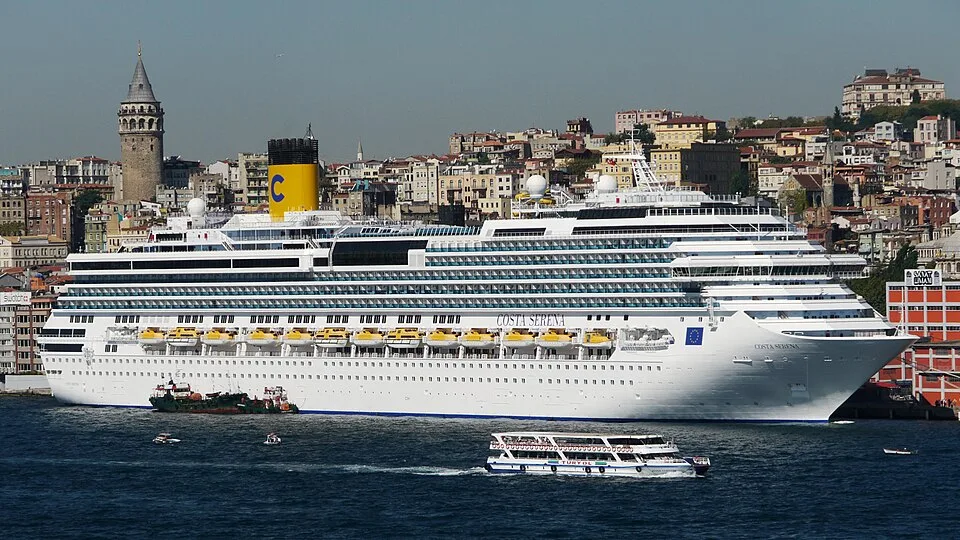
Costa Serena is the second Concordia-class ship and, since January 2012, the oldest of them left. Fincantieri delivered her at Sestri Ponente in 2007 for around €450 million; Marion Cotillard was her godmother; the interiors are themed on the Roman gods, which on a 114,000-ton ship means a great deal of marble-effect and a good deal of gold. She carries 3,014 guests at double occupancy in 1,500 cabins, against 1,100 crew.
Her sister Costa Concordia was lost off Isola del Giglio on January 13, 2012 with thirty-two deaths. Serena is a hull of the same class delivered five years earlier, and she has sailed for nineteen years without incident. It belongs on this page and it does not need dressing up.
The ship that went east and is coming back
Most of the interesting thing about Costa Serena is her deployment history. Costa sent her to China in 2015, where she spent most of a decade running short cruises from Shanghai to Japan and South Korea for the domestic Chinese market, a business that effectively ceased in 2020 and restarted only partially. From 2023 she worked India and Thailand instead, and Costa has now brought her back toward Europe by the longest route available.
The result is the most geographically ambitious calendar in the fleet, and the best argument for booking her: over nineteen months she works Asia, crosses to South America, spends a summer in the Mediterranean and a winter in the Caribbean.
It also means she is a different ship in each place. A vessel deployed for eight years into one market gets fitted out for that market (the dining, the entertainment and the shore program on a Shanghai-based ship are not the ones on a Catania-based ship), and Costa has been reworking her as she moves. Anyone booking her in the Mediterranean in 2027 is booking a ship that has spent most of the last decade somewhere else entirely, which is worth knowing when you read reviews of her: a review written in Asia is describing a different operation.
Where she actually sails
Five distinct programs, in sequence.
Asia, August to October 2026. Short runs, two to five nights, turning around at Keelung for Taipei, Busan and Naha in Okinawa. This is the tail of the Asian deployment and it is the shortest product on any Costa ship: a couple of three-night hops between Taiwan, Japan and Korea, with Bali appearing on the longer ones.
The repositioning, October to December 2026. Sixteen sailings are filed under World Cruise, which here means the long transfer out of Asia and across to South America, the sailings that run out to sixty-five nights and cover the Indian Ocean and the Atlantic in one go. These are the only genuinely long voyages on her schedule.
South America, December 2026 to April 2027. Based at Buenos Aires, Montevideo and Rio de Janeiro, running eight- to ten-night circuits down the River Plate coast with three- and four-night short breaks around the holidays. Ilha Bela, Ilha Grande and Balneário Camboriú are the regular calls.
The Mediterranean, April to November 2027. She comes home for a summer, and it is an eastern-flavored one. Catania in Sicily and Taranto in Puglia are her two busiest turnarounds, alongside Piraeus, with Valletta on Malta the most frequent call after them and Mykonos and Argostoli close behind. Savona, Marseille and Barcelona pick up the shoulder weeks and a run of three- and four-night mini-cruises.
The Caribbean, November 2027 to March 2028. She crosses again and spends the winter based at Fort-de-France in Martinique, Pointe-à-Pitre in Guadeloupe and Santo Domingo, on seven- and eight-night weeks calling at Basseterre, Tortola, St John’s and Philipsburg. Those are French and Dominican homeports, not American ones; this is the Caribbean sold to Europe.
Who she suits
Anyone who wants to be somewhere unusual on an inexpensive ship. There is no other vessel on this site that will take you from Taiwan to the Caribbean by way of Brazil, and the individual segments (a Sicilian summer week out of Catania, a Guadeloupe-based Caribbean week, a Buenos Aires holiday sailing) are all itineraries the American lines either do not run or run at three times the fare.
The repositioning voyages are the standout. Sixty-plus nights across the Indian Ocean and the South Atlantic at Costa’s pricing is close to the cheapest ocean crossing available anywhere.
She is the wrong ship for anyone who wants a good ship. She is from 2007, she has been worked hard on three continents, and 3,014 guests against 1,100 crew is a tight ratio on a hull with limited indoor public space. The cabins are small and the balcony count is low by modern standards.
She is also wrong for anyone who needs predictability. A ship that changes continent four times in nineteen months changes crew, market and language mix with it; the Caribbean weeks are sold into France, the South American ones into Argentina and Brazil, and the Mediterranean ones into Italy. Whatever language you speak, you will be in a minority on at least one of them.
Photo: Wolfgang Meinhart · CC BY-SA 3.0 (share-alike) · Re-encoded to WebP.