Costa Cruises
Costa Pacifica
The first cruise ship with a recording studio, now working both halves of the Mediterranean
Sailings Available
266
Ports Visited
28
Next Departure
Sep 20, 2026
Trip Length
3–16 nights
Now Booking
Sailings Aboard Costa Pacifica
Costa Cruises
Western Mediterranean from Savona
7 Nights
Sep 20, 2026 • departs Savona
Costa Cruises
Western Mediterranean from La Seyne | St. Tropez
7 Nights
Sep 21, 2026 • departs St Tropez
Costa Cruises
Western Mediterranean from Palma
7 Nights
Sep 22, 2026 • departs Palma de Mallorca
Costa Cruises
Western Mediterranean from Valencia
7 Nights
Sep 23, 2026 • departs Valencia
Costa Cruises
Western Mediterranean from Civitavecchia | Rome
7 Nights
Sep 26, 2026 • departs Civitavecchia
Costa Cruises
Western Mediterranean from La Seyne | St. Tropez
7 Nights
Sep 28, 2026 • departs St Tropez
Costa Cruises
Western Mediterranean from Palma
7 Nights
Sep 29, 2026 • departs Palma de Mallorca
Costa Cruises
Western Mediterranean from Valencia
6 Nights
Sep 30, 2026 • departs Valencia
Costa Cruises
Western Mediterranean from Valencia
5 Nights
Sep 30, 2026 • departs Valencia
Costa Cruises
Western Mediterranean from Civitavecchia | Rome
7 Nights
Oct 3, 2026 • departs Civitavecchia
Costa Cruises
Western Mediterranean from Savona
7 Nights
Oct 4, 2026 • departs Savona
Costa Cruises
Western Mediterranean from Marseilles
7 Nights
Oct 5, 2026 • departs Marseille
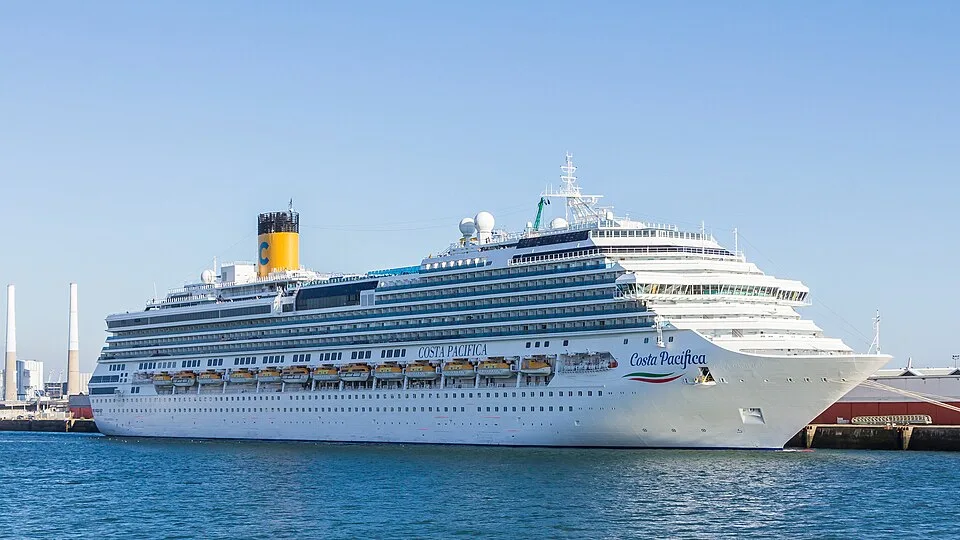
Costa Pacifica is the third of the five Concordia-class ships and the one Costa built around music. Fincantieri delivered her at Sestri Ponente on May 29, 2009 at a cost of around €450 million, and she went into service the following week. The theme is not superficial: her thirteen passenger decks are named after songs, the public rooms follow, and she was the first cruise ship anywhere to carry a real recording studio, where guests could cut a track and take it home. She and Costa Luminosa were also floated out simultaneously, which Guinness recorded as the first time two cruise ships had been launched together.
The class is the one whose lead ship was lost off Isola del Giglio in January 2012. Costa Pacifica is a sister to Costa Concordia, delivered three years after her, and she has run without incident since. It is a fact worth stating plainly rather than working around; four of the five hulls are still in service and this is one of them.
What she is
A conventional big diesel-electric ship of the late 2000s: 114,500 gross tons, 1,504 cabins, 3,014 guests at double occupancy against 1,100 crew, six Wärtsilä engines driving two fixed-pitch screws. There are five dining rooms, thirteen bars, four pools, a three-deck theater, a 4D cinema and a Samsara spa. There is no water park, no ropes course and no LNG. She is a comfortable, plain, busy ship, and after a decade and a half of Mediterranean service she looks it.
What separates her from her sisters is the music programming and the studio, and the fact that Costa has kept her on two genuinely different itineraries rather than parking her on one loop.
The Concordia class is worth understanding as a group, because four of the five are still sailing and they are not interchangeable. Costa Serena came first in 2007 and now works four continents; Costa Pacifica followed in 2009 with the music theme; Costa Favolosa in 2011 goes to Hamburg for the northern summer; Costa Fascinosa, the last of them, in 2012, crosses to the Caribbean. They share a hull, a cabin count and a general layout, and beyond that Costa uses them for four quite different jobs. Pacifica has the most conventional one, she stays in the Mediterranean year-round, and she is the only one of the four that covers both halves of it.
Where she actually sails
Everything on her calendar is in Europe, and it divides into an eastern half and a western half.
The Eastern Mediterranean week turns around at Piraeus for Athens and at Istanbul in roughly equal measure across the window, and always in seven nights. The circuit is Istanbul, Izmir, the Greek islands and the mainland: Santorini most often, then Heraklion on Crete, Mykonos, Rhodes, Volos, Nafplion and Kos. Istanbul is a weekly fixture, which for an American reader is the point of the itinerary; very few mainstream lines still call there weekly.
The Western Mediterranean week is the standard Costa multi-turnaround loop, sold from Savona, Marseille, Barcelona, Civitavecchia, Palermo and Naples, with Valencia, Palma de Mallorca and La Seyne for St Tropez appearing less often. The distinguishing call is La Goulette for Tunis, which comes up over and over; she is the ship in this fleet that goes to North Africa most consistently, along with Tangier, Málaga and Alicante on the longer runs.
The longer weeks are worth noticing. Alongside the sevens she runs a good number of eleven- and twelve-night Western Mediterranean itineraries out of Marseille, Barcelona, Savona, Palermo and Naples, which reach further west and south than the standard week does. There are also one-way legs between the two theaters (Savona to Piraeus, Barcelona to Istanbul, Piraeus back to Marseille) running nine to sixteen nights when she changes program in spring and autumn.
She sails year-round with no lay-up and no crossing. Savona is her busiest port overall, followed by Marseille, Barcelona and Palermo.
Who she suits
People who want the Eastern Mediterranean at Costa prices. The Athens-and-Istanbul week is the strongest thing on her schedule and it is not widely available: Santorini, Mykonos, Rhodes, Crete, Izmir and Istanbul in seven nights, from about the cost of a long weekend elsewhere. If that itinerary is what you are after, she is a serious answer.
She also suits anyone in northern Italy or southern France who wants a week away without flying, which is the whole logic of the Savona and Marseille turnarounds.
She does not suit anyone who cares about the ship itself. She is from 2009, she is full (3,014 guests to 1,100 crew), and the public spaces show the mileage. Compared with Costa Smeralda or Costa Toscana she is a different generation, and the fare difference is smaller than the quality difference.
She is also wrong for anyone expecting an English-language experience. On the Istanbul and Piraeus weeks in particular the passenger list is Italian, French, German, Spanish and Turkish; announcements cycle through all of them; and the shows are staged to work without much dialogue for exactly that reason.
Photo: Raimond Spekking · CC BY-SA 4.0 (share-alike) · Re-encoded to WebP.