Costa Cruises
Costa Favolosa
Costa's German ship in the northern summer, and the one that sells four-night breaks in spring
Sailings Available
176
Ports Visited
94
Next Departure
Nov 8, 2026
Trip Length
2–36 nights
Now Booking
Sailings Aboard Costa Favolosa
Costa Cruises
Ocean Cruises from Hamburg
18 Nights
Nov 8, 2026 • departs Hamburg
Costa Cruises
Ocean Cruises from Hamburg
22 Nights
Nov 8, 2026 • departs Hamburg
Costa Cruises
Ocean Cruises from Hamburg
24 Nights
Nov 8, 2026 • departs Hamburg
Costa Cruises
Ocean Cruises from Hamburg
10 Nights
Nov 8, 2026 • departs Hamburg
Costa Cruises
Ocean Cruises from Hamburg
25 Nights
Nov 8, 2026 • departs Hamburg
Costa Cruises
Ocean Cruises from Hamburg
17 Nights
Nov 8, 2026 • departs Hamburg
Costa Cruises
Ocean Cruises from Hamburg
4 Nights
Nov 8, 2026 • departs Hamburg
Costa Cruises
Ocean Cruises from Le Havre
13 Nights
Nov 12, 2026 • departs Le Havre
Costa Cruises
Ocean Cruises from Le Havre
21 Nights
Nov 12, 2026 • departs Le Havre
Costa Cruises
Ocean Cruises from Le Havre
14 Nights
Nov 12, 2026 • departs Le Havre
Costa Cruises
Ocean Cruises from Le Havre
20 Nights
Nov 12, 2026 • departs Le Havre
Costa Cruises
Ocean Cruises from Las Palmas | Gran Canaria
7 Nights
Nov 18, 2026 • departs Las Palmas
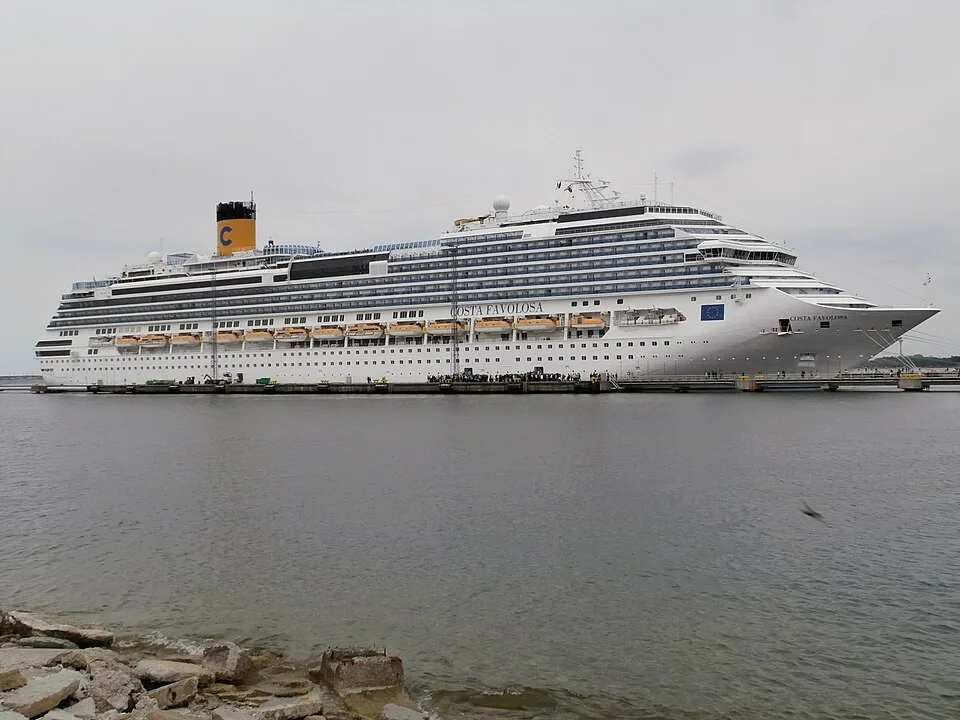
Costa Favolosa is the fourth Concordia-class ship, delivered by Fincantieri at Marghera in 2011 at a cost of €510 million and christened that July. Her name was chosen by public vote: Costa shortlisted twenty-five pairs of names, put them on its website, and more than forty-two thousand people picked this one. It means “fabulous,” which tells you most of what you need to know about the interiors.
She is a sister to Costa Concordia, the ship lost off Isola del Giglio in January 2012 with thirty-two deaths, and delivered seven months before that happened. Four of the five hulls remain in service; she is one of them and has sailed for fifteen years without incident. The fact is worth stating and then leaving alone.
What she is
113,216 gross tons, 290 metres, 1,508 cabins, 3,014 guests at double occupancy against 1,110 crew, thirteen passenger decks. Five restaurants, thirteen bars, four swimming pools and four hydromassage pools, a three-deck theater, a 4D cinema, a water slide, a glass-roofed pool deck with a cinema screen, and a Samsara spa of about 6,000 square metres, which is one of the largest afloat on a ship this age. Like her younger sister Costa Fascinosa she can take shore power and shut her engines down alongside.
She is a conventional early-2010s mass-market ship. What is unusual about her is who Costa sells her to.
The German ship
For the northern summer she is based at Hamburg, and eighteen of her turnarounds in the current window are there. That makes her, in practice, Costa’s ship for the German market, the fleet’s answer to the fact that Germany is one of the largest cruise markets in Europe and does not want to fly to Savona to board.
The Hamburg program runs seven to fifteen nights and it is a proper northern one. The fjords are the headline: Geiranger and Hellesylt, Flåm, Bergen, Ålesund, Nordfjordeid, Haugesund, Måløy, and Honningsvåg up in the far north. Scotland appears too (Kirkwall in Orkney, Invergordon, South Queensferry for Edinburgh) along with Amsterdam, Dover, Zeebrugge for Bruges, and Le Havre on the Channel runs. Longer versions head south to La Coruña, Lisbon, Cádiz and Málaga.
Where she actually sails
Hamburg, September to November 2026 and again June to September 2027. As above. Hamburg is her second-busiest port overall.
The Caribbean, December 2026 to March 2027. She crosses in November, from Hamburg or Le Havre by way of Las Palmas, and spends the winter on seven- and eight-night weeks based at Fort-de-France in Martinique, Pointe-à-Pitre in Guadeloupe and Santo Domingo. The calls are Basseterre, St John’s, Tortola and Philipsburg. As with Costa Fascinosa, this is a Caribbean program run out of French and Dominican homeports for a European passenger list, with no American turnaround anywhere in it.
The Mediterranean, March to May and October to November 2027. Back across the Atlantic and onto the standard Costa western loop from Barcelona, Marseille and Savona, her three busiest ports in the window. What is distinctive here is the length: a large share of these are Mini Cruises of three and four nights, roughly thirty of them, which is the shortest Mediterranean product any Costa ship offers and is sold as a long weekend rather than a holiday. The seven- and fourteen-night Western and Eastern Mediterranean weeks run alongside them.
One outlier. A single South America sailing appears in December 2027, ending at Buenos Aires, at the end of a long repositioning south, and the long transatlantic legs to Buenos Aires and Rio de Janeiro, running twenty to thirty-six nights out of Marseille, Savona and Barcelona, are on the calendar with calls at Recife, Salvador, Ilhéus and, on some of them, as far down as Ushuaia.
Who she suits
Anyone flying into Hamburg, or living within reach of it, who wants the Norwegian fjords and the North Sea without a connecting flight. The northern program is a real one (Geiranger, Flåm, Bergen and the Orkneys are the ports you would want), and it is priced well below the German lines that dominate that market.
The three- and four-night Mediterranean mini-cruises are the other reason to book her. They are cheap, they are short, and they work as a first cruise or as an add-on to a week in Barcelona. Nothing else on this line does that at this scale.
She does not suit anyone who wants a current ship. She is fifteen years old, the class was designed before balconies became near-universal, and 3,014 guests to 1,110 crew is a busy vessel. On a fifteen-night Hamburg sailing in September, when the weather turns, the indoor public space is the limiting factor.
She is a poor choice for a three-night sample if you are expecting a full cruise. A four-night mini-cruise is two full days and a sea day, and people who booked it as a vacation rather than a taster are the ones who come back unhappy.
And she is the wrong ship if you need English. Her two main markets are Germany and Italy; the Hamburg sailings are run in German first, the Caribbean ones in French and Italian, and the announcements cycle through five languages throughout.
Photo: Pjotr Mahhonin · CC BY-SA 4.0 (share-alike) · Re-encoded to WebP.