Costa Cruises
Costa Fascinosa
The last Concordia-class ship ever built, delivered four months after the disaster
Sailings Available
264
Ports Visited
58
Next Departure
Nov 4, 2026
Trip Length
3–35 nights
Now Booking
Sailings Aboard Costa Fascinosa
Costa Cruises
Western Mediterranean from Marseilles
10 Nights
Nov 4, 2026 • departs Marseille
Costa Cruises
Western Mediterranean from Savona
10 Nights
Nov 5, 2026 • departs Savona
Costa Cruises
Western Mediterranean from Savona
7 Nights
Nov 5, 2026 • departs Savona
Costa Cruises
Western Mediterranean from Barcelona
10 Nights
Nov 6, 2026 • departs Barcelona
Costa Cruises
Western Mediterranean from Marseilles
10 Nights
Nov 14, 2026 • departs Marseille
Costa Cruises
Western Mediterranean from Savona
10 Nights
Nov 15, 2026 • departs Savona
Costa Cruises
Western Mediterranean from Barcelona
10 Nights
Nov 16, 2026 • departs Barcelona
Costa Cruises
Western Mediterranean from Marseilles
10 Nights
Nov 24, 2026 • departs Marseille
Costa Cruises
Western Mediterranean from Savona
10 Nights
Nov 25, 2026 • departs Savona
Costa Cruises
Western Mediterranean from Barcelona
10 Nights
Nov 26, 2026 • departs Barcelona
Costa Cruises
Ocean Cruises from Marseilles
13 Nights
Dec 4, 2026 • departs Marseille
Costa Cruises
Ocean Cruises from Marseilles
16 Nights
Dec 4, 2026 • departs Marseille
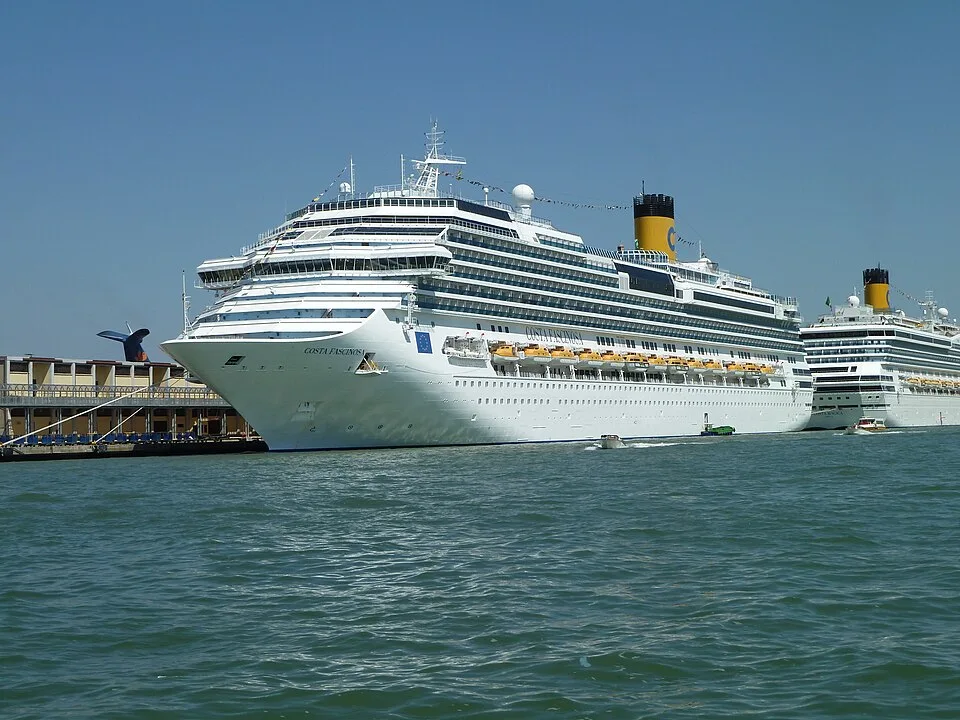
Costa Fascinosa is the last Concordia-class ship, and the circumstances of her delivery are the fact that defines her. Fincantieri laid her keel at Marghera in September 2010 and handed her over on May 5, 2012, four months after the lead ship of her class, Costa Concordia, struck a rock off Isola del Giglio and capsized with the loss of thirty-two lives. She was already built; there was nothing to do but finish her and christen her, which Costa did in Venice that month. She has run for fourteen years since without incident, and no further ships of the class were ordered.
Mechanically she is a modified Concordia hull: 113,321 gross tons, 290 metres, 1,507 cabins, 3,014 guests at double occupancy against 1,100 crew, thirteen passenger decks. She cost €510 million. The modification over the earlier ships is marginal, a handful of extra cabins, and the more meaningful addition is the shore-power connection, which lets her shut her engines down entirely alongside a properly equipped berth rather than running generators in the middle of a city.
What she is
Five restaurants, thirteen bars, four pools, a three-deck theater, a 4D cinema and a Samsara spa. She is a full-service ship of the early 2010s with no water park, no go-karts and no LNG. Compared to the two Excellence-class flagships she is a generation behind; compared to Costa Serena she is five years newer and it shows in the cabins.
Where she earns her place is deployment. Costa uses her as the transatlantic ship, and her calendar has more variety in it than anything else in the fleet except Costa Serena.
Where she actually sails
Three programs and two ocean crossings a year.
The Riviera summer, roughly March to October. The headline turnaround is listed as St Tropez, and it needs a word of explanation: the itineraries read “La Seyne | St. Tropez,” and it is La Seyne-sur-Mer, across the bay from Toulon, where the ship actually berths. St Tropez is a coach ride away. It is a real Provençal turnaround port and a convenient one; it is not the harbor in the photographs.
Around it she runs seven-night Western Mediterranean weeks from an unusually long list of Italian turnarounds: Savona, Genoa, Civitavecchia, La Spezia for Florence, Salerno for the Amalfi coast, Messina for Taormina, Catania and Taranto. Barcelona, Marseille and Palma fill in. Ibiza, Valencia, Olbia and Málaga are frequent calls. In late summer 2026 she opens with an Eastern Mediterranean rotation out of Catania, Taranto and Piraeus before moving west.
The Caribbean winter, December to March. She crosses in November and bases herself at La Romana in the Dominican Republic, her single busiest port in the entire window, with Pointe-à-Pitre in Guadeloupe as the second turnaround. The weeks run seven and fourteen nights to Tortola, Basseterre, Barbados, Castries, Samaná, Cabo Rojo and Catalina Island. Note what is not there: this is a European Caribbean program sold from a Dominican and a French homeport, and it does not touch Miami.
The crossings. The repositioning legs run fourteen to thirty-five nights in each direction, between Savona, Marseille or Barcelona and La Romana or Pointe-à-Pitre, calling at Málaga, Cádiz, Gibraltar and the Azores at Ponta Delgada. The longer versions of these go the scenic way, by New York, Boston and Halifax, which is a Canada and New England leg folded into a transatlantic.
A Bahamas element appears from late 2027. A block of sailings is filed under Bahamas from October 2027 onward, with Grand Turk, Port Canaveral and Fort Lauderdale showing up in the calls, a small change of shape in her second Caribbean season.
Who she suits
Anyone who wants the Caribbean without Florida. Flying to Santo Domingo or Pointe-à-Pitre and sailing the eastern islands on a European ship is a genuinely different vacation from a week out of Miami, the fares are low, and the ports she uses are less trafficked.
She also suits people who want an Italian coastal week from a port that is not Barcelona or Civitavecchia. La Spezia, Salerno, Messina and Taranto are all turnarounds on her schedule, and each one puts you in a different part of Italy at the start and end of the week.
And the crossings are worth a look for anyone with the time, three to five weeks across the Atlantic, sometimes by way of New England, at a fraction of what a line marketing “transatlantic” as a product charges.
She does not suit anyone who wants a modern ship. She is fourteen years old, she is full, and the Concordia-class layout puts a lot of people into a modest amount of indoor public space, which matters on a fourteen-night crossing more than it does on a Mediterranean week.
She is a poor fit for anyone booking on the strength of “St Tropez” without reading the fine print, and for anyone who assumes a Caribbean cruise means an American one. On the La Romana and Guadeloupe weeks the working languages are Italian and French, the food is Italian, and Anglophone passengers are a small minority.
Photo: Abxbay · CC BY-SA 3.0 (share-alike) · Re-encoded to WebP.