Costa Cruises
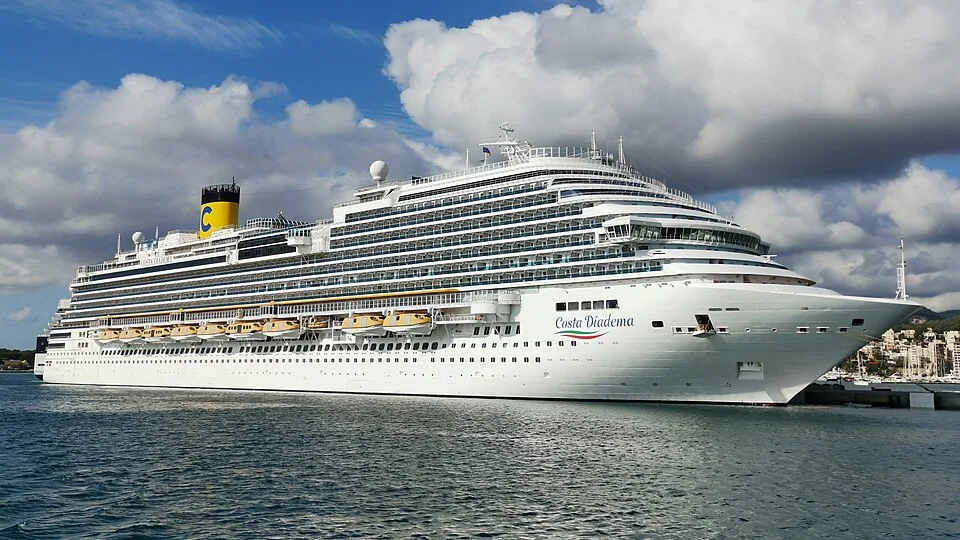
Costa Diadema
Flagship of the old fleet, and the ship that swaps the Norwegian fjords for Brazil every November
Sailings Available
252
Ports Visited
44
Next Departure
Nov 8, 2026
Trip Length
1–27 nights
Now Booking
Sailings Aboard Costa Diadema
Costa Cruises
Ocean Cruises from Lisbon
14 Nights
Nov 8, 2026 • departs Lisbon
Costa Cruises
Ocean Cruises from Lisbon
15 Nights
Nov 8, 2026 • departs Lisbon
Costa Cruises
Ocean Cruises from Las Palmas | Gran Canaria
13 Nights
Nov 10, 2026 • departs Las Palmas
Costa Cruises
Ocean Cruises from Las Palmas | Gran Canaria
12 Nights
Nov 10, 2026 • departs Las Palmas
Costa Cruises
Ocean Cruises from Santa Cruz | Tenerife
12 Nights
Nov 11, 2026 • departs Santa Cruz (Tenerife)
Costa Cruises
Ocean Cruises from Santa Cruz | Tenerife
11 Nights
Nov 11, 2026 • departs Santa Cruz (Tenerife)
Costa Cruises
Ocean Cruises from Maceio
4 Nights
Nov 19, 2026 • departs Maceio
Costa Cruises
Ocean Cruises from Salvador
3 Nights
Nov 20, 2026 • departs Salvador
Costa Cruises
South America from Santos | São Paulo
2 Nights
Nov 23, 2026 • departs Santos
Costa Cruises
South America from Santos | São Paulo
3 Nights
Nov 23, 2026 • departs Santos
Costa Cruises
South America from Itajai
3 Nights
Nov 25, 2026 • departs Itajai
Costa Cruises
South America from Itajai
4 Nights
Nov 28, 2026 • departs Itajai
Costa Diadema was the flagship, and for five years she was the largest ship Costa had ever ordered. Fincantieri built her at Marghera, outside Venice, delivered her on October 25, 2014 at a cost of €550 million, and she was christened in Venice a fortnight later. At 132,500 gross tons and 3,724 guests at double occupancy she is a Dream-class hull, a stretched development of the Carnival Dream design rather than anything derived from the Concordia ships, and she remains the biggest thing in the fleet outside the two LNG newbuilds.
The design signature is the promenade. She carries an open exterior walkway that runs more than five hundred metres around the ship at deck level, which is increasingly rare on a modern hull of this size and is the single best reason to choose her over a Concordia-class sister. She has 1,862 cabins, 756 of them with a balcony, a four-deck Samsara spa, a 4D cinema, three pools and eight restaurants.
Where she sits in the fleet
She is the bridge between the two halves of Costa. She is nine years newer than Costa Serena and five years older than Costa Smeralda, and she feels it in both directions: the cabins and public rooms are noticeably more current than the 2007-to-2012 Concordia ships, and noticeably less so than the LNG pair.
Mechanically she is conventional, six Wärtsilä engines totalling 67,200 kW turning two shafts, no azipods, no LNG. That makes her cheaper to run on the long ocean legs she now spends a good part of the year doing, and it is consistent with the way Costa uses her: she is the ship sent to the places where the fuel infrastructure for anything cleverer does not exist.
She is also, importantly, not a Concordia-class ship. It is an easy assumption to make given her age and her operator, and it is wrong: the Concordia hulls were built between 2006 and 2012 at 290 metres and around 114,000 tons, while Diadema is a 306-metre Dream-class development from two years later, with a different superstructure, a different cabin plan, 1,862 staterooms against their 1,507, and the wraparound promenade none of them has. If you have sailed a Concordia-class Costa ship and disliked the density, she is the one in the older fleet worth trying instead.
Where she actually sails
She has two homes and she alternates between them, with a three-week ocean crossing in each direction.
Northern Europe, roughly May through October. Seven nights out of Copenhagen and Kiel, running the Norwegian fjords (Geiranger and Hellesylt, Bergen, Stavanger, Ålesund, Haugesund, Kristiansand, Måløy) with Aarhus in the mix and occasional fourteen-night versions that go further north. Copenhagen and Kiel are her two busiest European turnarounds by a distance, and between them they carry most of her summer.
Brazil and the River Plate, November through April. She crosses in November and spends the southern summer based at Santos for São Paulo and Itajaí, with Buenos Aires and Montevideo as secondary turnarounds. The weeks are seven nights, with a good number of three- and four-night short breaks folded in around Carnival and the holidays. Regular calls are Ilha Bela, Maceió, Salvador and Rio de Janeiro. Santos and Itajaí are her two busiest ports overall.
Shoulder-season Mediterranean. In spring and autumn she does ten- to twelve-night Western Mediterranean and Atlantic loops out of Marseille, Barcelona and Savona, Málaga, Cádiz, Lisbon, Gibraltar, Tangier, Casablanca, Vigo, Cartagena, occasionally out to Las Palmas and Tenerife. These are longer and more interesting than the standard seven-night Costa week and they only exist because she is in transit.
The crossings themselves are on sale. Barcelona to Santos in twenty nights, Marseille to Rio in twenty-one, Savona to Itajaí in twenty-three, and the northbound equivalents. They call in the Canaries and Cape Verde on the way across. If you want a genuine ocean voyage rather than a Mediterranean shuttle, these are the sailings on this ship worth looking at.
There is nothing on her calendar in the Caribbean, and nothing in Asia.
Who she suits
People who want a large, well-equipped ship on itineraries that are actually going somewhere. A Copenhagen-based fjord week and a Santos-based Brazilian week are both real destinations rather than the same six Mediterranean ports again, and the promenade deck makes her a better ship for a cool-weather Norwegian sailing than most of what Costa runs.
The transatlantic legs are the best value on her schedule. Twenty-plus nights across the ocean at Costa’s fare structure is one of the cheapest ways to cross that exists.
She does not suit anyone expecting a new ship. She is from 2014, she has not been rebuilt, and next to Costa Toscana she looks her age. She does not suit anyone booking Norway for the small-ship experience either; 3,724 guests is a lot to put ashore in Geiranger, and the calls she makes are the big ones for exactly that reason.
And she is a poor fit for anyone who needs an English-speaking ship. The Brazilian season is sold largely into the Brazilian market and the northern season largely into the German and Italian ones; announcements run in several languages throughout, and on the Santos and Itajaí sailings Portuguese is the working language of the cruise.
Photo: Z thomas · CC BY-SA 4.0 (share-alike) · Re-encoded to WebP.