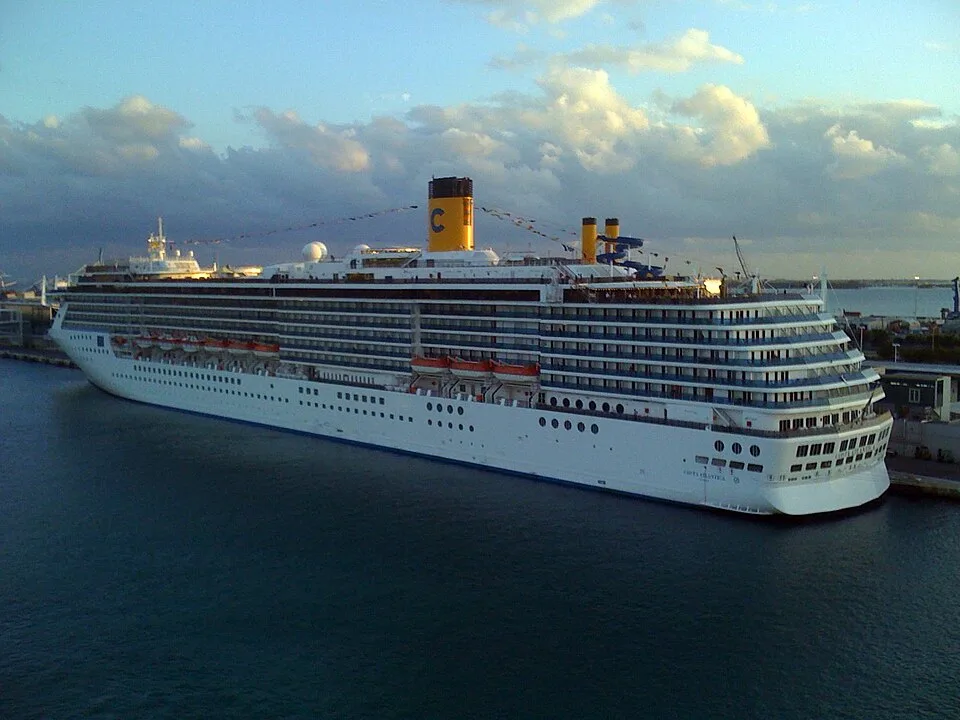
Carnival
Carnival Luminosa
Costa's ship of light, handed to Carnival in 2022, and now the one that sails to Alaska from San Francisco
Sailings Available
38
Ports Visited
47
Next Departure
Nov 30, 2026
Trip Length
4–16 nights
Now Booking
Sailings Aboard Carnival Luminosa
Carnival
14-Night Asia
14 Nights
Nov 30, 2026 • departs Singapore
Carnival
5-Night Mexico
5 Nights
Apr 28, 2027 • departs San Francisco
Carnival
10-Night Alaska
10 Nights
May 3, 2027 • departs San Francisco
Carnival
4-Night Mexico
4 Nights
May 13, 2027 • departs San Francisco
Carnival
10-Night Alaska
10 Nights
May 17, 2027 • departs San Francisco
Carnival
11-Night Alaska
11 Nights
Sep 6, 2027 • departs San Francisco
Carnival
15-Night Hawaii
15 Nights
Sep 17, 2027 • departs San Francisco
Carnival
16-Night Transpacific
16 Nights
Oct 2, 2027 • departs San Francisco
Carnival
16-Night Asia
16 Nights
Oct 28, 2027 • departs Hong Kong
Carnival
14-Night Panama Canal
14 Nights
Apr 6, 2028 • departs Long Beach (Los Angeles)
Carnival
9-Night Caribbean
9 Nights
Nov 18, 2028 • departs Baltimore
Carnival
12-Night Caribbean
12 Nights
Nov 27, 2028 • departs Baltimore
Carnival Luminosa began life as Costa Luminosa, and everything interesting about her follows from that. Fincantieri laid her keel at Marghera in October 2007, launched her in June 2008 and delivered her on May 1, 2009, one of a pair with Costa Deliziosa, built on the Fincantieri platform that also produced Holland America’s Vista ships. The name is the design brief: luminosa, luminous, a ship organized around light, glass and a ten-deck atrium.
Costa also spent money on art. She carries roughly 290 original works and several thousand prints, and in the atrium stands a bronze by Fernando Botero, Reclining Woman, commissioned for the ship, over eleven feet long and weighing about a ton. Carnival kept it. It is almost certainly the most valuable object on any ship in this fleet, and it is sitting in a stairwell lobby where people photograph it on the way to the buffet.
The transfer, and what it was not
In June 2022, with Costa’s Asian business gone and Carnival Cruise Line short of capacity in North America, Carnival Corporation announced that Costa Luminosa would move brands. She finished her last Costa sailing at Trieste on September 4, 2022, was handed over on September 8, and went into dry dock at Palermo for the conversion. She came out with the red, white and blue hull, a Fahrenheit 555 steakhouse, a RedFrog Rum Bar, Camp Ocean and a kids’ splash zone, and she started her Carnival career on November 6, 2022 out of Brisbane.
She was the first of the three Costa hulls to come across, and she was handled differently from the two that followed. Carnival Venezia and Carnival Firenze are marketed as “Carnival Fun Italian Style,” a deliberately Italian product with the Costa interiors left standing. Luminosa got no such branding. She was simply folded into the fleet as a Carnival ship, which means the European bones are still there (the cabin fittings, the corridor proportions, the way the public rooms stack) without any of the marketing that explains them.
The Costa inheritance is also why she has things no other Carnival ship has: an eighteen-hole golf simulator, a putting green on the top deck, a thalassotherapy pool and a thermal suite in the spa, and a Grand Prix race simulator. She has 1,130 cabins against 1,050 crew, which is a generous ratio, and at 92,600 gross tons she is one of the smaller ships in the fleet.
There is one part of her history worth stating plainly. In March 2020 she was at the center of the first weeks of the pandemic at sea: a passenger who left the ship in the Cayman Islands became that territory’s first COVID case and died, further cases came ashore in Puerto Rico, and dozens more were confirmed after she finally landed her passengers at Marseille. Litigation followed. It is a Costa-era story, not a Carnival one, but it is the reason her name may be familiar.
Where she actually sails
San Francisco, and then across the Pacific. Twenty-two of the twenty-five departures in this window leave from San Francisco, which makes her the only Carnival ship working that homeport.
The short program is Baja weekends: ten four-night runs down to Ensenada and back, and one five-night that adds Catalina Island. The long program is Alaska, and it is an unusual version of it, nine ten-night round trips from San Francisco to Ketchikan, Juneau, Skagway, scenic cruising in Tracy Arm and a call at Prince Rupert in British Columbia, plus one eleven-night that also reaches Sitka. Sailing to Alaska from San Francisco rather than Seattle costs two extra sea days at each end, which is exactly why the itinerary runs ten nights instead of seven, and the Canadian call is what makes a round-trip US voyage legal on a foreign-flagged ship. One fifteen-night Hawaii round trip (Hilo, Honolulu, Kahului, Kona, with Ensenada on the way home) closes out the season in September 2027.
Then she leaves. A sixteen-night transpacific from San Francisco to Tokyo in October 2027 calls at Ketchikan and Icy Strait Point on the way out, crosses the date line and finishes at Otaru, Aomori and Tokyo. Two more one-way voyages sit in the schedule with no US port at either end: fourteen nights from Tokyo to Singapore by way of Osaka, Fukuoka, Jeju, Keelung, Hong Kong and Phu My, and sixteen nights from Hong Kong to Brisbane through Vietnam, Bali, Darwin and Airlie Beach, crossing the equator on the way.
What is not here is the other half of her year. She spends Southern Hemisphere summers based in Australia, and none of those departures are in this inventory, which is why her count is twenty-five sailings rather than the seventy a full-time ship carries. The one-way repositioning voyages are the visible ends of a program that mostly happens somewhere else.
Who she suits
Anyone in Northern California who wants to walk onto a ship instead of flying to Seattle, and anyone who wants Alaska with time to settle in; ten nights on a 2,260-guest ship is a different holiday from seven on a 4,000-guest one. She is also the pick for people who like a European ship: quieter, more marble, a real spa, a Botero in the atrium, and none of the Carnival hardware that generates lines.
She does not suit families looking for the modern Carnival product. There is no coaster, no ropes course, a modest water feature and a 2009 Italian layout that does not flow the way the newer ships do. She does not suit anyone who dislikes sea days; a San Francisco Alaska run has four or five of them, and the Baja weekends are essentially a party at sea with one stop. And if you want her Australian or Asian itineraries, this is not where to look for them; only the crossings appear here.
Photo: JV & Lynda · CC BY 2.0 · Re-encoded to WebP.