American Cruise Lines
American Constellation
The first Constellation-class ship, and the one that spends the most of her year in Alaska
Sailings Available
100
Ports Visited
41
Next Departure
Mar 30, 2027
Trip Length
7–18 nights
Now Booking
Sailings Aboard American Constellation
American Cruise Lines
Puget Sound & San Juan Islands Cruise
8 Nights
Mar 30, 2027 • departs Tacoma
American Cruise Lines
Alaska Inside Passage Cruise
15 Nights
May 25, 2027 • departs Juneau
American Cruise Lines
Southeast Alaska Cruise
8 Nights
Jun 8, 2027 • departs Juneau
American Cruise Lines
Alaska National Parks
15 Nights
Jul 6, 2027 • departs Fairbanks
American Cruise Lines
Grand Alaska National Parks
18 Nights
Jul 20, 2027 • departs Fairbanks
American Cruise Lines
Alaskan Explorer Cruise
11 Nights
Jul 27, 2027 • departs Ketchikan
American Cruise Lines
Northwest National Parks
14 Nights
Sep 7, 2027 • departs Tacoma
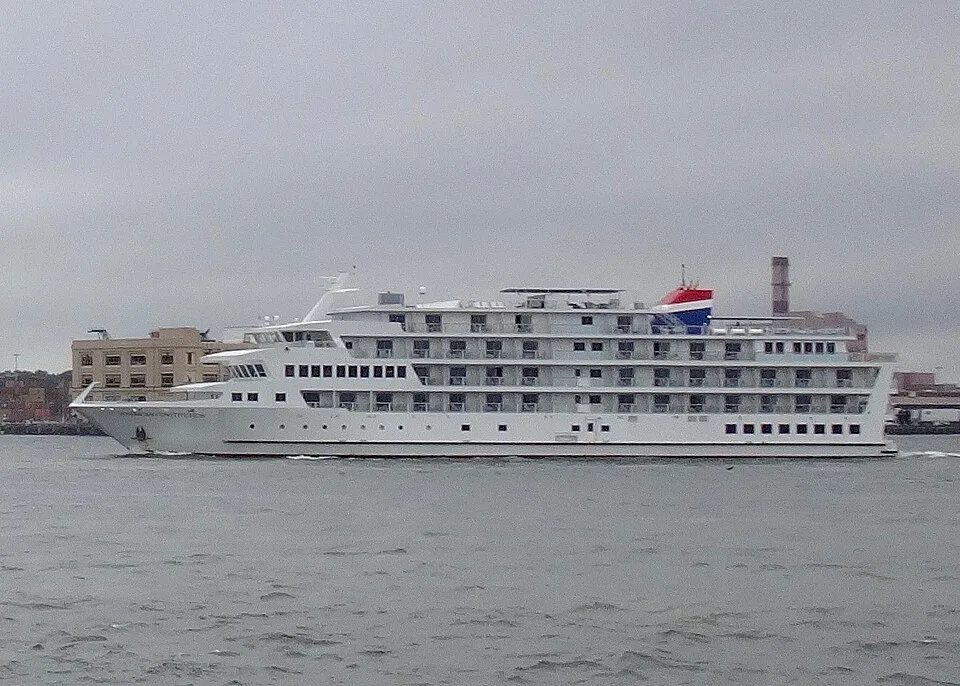
American Constellation is the older and slightly smaller of the two Constellation-class ships (269 feet, 90 staterooms, 170 guests over six decks) delivered from Chesapeake Shipbuilding in Salisbury, Maryland in the first half of 2017 and out on her inaugural cruise that May. American Constitution followed a year later at 280 feet. Between them they are the largest coastal monohulls the line has ever built, and they are a genuinely different animal from the rest of the fleet.
The distinction that matters is the bow. The line’s riverboats have a flat hydraulic bow that opens onto a levee. The Coastal Cats are catamarans drawing six and a half feet, drawn for protected water. American Constellation has a conventional raked bow, a deeper hull and Rolls-Royce stabilizers, which is what lets her be sent to Southeast Alaska for a season instead of a bay.
Six decks on a 269-foot hull
The class stacks more into a small ship than anything the line had built before. Staterooms spread across five levels and two elevators serve them, which given who books these cruises is a requirement rather than a courtesy. Cabins run from a 226-square-foot Single Waterview up to Veranda and Sky Suites of around 450 square feet, with most of the middle of the ship in 350-square-foot Deluxe and 368-square-foot Premium Balcony rooms.
Read the category names carefully. “Waterview” means a window, not a balcony, and both the single and the deluxe versions of it are still sold. This is not an all-balcony ship the way the modern riverboats and the Coastal Cats are, and it is the most common surprise on a Constellation-class booking.
Public rooms are few and they are the right ones: a Main Deck restaurant with close to 270 degrees of glass and one open seating for all 170 guests, the Cascade Lounge where the local musicians play, the Sky Lounge high and aft for the daily cocktail hour, the Study for reading and cards, a fitness center, and a sun deck with a putting green on it. There is no casino, no theater and no second restaurant.
Where she actually sails
A West Coast ship on a two-season rotation: Alaska through the summer, Puget Sound at either end of it, and nothing else at all. Alaska is the larger of the two halves, which is the one meaningful thing separating her from her sister; American Constitution runs the same itineraries out of the same homeports and leans slightly the other way.
Alaska, May to September. The workhorse is the eight-night Southeast Alaska cruise, round trip from Juneau, calling at Haines, Skagway, Petersburg and Wrangell with the Wrangell Narrows, Endicott Arm and the Dawes Glacier as the scenic days. Glacier Bay is on nearly all of them. She also runs the eleven-night Alaskan Explorer up from Ketchikan to Juneau, which is where Misty Fjords and Metlakatla come in, and a set of cruisetours that begin inland at Fairbanks and finish in Juneau at fifteen and eighteen nights, a rail and coach section through Denali, Anchorage, Seward and the Kenai Fjords bolted onto the front of the ship. If you are comparing those against the Alaskan Explorer, compare what is inside the number of days; they are not the same length of cruise. At the end of the season she brings herself south, Juneau down to Tacoma through the Inside Passage, Queen Charlotte Strait and the Strait of Georgia, which is the only open-water passage she makes all year.
Puget Sound, March to May and September to October. Eight nights round trip from Tacoma, and after the Southeast Alaska week it is the itinerary she runs most: Seattle, Port Angeles under the Olympics, Port Townsend, Poulsbo, Bremerton, Anacortes, Friday Harbor in the San Juans, a full day cruising the islands, and a call at Victoria, British Columbia. A longer Northwest National Parks version stretches to a fortnight and puts North Cascades ashore alongside it. Note that the Victoria call is real: the Puget Sound weeks do cross the border even though the Alaska weeks pointedly do not.
None of her Alaska weeks touch Canada. A foreign-flagged ship sailing round trip in Southeast Alaska has to insert a Canadian call to be legal, and this one does not, because she is US-built, US-flagged and American-crewed. That is also why Petersburg and Wrangell are on the list at all: fishing towns with fishing-town docks, and 170 people is a number they can absorb.
Who she suits
Travelers who want Southeast Alaska at small-town scale, with no border formality and no tendering. The eight-night round trip from Juneau is the straightforward version; the eleven-night Ketchikan run is more generous by Alaska standards and buys the glacier arms as well as the headline park. She suits Puget Sound travelers equally well, and that half of her year is underrated, the San Juans and the Olympic Peninsula out of Tacoma, at a fraction of the airfare Alaska costs to reach.
She is wrong for anyone who assumes a balcony comes with the cabin; check the category before you book. She is wrong for families, and wrong for anyone who wants a naturalist theater, a pool or a second dining venue. And she is not a choice you should agonize over against her sister: American Constitution is a few feet longer and sails the same routes from the same piers, so book on the date and the cabin category rather than the name on the bow.
Photo: Shiphistory62 · CC BY-SA 4.0 (share-alike) · Re-encoded to WebP.