AmaWaterways
AmaDouro
A hundred and two guests on a hull built to the size of the Douro's locks
Sailings Available
49
Ports Visited
4
Next Departure
Oct 20, 2026
Trip Length
7 nights
Now Booking
Sailings Aboard AmaDouro
AmaWaterways
Enticing Douro
7 Nights
Oct 20, 2026 • departs Porto
AmaWaterways
Enticing Douro (Wine Cruise)
7 Nights
Nov 3, 2026 • departs Porto
AmaWaterways
Enticing Douro (Wine Cruise)
7 Nights
Nov 10, 2026 • departs Porto
AmaWaterways
Enticing Douro (Wine Cruise)
7 Nights
Nov 24, 2026 • departs Porto
AmaWaterways
Enticing Douro - Christmas Time
7 Nights
Dec 22, 2026 • departs Vega de Terron
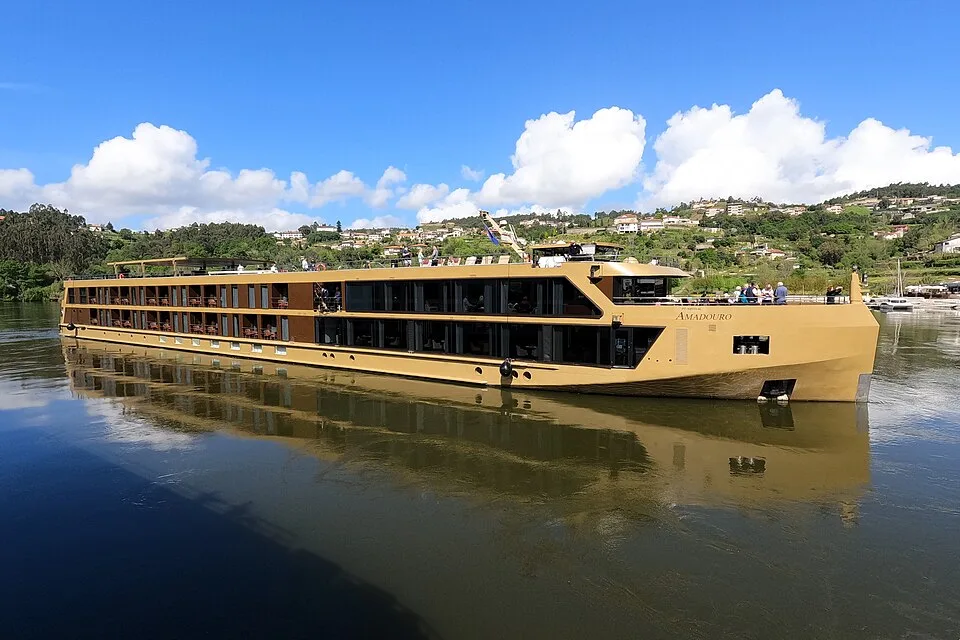
AmaDouro is 260 feet long and carries 102 guests. The AmaWaterways ships on the Rhine and the Danube are 443 feet and carry around 156. She is not a smaller ship because the company wanted a smaller ship on the Douro; she is a smaller ship because the Douro will not take a bigger one, and no amount of money changes that.
The river is the specification
The navigable Douro runs roughly 130 miles inland from Porto to the Spanish frontier, and it is navigable only because five Portuguese dams have locks in them. Those locks set a hard maximum of about 272 feet by 37 feet 5 inches. AmaDouro is 260 by 37, built to within a few feet of the limit in both directions, because there is no reason to build smaller and no possibility of building larger.
The second consequence is that she can never leave. There is no canal connecting the Douro to the rest of Europe’s waterways, so every ship on the river was built for it, delivered to it, and will finish its career on it. AmaDouro was built in 2019 at WestSEA’s yard at Viana do Castelo, on the Portuguese coast an hour north of Porto, and she is registered in Portugal, locally built and locally flagged, for a river that admits nothing else. She shares the water with AmaVida, which arrived in 2013, and since 2025 with AmaSintra.
What fits
Fifty-one staterooms and 102 guests, with thirty-eight crew, roughly one crew member for every 2.7 passengers, which is better staffing per head than the 443-foot boats manage with fifty-one crew and half again as many guests aboard.
The rooms run 161 square feet at the bottom of the range, 215 for the larger categories on the Porto Deck, and 323 for the suite. Thirty-six of the fifty-one have a balcony of some kind; the fifteen on the lowest cabin deck have windows that do not open, and they are cheaper for exactly that reason. Four decks (Sun, Porto, Lisbon and Douro) with a glass elevator between the cabin decks, better coverage than the older European hulls in this fleet provide.
There is one restaurant, not two: The Journey Restaurant serves everyone, and the Lark Lounge and Bar handles drinks and light food. The Chef’s Table, the second dining room that defines the European ships, does not fit on a boat this size. What does fit is a heated swimming pool on the Sun Deck, which is unusual on a river vessel of any size, plus a fitness room and a spa treatment room. She was built with solar panels over her upper deck feeding a hybrid diesel-electric plant, which is a quieter arrangement than the older boats and, on a river where the ship spends long hours moored in a narrow gorge, noticeable.
Where she actually sails
Porto, essentially always. Almost every loaded departure is a Porto round trip; the handful that are not run downstream from Vega de Terrón, the Spanish-side turning point, and finish at Porto. Every single sailing is seven nights. There are no ten-night variants and no repositioning weeks, because there is nowhere to reposition to.
Her port list has four names in it. Porto every week, Régua and Vega de Terrón on essentially all of them and Pinhão on about half, which is the whole of the Douro as a cruise river: upstream through the terraced port-wine quintas of the Alto Douro to the Spanish border, where a coach day reaches Salamanca, then back down. The same week, over and over.
Much of her calendar is explicitly a wine trip: Enticing Douro (Wine Cruise) outnumbers the plain Enticing Douro week, with Christmas Time and Festive Delights sailings filling out December. Her season is long but lopsided: heavy in October and November, busy in July and August, present in March and April, and empty in January and February.
The repetition is not a criticism of the ship. It is what a 130-mile river produces, and it is the same reason the boats are small.
Who she suits
Anyone whose interest is the wine valley rather than a tour of European capitals. The Alto Douro is a UNESCO landscape of hand-built stone terraces climbing the mountainsides above the water, it looks like nowhere else in Europe, and the ship is small enough that a quinta visit does not arrive as a coach convoy. The wine-cruise departures, the majority of them, put a visiting expert aboard, and on this river that is a better fit than it would be on a general-interest itinerary.
She is wrong for anyone who wants choice in dining, because there is one restaurant and one seating. She is wrong for anyone who expects a Douro cruise to be a Rhine cruise in Portuguese: this is a slower, narrower, emptier river, the cities are Porto at one end and a long coach ride at the other, and several days are vineyards and not much else. She is wrong for anyone shopping for itinerary variety, since every departure is the same seven nights. And if the twin balcony is what sold you on this line, look closely at the category chart before you book; the rooms here are a single balcony or a fixed window, and the narrow hull is the reason.
Photo: Ein Dahmer · CC BY-SA 4.0 (share-alike) · Re-encoded to WebP.